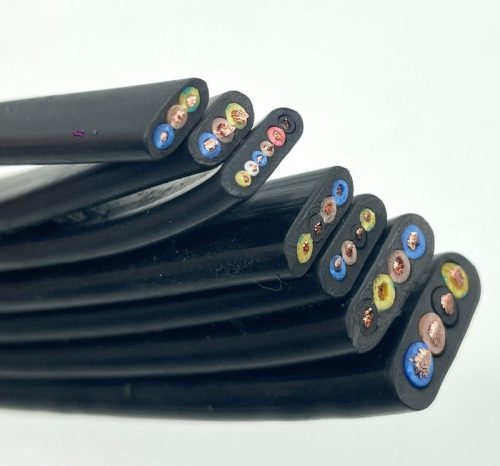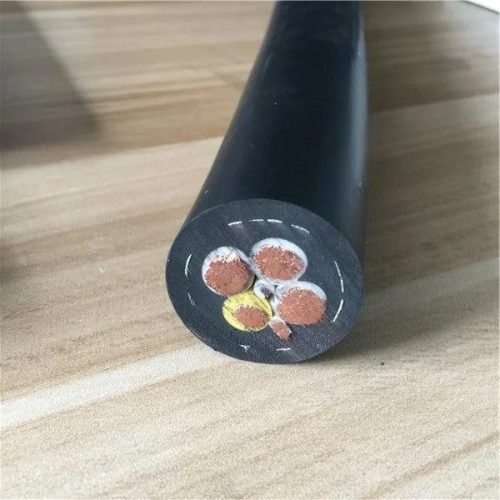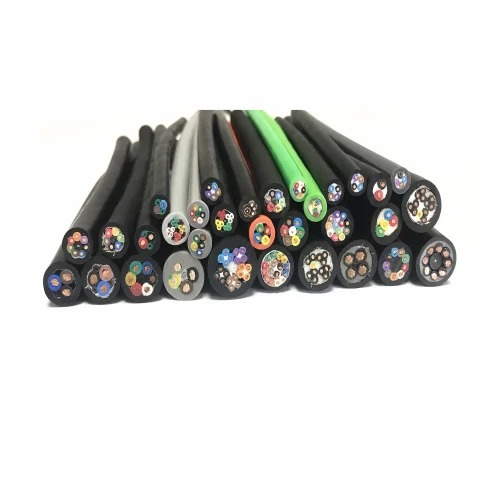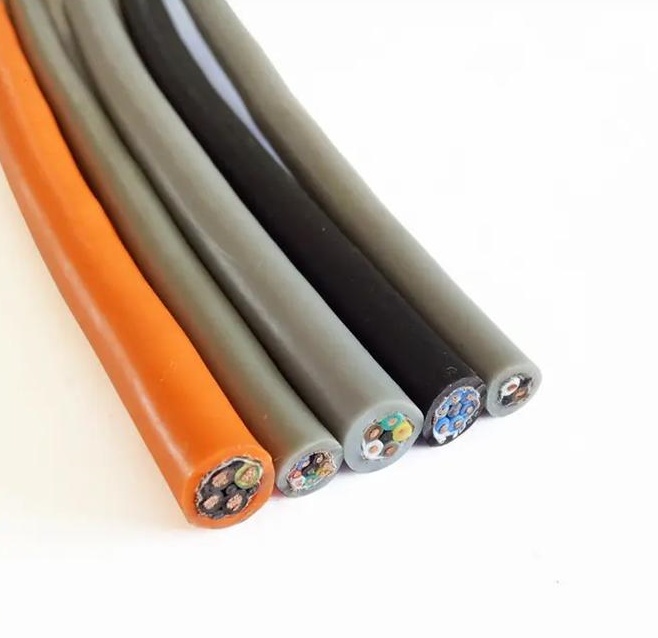
Motor Feedback & Encoder Cables for Precision Automation
Designed for the most demanding motion control applications, our motor transmission cables provide reliable signal integrity for speed sensors, braking systems, and motor temperature monitoring. These high-flex cables are engineered to perform in continuous movement scenarios, making them the ideal choice for automation technology, process control, woodworking machinery, robotics, and general industrial plant construction. They deliver consistent performance even in dry, damp, wet, and low-temperature environments where standard cables fail.
Engineered for Dynamic Applications and Long Life
This cable series is optimized for flexing installations rather than static routing. Key performance characteristics include:
- Excellent Oil Resistance: Withstands contact with mineral oils and synthetic lubricants commonly found in machinery.
- High-Flex Durability: Designed to withstand millions of bending cycles without conductor fatigue, significantly extending service life in cable carriers and robotic arms.
- Superior EMC Performance: Advanced shielding design ensures undisturbed signal transmission to resolvers and angular encoders, preventing costly positioning errors.
- Environmental Compliance: Fully compliant with RoHS directives regarding hazardous substances.
Technical Specifications & Construction
Our motor transmission cables are built to stringent international standards, ensuring reliability and consistency.
| Component | Specification |
|---|---|
| Conductor | Bare copper, stranded to DIN VDE 0812 |
| Insulation | Special high-performance polymer |
| Color Code | Color-coded cores for easy identification |
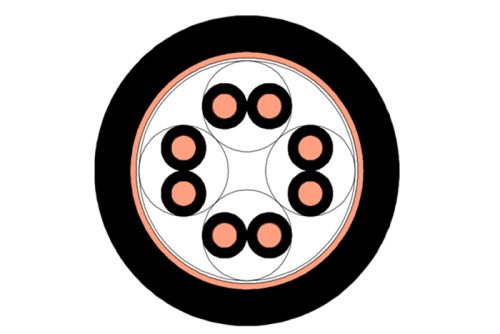
| Overall Shielding | Tinned copper wire braid, applied in pairs |
| Inner Sheath | Special polymer compound |
| Core Structure | Single cores or twisted pairs in layered stranding |
| Wrapping Layer | Non-woven tape or non-woven tape with PETP foil |
| Inner Sheathing (PVC Option) | PVC, T12 type to DIN VDE 0281+HD 21.1 |
| Outer Sheath (PUR Option) | Matte-surfaced PUR, TMPU to DIN VDE 0282+HD 22.1 |
| Sheath Color | Yellow (Yellow jacket); other colors available on request |
Electrical & Performance Parameters
| Parameter | Value |
|---|---|
| Max. Operating Voltage | 30V |
| UL Rated Voltage | 30V |
| Test Voltage (Core/Core) | 750V |
| Minimum Bend Radius – Fixed | 5 × D |
| Minimum Bend Radius – Flexing | 10 × D |
| Continuous Flexing | 12 × D |
| Temperature Range – Fixed | -40°C to +70°C (up to +80°C for short duration) |
| Temperature Range – Flexing | -20°C to +70°C (up to +80°C for short duration) |
| Flexing Strength | 5 × 10⁷ cJ/kg |
| Oil Resistance | Excellent – TMPU compound to DIN VDE 0282+HD 22.1 |
| Chemical Resistance | Good resistance to acids, alkalis, solvents, and hydraulic fluids |
Applications for Motor Transmission Cables
- Servo Motor Feedback: Connecting drive systems to resolvers, tachometers, and incremental/absolute encoders.
- Robotics: As an ultra-flexible robot cable for twisting and bending axes.
- Machine Tools: Signal transmission in CNC machining centers, woodworking equipment, and packaging lines.
- Harsh Environments: Damp, oily, or low-temperature zones where mechanical stress and chemical exposure are daily factors.
Custom Cable Manufacturing Services
As a specialist industrial cable manufacturer, we understand that standard catalog products don’t always fit your application. We offer custom-engineered motor transmission cables with the following modifications available:
- Custom outer jacket colors (standard is yellow).
- Hybrid designs combining power and signal cores.
- Special compound formulations for extreme temperature ranges or chemical exposure.
- Pre-assembled cable harnesses with connectors to reduce your on-site labor.
FAQ
What is a motor transmission cable used for? These cables are primarily used to connect the sensors on an electric motor—specifically encoders, speedometers, temperature sensors (like PTC/NTC thermistors), and holding brakes—back to the servo drive or VFD controller. They handle low-voltage data signals rather than the main three-phase power supply.
Why use a PUR jacket instead of PVC for moving applications? While PVC options are available, we strongly recommend Polyurethane (PUR) outer jackets for any continuous flex or cable track application. PUR offers dramatically better abrasion resistance, oil resistance, and cut resistance. Its matte surface also prevents cables from sticking together in cable carriers, reducing friction and extending the entire system’s life compared to standard PVC.
What do “fixed,” “flexing,” and “continuous flexing” bend radius values mean? These specify how tightly the cable can be bent for different installation types. The value “D” is the outer diameter of the cable.
- Fixed (5×D): The bend radius for a cable installed once and never moved.
- Flexing (10×D): For cables occasionally moved during machine maintenance.
- Continuous Flexing (12×D): The critical value for cables inside a moving drag chain or on a robot arm. Exceeding this 12×D radius in a dynamic setup will catastrophically shorten cable life.
Are these encoder cables RoHS compliant? Yes. All materials used in our motor transmission cable construction comply with the Restriction of Hazardous Substances (RoHS) directive, making them suitable for export to global markets including the EU and North America.
Do you manufacture hybrid cables that include both power and feedback pairs? Yes. We frequently custom-manufacture composite/hybrid cables that bundle the main motor power conductors with the shielded feedback signal pairs in a single jacket. This simplifies installation on large robotic and machine-building projects. Please contact us with your required AWG sizes and core counts for a feasibility review.