الوصف التفصيلي
Why an EV High Voltage Cable Needs a Screen
A traction battery cable does not run through a quiet environment. It runs beside motor phase cables, past an inverter switching at tens of kilohertz, and often inside a pack that also contains the battery management electronics. In that environment an unscreened conductor is an antenna: the switching field couples into it, and the induced voltage appears as noise wherever that circuit is measured.
A screen gives the interference a defined path to ground instead of letting it ride on the conductor. The screen is not there for safety and it does not carry load current — it carries the induced current, which is why its impedance to ground has to stay low along the entire run.
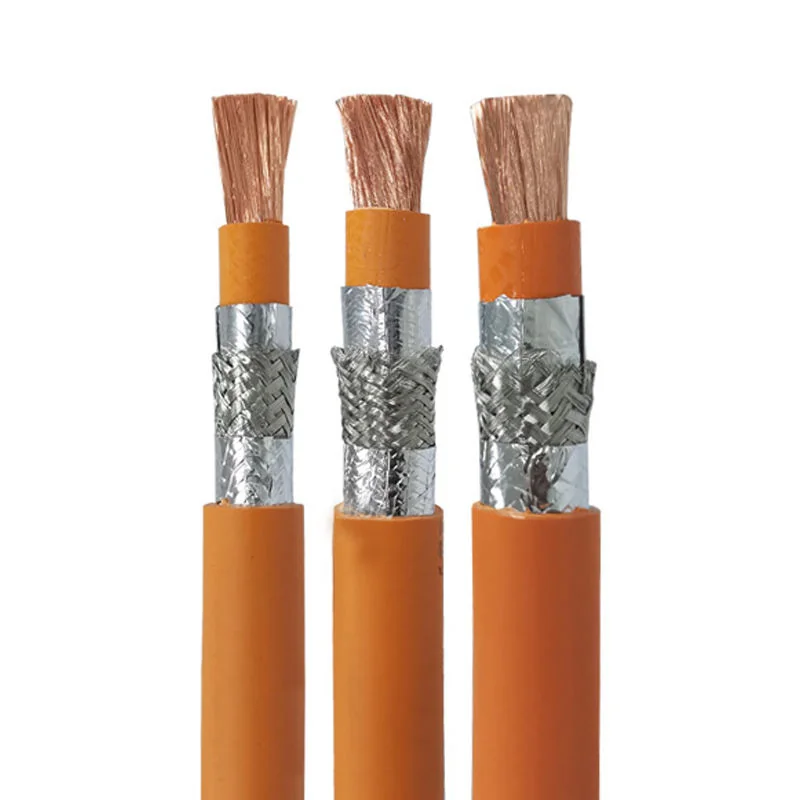
EVRP is the screened version of the EVR high voltage cable: same 1500 V class, same XLPE sheath, with two screen layers added.
Construction: Two Screen Layers Over XLPE
The build runs from the conductor outward, and the two screen layers are the reason this cable exists:
- Conductor — multi-strand oxygen-free copper at 99.999% purity. The high purity keeps resistance low, which keeps the conductor temperature rise small at high current and the voltage stable at the far end.
- Insulation — XLPE, applied at a low-eccentricity wall. The evenness matters more here than on a distribution cable: the impulse voltage from a traction inverter finds the thin spot of an eccentric extrusion first.
- Foil screen — an aluminium foil layer, wrapped 360° around the insulated core. It is the electrostatic barrier, continuous along the length with no braid gap.
- Braid screen — a tinned copper braid over the foil. It carries the induced screen current and provides the low-resistance path to ground; the tinning keeps that path stable as the braid ages.
- Sheath — XLPE, rated 125 °C. It holds the assembly together and provides the oil, water, and UV resistance.
Ratings and Cross-Section Range
| Parameter | Value |
|---|---|
| Rated voltage | 1500 V |
| Screen | Aluminium foil + tinned copper braid |
| Cross-section range | 2.5–150 mm² |
| Standard sizes | 1×2.5 to 1×150 mm² |
| Conductor | Oxygen-free copper, 99.999% |
| Insulation and sheath | XLPE |
| Temperature range | −40 °C to +125 °C |
| Flame behaviour | Self-extinguishing, no burning at 125 °C |
| Oil resistance | Continuous immersion |
| Immersion test | Soft after 60 days |
| Standard colours | Orange, black |
| Standard length | 100 m per coil |
| Certification | IATF 16949 |
The twelve standard sizes run from 2.5 mm² to 150 mm² in single-core construction. The smaller sizes are used for control and auxiliary high voltage circuits, and the larger sizes for the main pack and inverter feeds.
Where EVRP Fits in the Vehicle
The cable is used on four routes, all of which share a characteristic: the conductor is close to something that switches.
- Charging inlet to battery — the run from the vehicle socket to the pack, which passes close to the on-board charger.
- Inside the battery pack — module and string interconnection, in a space shared with the battery management electronics.
- Battery to motor and auxiliary components — the main traction path and the feeds to the inverter, the PTC heater, and the DC-DC converter.
- Charging pile and storage cabinet wiring — DC charging cabinets and battery storage cabinets where the EMC design calls for a screened conductor.
Colours, Lengths, and Ordering
Orange and black are standard, with other colours available on request. Orange is the conventional high voltage identification colour in a vehicle harness, and it is the colour that a service technician is trained to treat as live.
Supply is a 100 m coil, with lengths below 100 m as measured cut lengths. The sheath carries metre marking, so the installed length can be read from the cable.
The cable is produced under an IATF 16949 quality management system, which is the automotive sector requirement for a component supplier. Where a project requires a product certificate beyond the quality system, state the destination market with the enquiry.
To specify EVRP cable, four items decide the build: the cross-section, the circuit voltage and whether it is AC or DC, the maximum temperature at the installation point, and the route length. Send them through the enquiry form on this page and the build is confirmed against them.