বিস্তারিত বিবরণ
What a Charging Gun Cable Has to Do That a Power Cable Does Not
A charging gun cable is handled. It is dragged across a car park floor, coiled over a hook, dropped on concrete, and pulled out of a connector by a driver in a hurry. A fixed power cable never sees that duty, and the difference shows up in the two properties that dominate the design: flexibility and resistance to abrasion.
The electrical requirement is modest by comparison. The cable is a 450/750 V connection between the charging post and the vehicle, not a 0.6/1 kV distribution cable. What sets this cable apart is that it has to survive the handling while staying electrically sound — and it has to do that while remaining soft enough to coil at −50 °C.
The construction is built to GB/T 33594-2017, the Chinese national standard for charging cables for electric vehicles.
Construction: Oxygen-Free Copper, Modified PVC, and the Wide Temperature Range
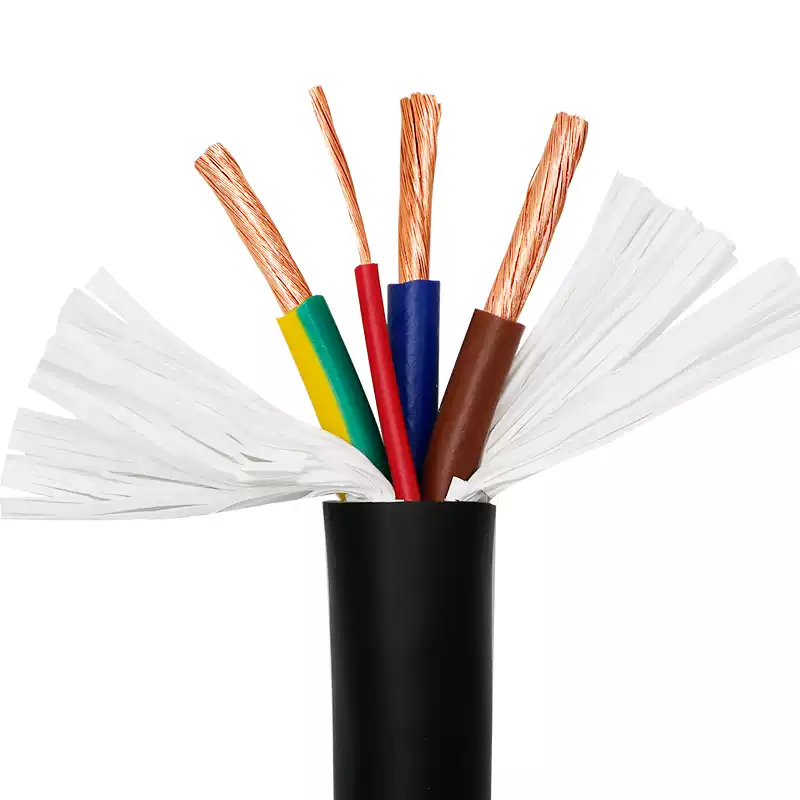
The cable is built in four layers, and the compound choice on the last two is what delivers the temperature range:
- Conductor — oxygen-free copper at 99.999% purity. The high-purity conductor keeps the resistance low, and a low-resistance conductor runs cooler at the connector, which is the part of a charging cable that a hand actually touches.
- Insulation — modified PVC, a new environmentally friendly compound. The modification is what raises the temperature ceiling above that of a standard PVC while keeping the compound flame retardant and free of irritating odour when it burns.
- Filler — a filler element keeps the core assembly round and concentric, so the sheath wall stays even.
- Sheath — modified PVC, applied at a low-eccentricity wall. An even wall is what prevents the thin spot that becomes the breakdown point when the cable is bent repeatedly.
Core Configurations
| Configuration (mm²) | Configuration (mm²) | Configuration (mm²) |
|---|---|---|
| 3×1.5+1×0.75 | 3×4+1×0.75 | 3×6+1×0.75 |
| 3×1.5+2×0.75 | 3×2.5+2×0.75 | 3×4+2×0.75 |
| 3×6+2×0.75 | 5×2.5+1×0.75 | 5×4+1×0.75 |
| 5×6+1×0.75 | 5×2.5+2×0.75 | 5×4+2×0.75 |
| 5×6+2×0.75 | — | — |
The 3-core builds suit a single-phase charging connection, and the 5-core builds suit a three-phase connection. Each configuration pairs the main power cores with one or two smaller auxiliary cores at 0.75 mm²; the function of that core follows the connector wiring rather than the cable alone, so it is confirmed against the connector design.
The GB/T 33594-2017 Standard
The standard is the part that is easy to overlook and hard to fix later. It sets the construction and the test regime for a charging cable, and a domestic charging pile project is generally inspected against it. A cable built to a different national standard may perform the same function and still be rejected at inspection, because the acceptance criterion is the standard named in the project specification.
The cable also carries CCC and RoHS. CCC is the domestic market mark; for an export project, confirm which certification the destination market requires before the order is placed.
Ordering and Delivery
The range is built rather than limited to a fixed stock list, so a configuration outside the thirteen listed above can be produced to requirement. The jacket carries clear inkjet printing with metre marking, so the installed length can be read from the cable.
Standard supply is a 100 m or 200 m coil with a certificate, and lengths below 100 m as measured cut lengths. The inkjet printing on the sheath carries the product designation as well as the metre marking, so a partly used coil can still be identified by the cable type rather than by the label on the reel.
To specify the cable, four items decide the build: the number of power cores and the phase arrangement, the conductor cross-section, the connector type at each end, and the operating temperature at the installation point. Send them through the enquiry form on this page, together with the standard the project is inspected against, and the configuration is confirmed against those inputs.