বিস্তারিত বিবরণ
What an EV High Voltage Harness Assembly Does
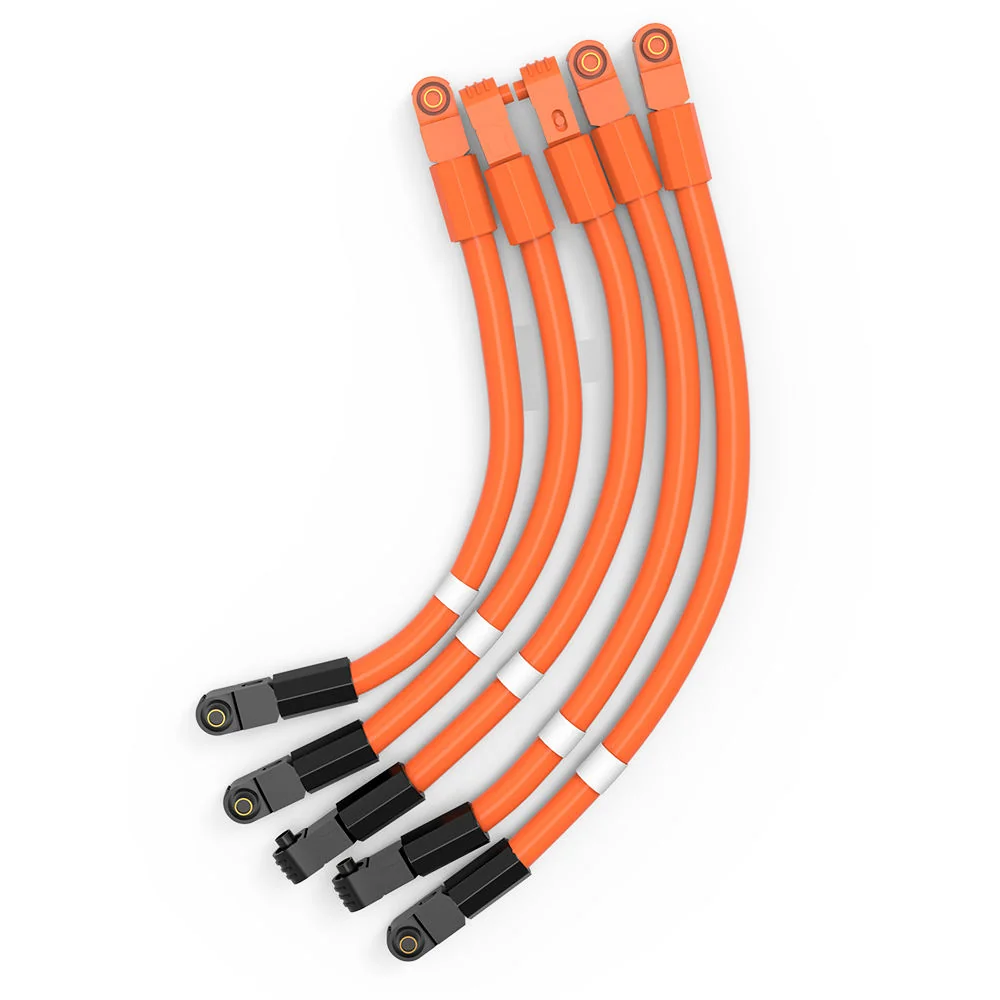
An EV high voltage harness assembly is the finished power path between the traction battery and the equipment that draws from it. It is not bulk cable sold by the metre: the conductors are cut to length, stripped, fitted with crimped copper lugs or high voltage connectors, and sealed, so the part arrives ready to bolt into the pack, the distribution box, or the inverter.
The distinction matters at build time. A field-crimped joint depends on the tooling and the operator at the assembly station, and a poor crimp shows up later as a hot joint under load. A factory assembly moves that joint into a controlled press with a fixed crimp height, and the part arrives with the termination already made.
Three DC voltage classes are available in the same build family — 600 V, 1000 V, and 1500 V DC. A single drawing set can therefore cover a 400 V pack, an 800 V-class pack, and a 1500 V storage string without changing the lug or connector family.
How the Harness Is Built
The construction runs from the conductor outward, and each layer is chosen against a specific condition rather than by default.
- Conductor — oxygen-free copper in a multi-strand finely stranded construction. The fine stranding keeps the bundle flexible enough to follow the routing around a pack frame or a motor mount, while the copper cross-section carries the circuit current.
- Insulation and sheath — PVC, silicone, XLPO, or XLPE. The compound sets the temperature class and the flexibility, so it is selected with the routing in mind, not only with the current.
- Termination — crimped copper lugs. The lug bore, the opening direction, and the cable-entry angle are all set on the drawing, because a lug that fits the stud but enters at the wrong angle will not dress against the pack wall.
- Sealing — the connector pair reaches IP67 when mated. The seal is a property of the engaged pair, not of either half alone.
- Flame — VW-1 rated, a vertical wire flame test that matters where the harness shares a compartment with other electrical equipment.
Electrical and Thermal Ratings
| Parameter | Value |
|---|---|
| Rated voltage | 600 / 1000 / 1500 V DC |
| Current carrying capacity | 20–300 A at 1500 V |
| Cross-section, general range | 25–120 mm² |
| Cross-section, three-phase motor harness | 35 / 70 / 95 mm² |
| Cross-section, battery pack harness | 35 / 50 / 70 mm² |
| Conductor | Oxygen-free copper, finely stranded |
| Temperature rating | −40 °C to +125 °C / +150 °C / +180 °C |
| Flame rating | VW-1 |
| Ingress protection | IP67, mated |
| Conductor finish | Bare copper |
The current figure is a range rather than a single number because the same 1500 V assembly can be built at 25 mm² or at 120 mm². The cross-section and the installation method together set the continuous current, so the two are specified together on the drawing.
Harness Configurations for Battery Packs, Motors, and Energy Storage
Six build forms are covered, and they differ in termination and routing rather than in conductor:
- Battery pack harness — module links and the main positive and main negative runs, in 35, 50, and 70 mm², terminated with lugs sized to the pack studs.
- Three-phase motor power harness — inverter to motor, in 35, 70, and 95 mm², carrying the full drive current.
- High voltage corrugated conduit harness — the cable run is protected by a corrugated conduit where it passes along the underbody or through a shared compartment.
- Waterproof EV harness — sealed connector bodies for routes exposed to splash or wash-down.
- Adapter harness — transitions between two connector standards or between a connectorised end and a lug end.
- Energy storage harness — inter-rack and rack-to-PCS power links, including the main positive and main negative runs inside a storage container.
Specifying a Custom Harness
Because the part is built to drawing, the specification has to carry more than a cross-section and a length. The items below are the ones that change the build:
- Conductor cross-section per circuit, and the number of circuits in the harness
- Harness length, measured from lug face to lug face rather than along the cable
- Lug bore diameter, opening direction, and cable-entry angle
- Connector type and keying, and which end is connectorised
- Voltage class — 600, 1000, or 1500 V DC
- Temperature class — 125 °C, 150 °C, or 180 °C
- Insulation colour, and any marking or label required on the assembly
- Whether the route needs corrugated conduit or a sealed connector body
Certification and Market Requirements
The assemblies are supplied with CE and RoHS compliance, and the supplier lists CCC, UL, ISO, and SAA markings as well. Certification is market-specific: a harness that ships into the EU is documented against CE, while a North American build needs the UL file, and a Chinese domestic build needs CCC. Confirm the certificate required for the destination market before the order is placed, and the documentation is matched to that market rather than assumed.
Choosing the Right Harness for Your Build
The selection comes down to three questions. What is the circuit voltage — 600, 1000, or 1500 V DC? What current must the conductor carry continuously, which sets the cross-section between 25 mm² and 120 mm²? And what is the temperature at the termination point, which sets the compound and the 125 °C, 150 °C, or 180 °C class?
Answer those three, add the routing length and the lug or connector details, and the harness can be quoted against a drawing. Send the circuit diagram, the sample, or the parameter list through the enquiry form on this page and the assembly is specified from there.