Descrizione Dettagliata
Where UL1007 Fits Among Hookup Wires
UL1007 is the general-purpose single-core hookup wire of the UL AWM family: 300 V, 80 °C, PVC insulated, tinned copper, from 30 AWG to 16 AWG. It is the wire that runs between a terminal block and a switch inside an appliance, or between a connector and a board inside an instrument.
Its position in the family is defined by what it is not. UL1015 is the same idea at 600 V and 105 °C, with a thicker wall; UL1007 trades that headroom for a smaller diameter and more flexibility. For internal wiring in equipment that runs at mains voltage but a moderate enclosure temperature, UL1007 is the smaller and easier wire to route.
Construction: Tinned Copper and a 300 V PVC Wall
The build is deliberately simple, and each element is there for a specific reason:
- Conductor — tinned copper, multi-strand. The stranding gives the wire a small bend radius, which is what allows it to follow a tight route inside a chassis; the tin coating is what keeps the conductor from oxidizing at a terminal that is stripped and left open for years.
- Insulation — PVC in a new compound, extruded at a low-eccentricity wall. A 300 V rating is achieved with a relatively thin wall, so the evenness of that wall matters more than its thickness: the failure point on a bent wire is the thin side of an eccentric extrusion, not the nominal wall.
- Marking — the insulation carries the product designation, the standard, the temperature and voltage rating, and the UL file number.
Ratings and the UL File
| Parameter | Value |
|---|---|
| Standard | UL 758 (AWM) |
| UL file number | E531469 |
| Rated voltage | 300 V |
| Temperature range | −30 °C to +80 °C |
| AWG range | 30 to 16 AWG |
| Conductor | Tinned copper, multi-strand |
| Insulation | PVC, flame retardant |
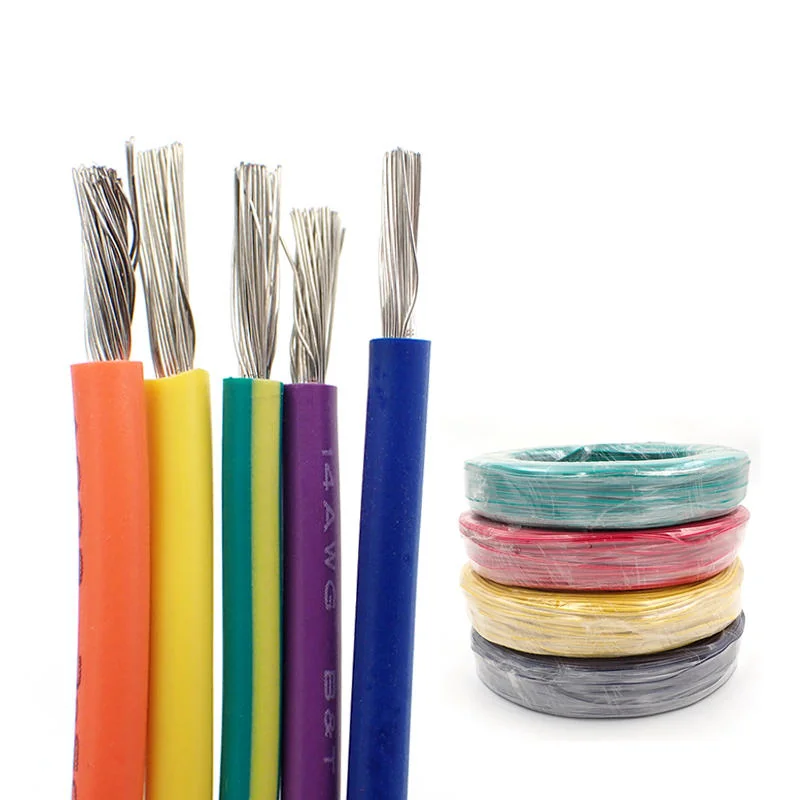
| Colours | Red, black, brown, yellow, green |
| Standard length | 100 m per coil |
| Certification | UL, RoHS |
What the UL 758 Listing Means in Practice
The listing is the part that a buyer cannot verify from the datasheet, and it is the part that decides whether an appliance passes inspection.
UL 758 is the Appliance Wiring Material standard. The file number E531469 ties the wire to a specific listing that records the construction, the temperature and voltage rating, and the manufacturer. An inspector can take the number printed on the insulation and check it against the UL file — which is why the number is printed on the wire rather than only on the carton.
A wire without a traceable file number is not a listed AWM product, regardless of what the jacket print says. For a build that will be inspected, the file number is the item to record.
Where UL1007 Is Not the Right Wire
Three situations call for a different wire, and it is worth checking them before the build is fixed.
Where the circuit runs above 300 V, UL1007 is the wrong class — UL1015 carries 600 V at 105 °C with a thicker wall. Where the enclosure reaches above 80 °C in service, the 80 °C class is again the limiting item, and a 105 °C PVC or a silicone wire is the correct choice. Where the wire has to survive continuous flexing in a moving application, none of the hookup wire family is right, because these are fixed-installation wires; a drag chain cable is built for that duty.
For internal wiring in an appliance that runs at mains voltage and a moderate enclosure temperature, UL1007 remains the smaller and more flexible option.
Colours, Coils, and Ordering
Red, black, brown, yellow, and green are standard, and other colours are available on request. The colour range exists so that a circuit can be coded without adding sleeving, which matters in a tight enclosure where every millimetre of diameter counts.
Standard supply is a 100 m coil, with lengths below 100 m as measured cut lengths. Because the insulation carries the product designation and the ratings, a partly used coil remains identifiable.
To specify the wire, four items are enough: the AWG, the colour, the coil or cut length, and the insulation temperature the enclosure actually reaches. Send them through the enquiry form on this page, and the wire is matched to the build.