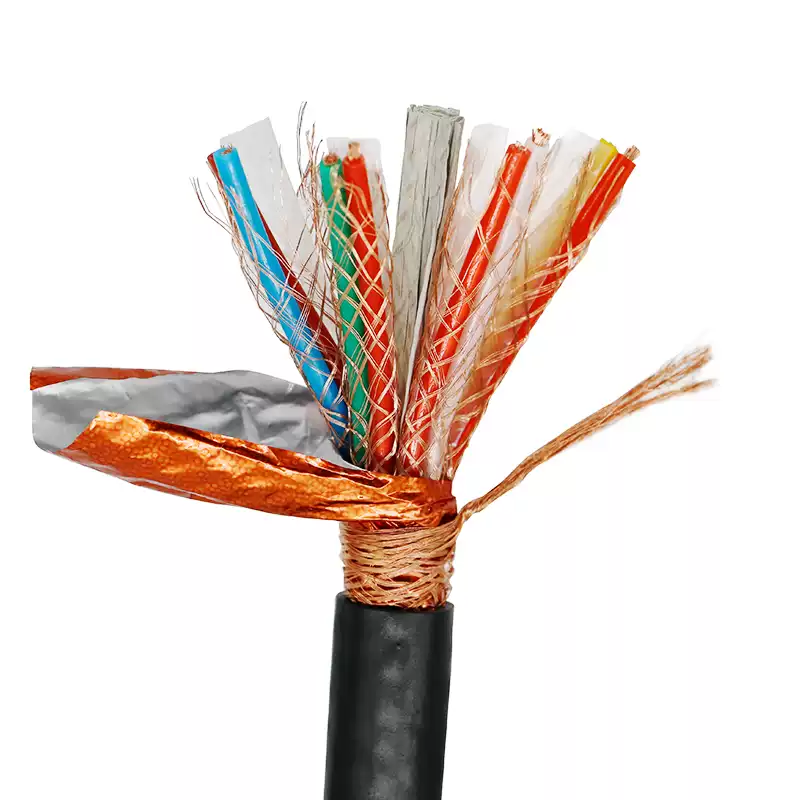
DJYPVP Computer & Instrumentation Cable — GB Type PE Insulated Signal Cable with Individual Copper Braid Screen, Overall Foil Plus Braid Screen, and Flame Retardant PVC Sheath
Kabel Industri, Perlombongan dan Kawalan /Computer & Instrumentation Cable

DJYPVP Computer & Instrumentation Cable — GB Type PE Insulated Signal Cable with Individual Copper Braid Screen, Overall Foil Plus Braid Screen, and Flame Retardant PVC Sheath

DJYPVP and DJYPVRP computer and instrumentation cable: PE insulation, individual copper braid screen, overall foil plus braid screen, flame retardant PVC sheath.

Ciri Utama

Two screening layers at different levels — an individual oxygen-free copper braid around each pair or group, and an overall screen of aluminium foil plus copper braid around the whole assembly, so interference is stopped before it reaches the inner conductors as well as at the cable boundary
Aluminium foil wrapped 360° with a water-blocking film — a full circumferential wrap leaves no longitudinal gap for electrostatic coupling, and the film behind it limits water travel along the screen if the sheath is damaged
PE insulation — polyethylene dielectric on an oxygen-free copper conductor, the standard insulation for signal and instrumentation cores where a stable dielectric is needed along the run
Dense multi-layer copper braid — the braid is woven at a high density rather than a sparse spiral, which raises coverage and lowers the transfer impedance of the screen
Flame retardant construction — the ZR designation applies to the sheath compound, so the cable does not support flame propagation along a tray or a duct bundle
Thickened sheath for mechanical and ageing resistance — the wall is built up beyond a thin control-cable jacket, which matters where the cable is pulled through conduits and cable trays on a construction site
Metre marking and full-length delivery — the jacket is printed with metre marking, and the coil is supplied to the stated length rather than short-measured
Available in solid or stranded conductor form — the model range covers both single-solid-copper and multi-strand oxygen-free copper constructions, selected by the routing and the termination method

Aplikasi

Data centre and server room cabling — signal and control circuits between cabinets, where cable density is high and interference sources are closeModern warehouse and logistics systems — conveyor control, sortation signalling, and scanner data links along a distribution floorWastewater treatment plant instrumentation — sensor and control circuits between field instruments and the plant control roomDigital broadcast and public address wiring — signal distribution runs in commercial and institutional buildingsCommercial and engineering installation cabling — general signal wiring in project construction where a shielded computer cable is specifiedInstrument and control panel interconnection — analogue signal loops between field devices and marshalling panels

Spesifikasi Teknikal

Product Type Computer and instrumentation cable, shielded signal cable
Type Designations ZR-DJYPVP and DJYPVRP
Conductor Material Oxygen-free copper
Conductor Form Single solid copper or multi-strand oxygen-free copper, depending on the model
Insulation Polyethylene (PE)
Individual Screen Oxygen-free copper braid, applied per pair or group
Overall Screen (Foil) Aluminium foil, 360° circumferential wrap, with water-blocking film
Overall Screen (Braid) Dense multi-layer oxygen-free copper braid
Sheath Material Flame retardant PVC compound, new environmentally friendly material
Sheath Construction Thickened wall for abrasion and ageing resistance
Flame Behaviour Flame retardant (ZR designation)
Core Count and Cross-Section Multiple models within the range — specify the core count and cross-section required for the circuit
Marking Machine-printed metre marking and product designation on the sheath
Certifications CCC, ISO 9001, RoHS
Packing 100 m or 200 m per coil with certificate; lengths below 100 m supplied as measured cut lengths
Application (Buildings) Data centre cabling, modern warehouse wiring, digital broadcast wiring, commercial and engineering installation
Application (Plant) Wastewater treatment plant instrumentation and control circuits

Penerangan Terperinci

What a Computer and Instrumentation Cable Does in a Signal Circuit

A computer and instrumentation cable carries low-level signals — analogue measurement loops, control signals, and data links — between a field device and the panel or controller that reads it. The conductors are small and the signal is weak, so the cable's job is less about carrying current and more about keeping the signal intact along the route.

That is why the construction in this range is built around screening rather than around insulation thickness. The signal level is low enough that interference coupled onto the conductors becomes a measurement error, and the interference sources on an industrial site — variable frequency drives, contactor coils, welding equipment, adjacent power cables — are close by.

The DJYPVP and DJYPVRP types are the Chinese GB designations for this class of shielded computer and instrumentation cable, and the range is built in a solid-conductor form and in a multi-strand oxygen-free copper form.

Construction: Conductor, PE Insulation, and Two Shield Layers

The cable is built from five layers, and the screening is the part that takes the space:

  • Conductor — oxygen-free copper, in single-solid or multi-strand form. The solid form holds a stable geometry for a fixed installation; the stranded form is used where the route needs flexibility.
  • Insulation — polyethylene (PE), applied over each conductor. PE gives a stable dielectric along the length, which is the property that keeps a signal loop consistent from one end to the other.
  • Individual screen — an oxygen-free copper braid applied around each pair or group. This is the layer that controls coupling between adjacent circuits inside the same cable.
  • Overall screen — aluminium foil with a 360° circumferential wrap, backed by a water-blocking film, and then an overall copper braid. The foil closes the electrostatic path around the whole assembly; the braid carries the screen current and handles the magnetic component.
  • Sheath — a flame retardant PVC compound, applied at a thickened wall for abrasion and ageing resistance.

Why the Screen Is Built in Two Layers

A single overall screen handles interference entering the cable from outside, but it does nothing about coupling between the circuits inside. In an instrumentation bundle where several loops share one jacket, that internal coupling is a real error source: a signal on one pair induces a voltage on its neighbour.

The two-layer arrangement separates the two problems. The individual braid around each pair addresses internal crosstalk, and the overall foil-plus-braid addresses the external field. The 360° foil wrap matters here because a foil that is wrapped with a longitudinal overlap gap leaves a slot through which electrostatic coupling passes — a full circumferential wrap does not.

The water-blocking film behind the foil has a second function beyond moisture: it keeps the foil in contact with the braid along the length, so the two screen layers act as one electrical screen rather than as two separate layers with an intermittent connection.

Where the Cable Is Installed

The range is used in four settings where signal integrity and cable density meet:

  • Data centres and server rooms — signal and control circuits between cabinets, in trays where power and data run close together.
  • Modern warehouses and logistics floors — conveyor control, sortation signalling, and scanner data links.
  • Wastewater treatment plants — sensor and control loops between field instruments and the plant control room.
  • Digital broadcast and public address systems — signal distribution in commercial and institutional buildings.
It is also specified for general commercial and engineering installation cabling, and for instrument-to-panel interconnection in marshalling cabinets.

Certification, Lengths, and Ordering

The cable carries CCC, ISO 9001, and RoHS. CCC is the relevant mark for the Chinese domestic market; for an export project, confirm which certification the destination requires before the order is placed, since the marking follows the market rather than the construction.

Supply is a 100 m or 200 m coil with a certificate, and lengths below 100 m as measured cut lengths. The sheath is machine-printed with metre marking and the product designation, so the installed length and the cable type can both be read from the jacket at commissioning.

To specify the cable, three items decide the model: the number of pairs or cores, the conductor cross-section, and whether a solid or stranded conductor is required. Add the route — tray, duct, or cabinet — and the screening requirement for the environment, and the model is matched to the circuit. Send those details through the enquiry form on this page.

Soalan Lazim

What is the difference between the individual screen and the overall screen?

The individual screen is a copper braid applied around each pair or group, and the overall screen is the aluminium foil plus copper braid around the whole assembly. The individual screen stops interference that couples between adjacent pairs inside the cable; the overall screen stops interference entering the cable from outside. A cable with only an overall screen still allows crosstalk between pairs.

Why is there a water-blocking film behind the aluminium foil?

The film sits between the foil and the inner cores. If the sheath is damaged and moisture enters, the film limits how far water can travel along the screen, so the damage stays local instead of running the length of the cable. It also keeps the foil in contact with the braid.

Can this cable be supplied in the core count and cross-section I need?

Yes. The range covers multiple models rather than a single fixed construction, and the core count and cross-section are selected for the circuit. State the number of pairs or cores, the conductor cross-section, and whether a solid or stranded conductor is needed, and the model is matched to that.

Is the cable suitable for outdoor or wet locations?

The construction is a flame retardant PVC sheathed signal cable for trays, ducts, and cabinets, and the sheath is not specified as an outdoor or continuously wet-location jacket. For a wet or buried route, confirm the sheath requirement before ordering rather than relying on the standard PVC sheath.

How is the length supplied and is it marked?

Standard coils are 100 m and 200 m with a certificate, and lengths below 100 m are supplied as measured cut lengths. The sheath carries machine-printed metre marking, so the installed length can be read directly from the cable.

Tanya Produk Ini

Produk: DJYPVP Computer & Instrumentation Cable — GB Type PE Insulated Signal Cable with Individual Copper Braid Screen, Overall Foil Plus Braid Screen, and Flame Retardant PVC Sheath

Tambah spesifikasi teknikal (pilihan)

Lebih banyak butiran anda berikan, lebih cepat dan tepat sebut harga kami.

Tiada fail dipilih

Fail PDF, Office, imej atau CAD — sehingga 5 MB

Perlukan Bantuan?

Pensijilan

ISO 9001
Kualiti
CE
Eropah
RoHS
Alam Sekitar
TÜV
Pensijilan

Perlukan Sebut Harga untuk Produk Ini?

Hantar keperluan anda dan terima sebut harga terperinci dalam 24 jam.