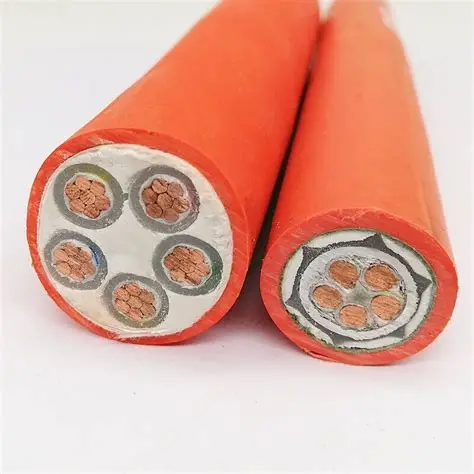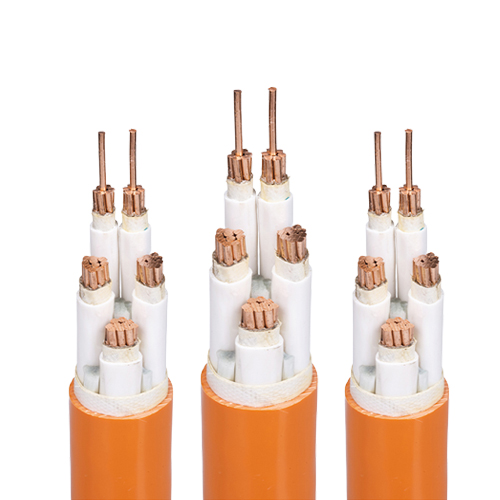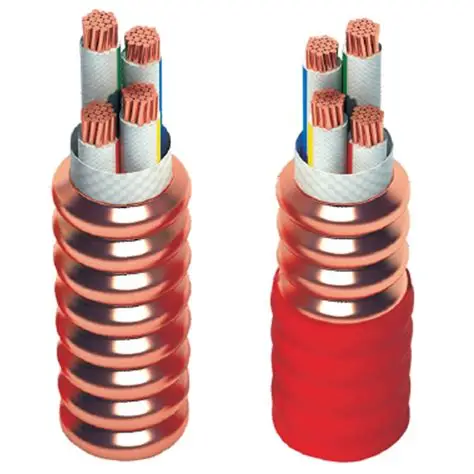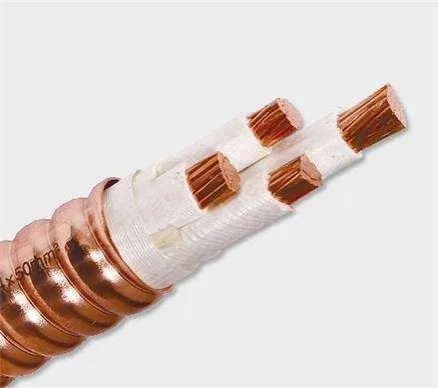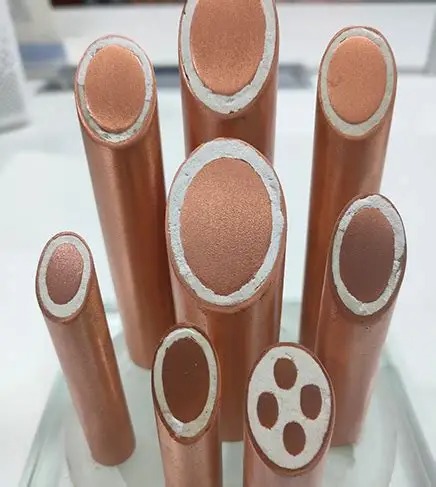
What is BTTQ/BTTYQ – Flame-Retardant mineral insulated Power Cable?
Chinese Name: BTTQ/BTTYQ Flexible Mineral Insulated Fire-Resistant Cable
- BTTQ/BTTYQ: Model representation method for flexible mineral insulated fire-resistant cable
- B: Wiring cable
- T: Copper conductor
- T: Copper sheath
- Q: Light PVC outer sheath
- YQ: Light PE outer sheath
Specific Types and Models
The BTTQ/BTTYQ flexible mineral insulated fire-resistant cable models mainly include the following:
| Model | Core Number | Cross-section Range (mm²) | Application |
|---|---|---|---|
| BTTQ | 1-5 cores | 1.5-400 | Power and lighting circuits in general areas |
| BTTYQ | 1-5 cores | 1.5-400 | Areas requiring moisture and corrosion resistance |
| BTTQ-23 | 1-5 cores | 1.5-400 | Underground installation |
| BTTYQ-23 | 1-5 cores | 1.5-400 | Moisture and corrosion resistance underground installation |
Working Principle
The working principle of BTTQ/BTTYQ flexible mineral insulated fire-resistant cable is based on the basic characteristics of mineral insulated cables:
- Mineral Insulation Principle: Using magnesium oxide as the insulating material. Magnesium oxide is an inorganic mineral with non-flammable, high-temperature resistance, and excellent insulation properties.
- Copper Conductor Transmission: High-purity copper conductors are used to ensure excellent conductivity.
- Copper Sheath Protection: Seamless copper tube as the sheath provides mechanical protection and shielding.
- Outer Sheath Protection: Q or YQ light outer sheath provides additional protection, improving the cable’s moisture and corrosion resistance.
In case of fire, BTTQ/BTTYQ cables can maintain normal operation because:
- Magnesium oxide insulating material does not burn or melt at high temperatures.
- Copper sheath can withstand high temperatures and maintain structural integrity.
- Cable structure design ensures power and signal transmission even in flames.
Technical Parameters
Electrical Parameters
| Parameter | Value | Description |
|---|---|---|
| Rated Voltage | 0.6/1kV | Standard rated voltage |
| Test Voltage | 3.5kV/5min | Power frequency withstand voltage test |
| Insulation Resistance | ≥1000MΩ·km | At 20°C |
| Short Circuit Temperature | ≤400°C | Duration 5 seconds |
Fire Resistance Performance Parameters
| Parameter | Value | Test Standard |
|---|---|---|
| Flame Retardant Level | Class IA | GB/T 18380 |
| Fire Resistance Level | NHⅠ Class | GB/T 19216 |
| Fire Resistance Time | ≥180min | 950°C-1000°C |
| Smoke Density | ≤75% | GB/T 17651 |
Current Carrying Capacity Parameters
Current carrying capacity of BTTQ/BTTYQ cables under different installation conditions (ambient temperature 25°C):
| Nominal Cross-section (mm²) | Air Installation (A) | Soil Installation (A) | Conduit Installation (A) |
|---|---|---|---|
| 1.5 | 24 | 22 | 18 |
| 2.5 | 32 | 29 | 25 |
| 4 | 42 | 38 | 33 |
| 6 | 55 | 50 | 43 |
| 10 | 75 | 68 | 59 |
| 16 | 100 | 91 | 79 |
| 25 | 135 | 122 | 106 |
| 35 | 165 | 150 | 130 |
| 50 | 210 | 191 | 165 |
| 70 | 265 | 241 | 209 |
Advantages and Disadvantages
Advantages
- Excellent Fire Resistance: Can maintain normal operation for more than 3 hours in high-temperature flames of 950°C-1000°C, one of the highest fire-resistant cables currently available.
- Non-toxic and Environmentally Friendly: Does not produce toxic or harmful gases when burned, meeting environmental requirements.
- Long Service Life: Mineral insulating materials have stable performance, with a service life of up to 70 years or more.
- High Mechanical Strength: Metal sheath provides good mechanical protection, resistant to impact and tensile forces.
- Good Shielding Performance: Copper sheath can serve as a shielding layer, effectively reducing electromagnetic interference.
- High Current Carrying Capacity: Higher current carrying capacity than ordinary cables for the same cross-section.
- Waterproof and Moisture-Proof: Fully sealed structure, excellent waterproof and moisture-proof performance.
Disadvantages
- Higher Price: Due to high material and process requirements, the price is higher than ordinary cables.
- Heavier Weight: The copper sheath and mineral insulating materials make the cable heavier.
- Difficult Installation: Requires professional installation equipment and technology.
- Larger Bending Radius: Although flexible, the bending radius is still larger than ordinary cables.