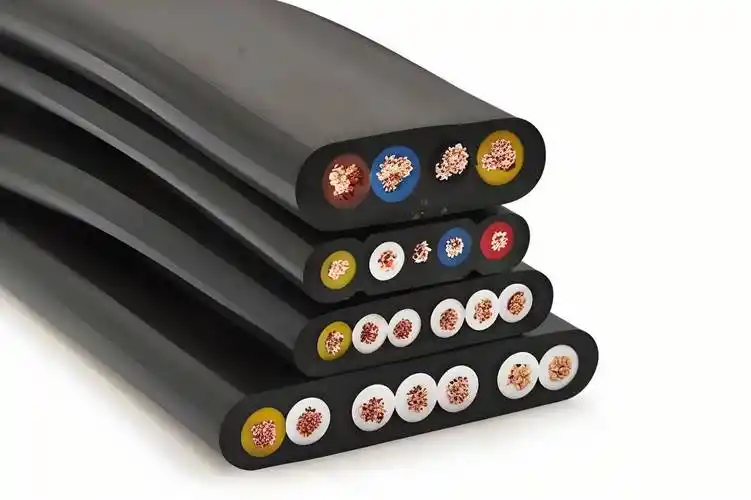
Detailed Description
Heavy Duty — What the "Extra" Gets You
Standard flat cable is adequate for thousands of indoor factory applications. Heavy duty flat cable is for the applications where standard fails within months.
The "heavy duty" designation represents quantifiable differences:
| Design Element | Standard Flat Cable | Heavy Duty Flat Cable |
|---|---|---|
| Jacket thickness | 0.8–1.5 mm | 1.5–3.0 mm — 50–100% thicker |
| Steel wire messengers | Standard size — rated for cable weight only | Oversized 2× — rated for cable weight + impact + wind |
| Core filler density | Standard — some void space | High-density — minimal void, maximum compression resistance |
| Jacket tear strength (PUR) | ≥60 N/mm | ≥90 N/mm — enhanced formulation |
| Abrasion life (PUR) | 100% (baseline) | 160% — thicker jacket = longer wear life |
| Impact resistance | Moderate — jacket absorbs some impact | High — CR cushion + thick jacket absorbs heavy impact |
| Working tensile capacity | 5–20 kN | 10–60 kN |
| Reeling cycles (12:1 D/d) | >50 000 | >100 000 |
The additional material in the jacket and reinforcement increases the cable cost by approximately 20–35% over standard flat cable. In heavy-duty applications, this premium is recovered through 2–3× longer service life and reduced replacement downtime.
Why Thicker Jacket Matters — More Than Abrasion
A thicker jacket provides more than just additional abrasion material. It changes the cable's mechanical response to damage:
Cut Resistance
When a sharp object strikes the cable, the force concentrates at the point of contact. A 1.0 mm jacket is penetrated with less force than a 2.5 mm jacket — not just because there is more material, but because the additional thickness distributes the impact force over a wider area before it reaches the core. The jacket acts as a structural beam — doubling the thickness increases the bending stiffness 8× (proportional to thickness³).
Compression Recovery
When the cable is compressed between drum layers, the jacket must recover its original thickness. A thicker jacket has more material to absorb and redistribute compressive force. After sustained compression, a thick PUR jacket recovers >95% of its original thickness — a thin jacket may recover only 80–85%, permanently reducing its protective capability.
Heat Dissipation
Heavy-duty applications often involve high current. The power conductors generate heat. A thicker jacket provides additional thermal insulation — paradoxically protecting the cable from external heat sources (radiant heat from steel mill ladles, direct sunlight on open-pit mining equipment) while allowing internal heat to dissipate through the wide flat surface area.
Mining and Steel Mill — Two Defining Heavy-Duty Environments
Mining
The cable is dragged across blasted rock, run over by heavy equipment, exposed to -20°C to +45°C, UV-blasted at altitude, and subjected to falling rock fragments from bucket spills. A cable replacement requires a crane and production shutdown — costing $10 000–50 000+ per hour.
Heavy duty specification: PUR jacket 2.5 mm minimum, oversized steel messengers, high-density core stranding, MSHA flame certification, yellow jacket for visibility.Steel Mill
The cable operates near 1 200°C molten steel, is exposed to metallic scale dust (conductive and abrasive), endures radiant heat that can raise the jacket surface temperature to 80–100°C, and risks impact from moving scrap and billets.
Heavy duty specification: CR jacket 2.0 mm minimum (better radiant heat resistance than PUR), oversized steel messengers, inner CR cushion layer, black jacket (hides metallic dust discoloration).Why Choose Yichi Cable Heavy Duty Flat?
- Quantified "heavy duty": We specify the numbers — jacket thickness in mm, tensile rating in kN, tear strength in N/mm — not a marketing adjective
- Application-specific jacket: CR for mining and steel mill (heat + flame), PUR for marine and outdoor (chemical + UV + cold) — we recommend based on your environment
- Oversized messengers standard: Heavy duty means the steel wires are sized for maximum anticipated load, not minimum — we engineer for your worst day, not your average
- Compression-tested core: Our high-density stranding is tested under simulated 15-layer drum compression — conductor cross-section remains circular within ±3% at rated load
- Thickness measurement at installation and service: We provide baseline jacket thickness data and recommend periodic ultrasonic measurement — track actual wear rate, replace before failure