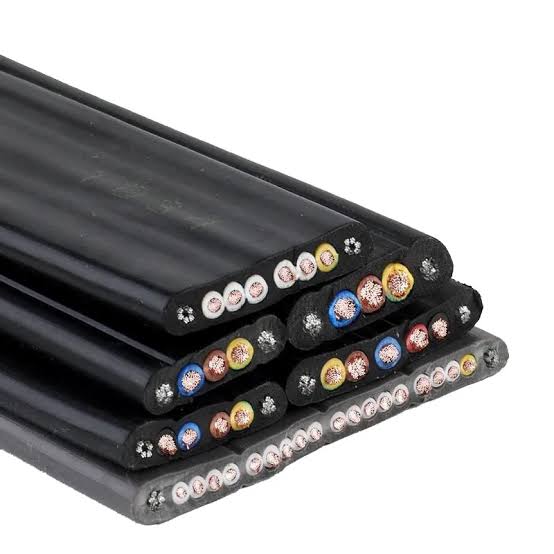
Detailed Description
Flat Cable Geometry — Why Shape Matters on a Reel
A round cable on a drum creates pyramid-shaped voids between adjacent turns. These voids represent wasted drum space — and more critically, they allow upper-layer turns to "fall" into the gaps, creating uneven spooling that damages the cable.
A flat cable eliminates this problem entirely. Each turn sits flush against the turn below it and adjacent to it, like stacking sheets of paper. The geometry provides three benefits:
- Maximum drum utilization: Up to 50% more cable length on the same drum compared to round cable of equivalent copper cross-section
- Uniform layer compression: The flat surface distributes compressive force evenly across its entire width — no point loading that crushes conductors
- Impossible to tangle: Flat cables physically cannot cross-wind or tangle on the drum. The geometry enforces correct spooling
Four Jacket Options — One Flat Profile
The flat cable geometry is compatible with multiple jacket materials. Choose based on your environment and budget:
| Jacket | Oil Resistance | Abrasion | Cold Flex | UV | Relative Cost | Best Application |
|---|---|---|---|---|---|---|
| PVC | ⭐ | ⭐⭐ | -5°C | ⭐ | 1.0× | Indoor, clean, budget-primary |
| NBR | ⭐⭐⭐ | ⭐⭐⭐ | -15°C | ⭐⭐ | 1.1× | Indoor, moderate oil, best value |
| CR | ⭐⭐⭐ | ⭐⭐⭐ | -25°C | ⭐⭐⭐⭐ | 1.3× | Outdoor, mining, heavy industry |
| PUR | ⭐⭐⭐⭐⭐ | ⭐⭐⭐⭐⭐ | -40°C | ⭐⭐⭐⭐ | 1.4× | Premium — all harsh environments |
All four jacket options are available on the same flat cable geometry — same conductor arrangement, same steel wire edge messengers, different jacket material. This means you can standardize on the flat cable drum system and select the jacket material that matches each specific installation's environment.
Dual Edge Messengers — Carrying Tension Without Stretching Copper
Flat reeling cable incorporates galvanized steel wire ropes vulcanized into both edges of the flat profile. The messengers:
- Carry tensile load: The steel wires carry 100% of the winding tension — the copper conductors experience zero mechanical load
- Prevent stretching: Steel's Young's modulus (210 GPa) is approximately 2× that of copper (110 GPa) — the cable does not stretch under winding tension
- Stabilize the flat profile: The messengers prevent the cable from curling at the edges, maintaining the flat ribbon geometry throughout the cable's life
- Enable longer spans: With sufficient messenger cross-section, flat reeling cable can span up to 80 m in combined festoon-reel applications
Flat Reeling Cable vs Flat Drag Chain Cable
| Flat Drag Chain Cable | Flat Reeling Cable | |
|---|---|---|
| Primary motion | Bending in carrier | Winding on drum |
| Tensile load | Near zero (carrier-supported) | Full cable weight + winding tension |
| Edge messengers | Optional | Standard — required |
| Jacket focus | Low friction for carrier gliding | Abrasion + compression resistance |
| D/d ratio | 7.5–10×D (bending) | 10–15:1 drum ratio |
| Compression | None | Multi-layer drum loading |
| Life metric | Flex cycles | Reeling cycles |
Do not substitute a flat drag chain cable for reeling — the absence of edge messengers means the copper conductors will carry the winding tension, leading to conductor stretch, thinning, and eventual failure.
Why Choose Yichi Cable Reeling Flat?
- Full jacket material range: PVC, NBR, CR, and PUR — all on the same flat cable geometry. Standardize your drum system, optimize jacket per installation
- Vulcanized messenger bonding: Steel wire messengers are chemically bonded into the jacket — not mechanically trapped. No messenger slippage under sustained tension
- Engineered messenger sizing: We calculate the required steel wire cross-section based on your drum depth, cable length, and winding tension — not a one-size standard
- Flat extrusion expertise: Extruding a flat profile jacket with uniform thickness across its entire width requires precise die design and process control — it is more difficult than round extrusion. We have the expertise