Detailed Description
Why Flat? The Engineering Case for Ribbon Geometry
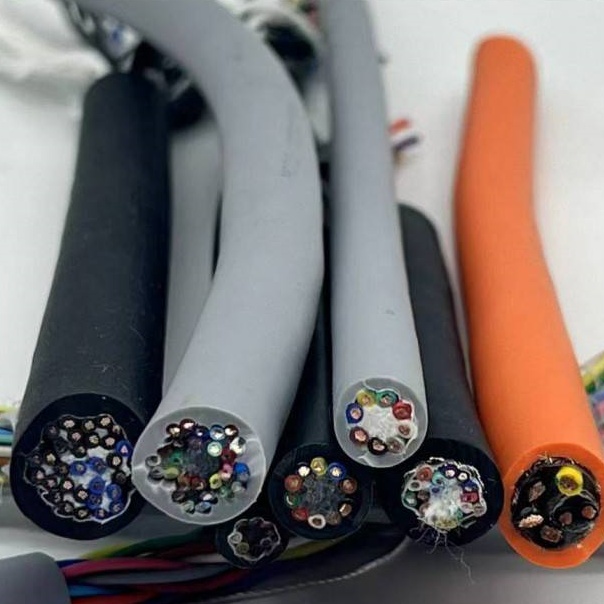
A round drag chain cable bundle fills a carrier's cross-section as a roughly circular cluster of cylinders. This creates three problems:
- Friction multiplication: Round cables roll and rub against each other and the carrier walls in all directions — the effective friction surface area is large and unpredictable
- Twist tendency: Round cables naturally twist when pulled through bends. Without anti-twist devices, this "corkscrewing" accumulates cycle by cycle until internal conductors break
- Height waste: The circular bundle leaves significant unused space above and below — space that cannot be used by additional cables without stacking and crushing
- Lower friction: The smooth, wide ribbon geometry slides against the carrier floor with a consistent, predictable contact patch — approximately 30% lower friction than an equivalent round bundle
- No twisting: The rectangular cross-section is mechanically stable in one plane. It literally cannot twist in a properly designed carrier. No anti-twist devices, no corkscrew failures
- Height efficiency: A 3 mm thick flat cable replaces a 12 mm diameter round bundle — that is 75% height reduction, enabling more cables in the same carrier or a smaller carrier
Flat vs Round — Performance Comparison
| Property | Round Drag Chain Cable | Flat Drag Chain Cable |
|---|---|---|
| Carrier friction | Higher (multi-directional rolling) | ~30% lower (stable flat contact patch) |
| Twist resistance | Requires anti-twist devices | Inherently twist-proof |
| Height utilization | Waste above and below circular bundle | Efficient — full height utilized |
| Heat dissipation | Lower — cores thermally insulated by neighbors | Better — wider surface area for convection |
| Flex life (same bend radius) | Baseline | 1.5–2× longer |
| Integration | Separate cables for power, signal, encoder | Single cable — power + signal + encoder |
| Bend direction | Free in any direction | Single-plane only — must not bend "hard way" |
| Cost | Lower per-meter material cost | Slightly higher per meter; saves on carrier size |
Flat Cable Construction — Layer by Layer
1. Conductor
Fine stranded bare copper, IEC 60228 Class 5 or Class 6. Single wire diameter 0.10–0.15 mm (slightly coarser than high-flex round cables — the uniform bending plane allows this without compromising flex life).
2. Core Insulation
PVC or NBR-PVC blend, thickness 0.3–0.8 mm depending on cross-section. The cores are arranged in a parallel or staggered parallel configuration — a single row of conductors lying side by side.
3. Core Identification
Standard: black cores with white consecutive numbering (1, 2, 3...). Green-yellow protective conductor from 3 cores upward. Color coding per DIN 47100 available on request.
4. Reinforcement (Optional)
For long-span festoon or suspended applications, steel wire or aramid fiber reinforcement strands are embedded along the cable edges. These carry tensile load, preventing the cable from stretching under its own weight.
5. Inner Wrap / Shield (Optional)
A PET non-woven tape layer optionally followed by a tinned copper braid overall shield (≥ 80% coverage). The shield follows the flat profile — it does not add significant thickness.
6. Outer Jacket
NBR-PVC blend (standard) or PUR (enhanced). Key characteristics:
- NBR-PVC: Good abrasion resistance, moderate oil resistance, cost-effective
- PUR: Superior abrasion and oil resistance, wider temperature range, UV-stable, halogen-free — specified for demanding environments
Bend Radius — One Dimension Only
The flat cable's minimum bend radius is measured against its thickness, not its width. Two rules:
Rule 1: Bend in the Flat Plane Only
The cable is designed to bend like a ribbon — folding over its thin cross-section. The minimum dynamic bend radius is 7.5–10 × cable thickness.
Rule 2: NEVER Bend the "Hard Way"
Bending a flat cable against its wide cross-section (edge-wise, like folding a piece of paper against its spine) drastically reduces flex life and can cause immediate conductor damage. If your carrier design requires bends in multiple planes, a round cable is the appropriate choice.
Typical Configurations
| Cores × mm² | Width (mm) | Thickness (mm) | Typical Use |
|---|---|---|---|
| 4 × 0.75 | 13 | 3.2 | Compact sensor wiring, 4 signals |
| 8 × 0.5 | 18 | 3.5 | Multi-signal encoder + limit switches |
| 8 × 1.0 | 22 | 4.5 | Power + control for small axis |
| 12 × 0.75 | 28 | 4.8 | CNC tool changer control + feedback |
| 4G1.5 + 4 × 0.5 | 25 | 5.5 | Power (4×1.5) + encoder (4×0.5) combo |
| 3G2.5 + 6 × 0.75 | 32 | 6.5 | Motor power (3×2.5) + signal (6×0.75) |
| 24 × 0.25 | 36 | 5.0 | High-density signal — 24 channels |
G = with green-yellow protective conductor. Configurations with "+" are mixed-gauge cables — larger power cores and smaller signal cores in the same ribbon.
Installation — Getting the Most From Flat Cable
- Carrier floor: Use carriers with smooth, flat floors. Ribbed or grooved floors create localized pressure points that reduce flat cable life.
- Separator plates: If multiple flat cables run in the same carrier, separate them with smooth plastic plates. Flat cables should never be stacked directly on top of each other.
- Clamping: Use flat cable-specific clamps with a wide, flat grip surface. Standard round cable clamps will damage the flat profile.
- Transition zones: Where the flat cable exits the carrier and enters a junction box, allow a straight run of at least 10 × cable width before any bend. This prevents the carrier's movement from concentrating flex stress at the exit point.
- Travel marking: Because the flat profile prevents visual twisting, mark both ends of the cable with a longitudinal line (paint pen) at the clamp points. If the line later appears twisted, the cable has been incorrectly re-installed.
Why Choose Yichi Cable Flat Drag Chain?
- Mixed-gauge capability: Power + signal in one flat cable — reduces carrier complexity and connector count
- PUR option for harsh environments: Oil, coolant, UV, and outdoor rated with halogen-free jacket
- Custom width and thickness: We match your carrier's internal dimensions — not a generic off-the-shelf size
- Pre-production samples: Test a sample length in your actual carrier before committing to a full production order
- Flex life verified: Every new flat cable design is tested in our CNAS-accredited lab before first shipment