Detailed Description
What TRVV Drag Chain Cable Solves
TRVV drag chain cable is a copper-core PVC flexible cable designed for continuous reciprocating motion. In the field it is also called drag chain cable, drag wire cable, or tank chain cable. It is not a fixed-installation cable with a flexible jacket; its conductor, insulation, tensile element, and jacket are built as a system for repeated bending inside a cable carrier, energy chain, or drag chain.
The cable is used on industrial robot arms and manipulators, tank chains, large lifting and transport equipment, large CNC machine tools, intelligent warehouse systems, engraving machines, automated production lines, electronic equipment, machine tool processing equipment, power equipment, and logistics conveying systems. It can work in oil-contaminated areas such as engraving machines and CNC light machine tools. The key selection question for equipment builders, system integrators, and maintenance engineers is whether the cable will survive the actual bending radius, travel length, speed, and oil exposure of the machine. TRVV is aimed at continuous reciprocating motion and frequent bending in industrial environments.
Layer-by-Layer Construction
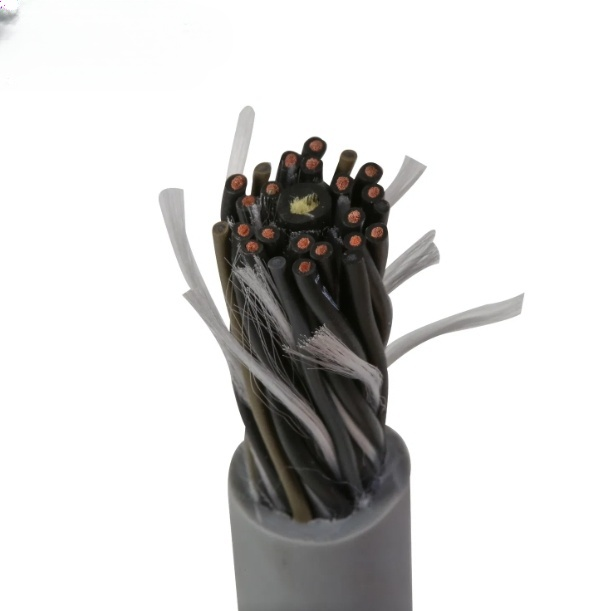
The conductor is made from 99.99% oxygen-free copper, drawn into multi-strand ultra-fine oxygen-free copper wire. Copper purity is ≥ 99.9953%, oxygen content is ≤ 0.0003%, and impurity content is ≤ 0.0044%. The stranding process is done in two stages: group-stranded first, then multi-strand together. This improves flexibility and bending resistance, so the core is less likely to break after repeated motion.
From the inside out, the core construction is: oxygen-free copper conductor → nitrile PVC insulation → tensile cotton rope → non-woven fabric → nitrile PVC jacket. The insulation is a special oil-resistant and abrasion-resistant nitrile PVC. The tensile structure uses a full amount of cotton rope to resist moving tension and keep the cable round, plus a full non-woven fabric wrap. The jacket is flexible PVC or a special oil-resistant and abrasion-resistant modified PVC. In long-term oily environments the jacket does not harden or crack. The extrusion process is controlled for low eccentricity and even jacket thickness to reduce the risk of current breakdown.
For the TRVVP version, the shield is a tinned copper braid plus an aluminium foil shield layer, covered by a PVC insulation jacket. This is a double-shield construction with a high-density braid, which improves interference resistance and transmission stability.
TRVV Specifications and Electrical Data
The rated voltage is 300/300 V or 300/500 V. The ambient temperature range is -40°C to +105°C. The bending life is 10 million cycles under laboratory simulation. The execution standard is the national standard, with a rated temperature of 105°C and enterprise standard Q'JB/T8734.3-2016. The standard cross-section range is 0.3 mm² to 4 mm², with 2–30 cores. TRVVP is available in 2–5 cores, and other specifications are available on request. Packaging is 100 m or 200 m reels, with custom lengths and zero-cut short lengths. The standard colour is gray, with black and gray in stock. The minimum bending radius is R > 7.5 × cable outer diameter.
| Conductor (mm²) | OD (mm) | Core ID (mm) | Max. Conductor Resistance @20°C (Ω/km) | Insulation Thickness (mm) | Jacket Thickness (mm) | Rated Voltage | Recommended Load @220V |
|---|---|---|---|---|---|---|---|
| 2 × 0.5 | 5.4 ± 0.2 | 1.8 | 39 | 0.6 | 1.2 | 300/300 V | 1000 W |
| 2 × 1.0 | 7.2 ± 0.2 | 2.4 | 19.5 | 0.6 | 1.6 | 300/500 V | 2000 W |
| 2 × 1.5 | 8.2 ± 0.2 | 2.8 | 13.3 | 0.7 | 1.7 | 300/500 V | 3000 W |
| 3 × 0.5 | 6.0 ± 0.2 | 1.8 | 39 | 0.6 | 1.2 | 300/300 V | 1000 W |
| 3 × 1.0 | 7.6 ± 0.2 | 2.4 | 19.5 | 0.6 | 1.6 | 300/500 V | 2000 W |
| 3 × 1.5 | 8.7 ± 0.2 | 2.8 | 13.3 | 0.7 | 1.7 | 300/500 V | 3000 W |
| 3 × 2.5 | 10.1 ± 0.2 | 3.4 | 7.98 | 0.8 | 1.8 | 300/500 V | 5000 W |
| 4 × 0.5 | 6.8 ± 0.2 | 1.8 | 39 | 0.6 | 1.2 | 300/300 V | 1000 W |
| 4 × 1.0 | 8.3 ± 0.2 | 2.4 | 19.5 | 0.6 | 1.6 | 300/500 V | 2000 W |
| 4 × 2.5 | 11.3 ± 0.2 | 3.4 | 7.98 | 0.8 | 1.8 | 300/500 V | 5000 W |
| 5 × 1.0 | 9.8 ± 0.2 | 2.4 | 19.5 | 0.6 | 1.6 | 300/500 V | 2000 W |
| 6 × 1.0 | 9.9 ± 0.2 | 2.4 | 19.5 | 0.6 | 1.6 | 300/500 V | 2000 W |
| 8 × 1.0 | 11.0 ± 0.2 | 2.4 | 19.5 | 0.6 | 1.6 | 300/500 V | 2000 W |
| 12 × 1.0 | 13.8 ± 0.2 | 2.4 | 19.5 | 0.6 | 1.6 | 300/500 V | 2000 W |
| 20 × 1.0 | 16.3 ± 0.2 | 2.4 | 19.5 | 0.6 | 1.6 | 300/500 V | 2000 W |
Core counts cover 2, 3, 4, 5, 6, 7, 8, 10, 12, 16, 20, 24, 25, and 30. Core identification follows the standard colour sequence: up to 10 cores use white cores with number markings plus yellow/green rings. 6-core: red, black, yellow, green, white, brown. 7-core: the same plus blue. 8-core: red, black, yellow, green, blue, white, brown, gray. 10-core: the same plus orange and purple. 12-core: red, black, yellow, green, white, brown, blue, gray, orange, purple, pink, light green.
Installation Rules for Continuous Reciprocating Motion
The rated 10 million flex cycles depend on correct installation. The following rules come directly from the cable design requirements:
- Straighten the cables before laying. Avoid squeezing and multi-layer overlapping, because cables rubbing against each other will shorten service life.
- Match the cable and drag chain dimensions. Leave a gap of at least 10% of the cable diameter, and do not route the cables too densely.
- The bending radius must be greater than 7.5 × cable outer diameter (d = cable OD).
- Service life does not depend on softness alone. It depends on material selection plus the drag chain bending angle and mechanical movement speed.
- The routing length should pass just through the centre line of the drag chain.
- Fix the cable at both ends, or at least at the moving end of the drag chain. The distance from the moving point to the chain end should be 20–30 × cable diameter.
- If cables with very different outer diameters are mixed, use separators. Otherwise thin cables can be pressed by thick cables and break.
- If the cable is mixed with hard objects such as air supply tubes, use separators.
TRVVP Double-Shielded Version
TRVVP uses the same conductor and oil-resistant nitrile PVC insulation, but adds a tinned copper braid plus an aluminium foil shield layer and a PVC insulation jacket. The double shield and high-density braid give stronger interference resistance and more stable transmission. Typical configurations include 2×0.15 to 2×6.0, 3×0.15 to 3×6.0, 4×0.15 to 4×6.0, and 5×0.15 to 5×1.5. Composite constructions such as 3×1.5+1×1.0, 3×2.5+1×1.0, 3×4+1×2.5, and 3×6+1×4 are also available.
For earthing, cables below 0.3 mm² do not include a yellow/green earth core; cables from 0.3 mm² and above include one. Core colours follow the standard sequence: 2-core blue/brown; 3-core blue/brown/yellow or blue/brown/green-yellow; 4-core red/black/yellow/green with earth; 5-core red/black/yellow/green/white or red/brown/blue/black/earth.
Certifications, Standards, and Selection Notes
Yichi manufactures TRVV and TRVVP cable under national standard and enterprise standard Q'JB/T8734.3-2016, with a rated temperature of 105°C. The certificates are traceable: CCC 2018010105104282 / 2018010105104278 / 2018010105104279 / 2018010105104280, CE No. TST20230380488-ISC, UL No. E531469, RoHS No. NB202303036, and ISO 9001 No. 04623Q15032R0S. SAA, national industrial product production licence, SGS, and MA inspection reports are also available. Several patents cover the motion cable, drag chain data network cable, and intelligent robot cable constructions.
From a selection standpoint, TRVV is the right choice when you need an unshielded power or control cable for a cable carrier with moderate EMI, a bending radius above 7.5 × OD, and an oil mist or coolant environment within -40°C to +105°C. Choose TRVVP when the same carrier also carries encoder, controller, or data signals, or when a VFD or servo drive is close enough to induce noise. If the application requires torsional twisting at a robot joint, a standard TRVV construction is not the correct cable; a dedicated torsion-rated structure should be used instead. If you need a cross-section outside 0.3–4 mm² or a core count above 30, check the custom range before specifying. Free samples are available, and standard stock ships quickly. Yichi can open VAT invoices and customise core count, cross-section, and packaging length.