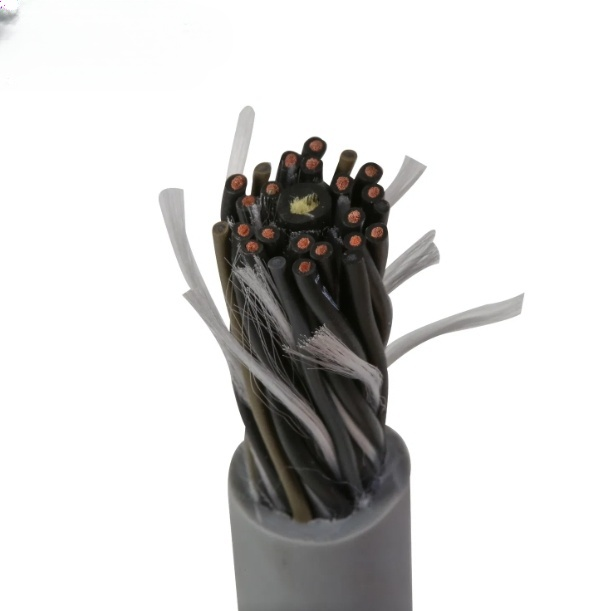
Detailed Description
Beyond Drag Chains — The 3D Motion Challenge
A drag chain cable bends in one plane — a 2D motion. The cable experiences compression at the inner radius and tension at the outer radius. This is well-understood engineering with solutions dating back decades.
A robot arm cable bends AND twists simultaneously — a 3D motion. When axis 4, 5, and 6 of a 6-axis robot move through their range, the cable routed through the arm experiences:
- Bending: As the arm articulates, the cable flexes around the joint's bend radius
- Torsion (twisting): As the wrist rotates, the entire cable twists along its longitudinal axis — potentially ±360° for a full rotation
- Radial compression: Twisting a cylindrical cable creates inward radial force that crushes inner cores against each other
A High Flexibility Cable is engineered for all three forces simultaneously.
The Reverse-Lay Conductor — Engineering Zero Torsion Stress
The single most important design feature in a torsion-rated cable is reverse-lay stranding:
- Inner layer: Conductors are stranded with a left-hand lay (counterclockwise twist)
- Outer layer: Conductors are stranded with a right-hand lay (clockwise twist)
- Result: When the cable is twisted in either direction, one layer tightens while the other loosens — but crucially, the net torsional stress on the individual copper strands is near zero because the two opposing lay directions cancel each other out
Without this feature, a standard drag chain cable under torsion would concentrate all twist stress on one or two conductor layers, causing those specific strands to fatigue and break long before the cable's rated bending life.
Why a Spiral Shield, Not a Braid
| Shield Type | Torsion Compatibility | Why |
|---|---|---|
| Braid (cross-woven) | ❌ Poor | Crossed wires lock against each other when twisted — opens diamond-shaped gaps in shield coverage |
| Spiral (parallel-wrapped) | ✅ Excellent | Wires are parallel — they slide against each other during twist without opening gaps |
| Foil (continuous wrap) | ✅ Good | No gaps to open, but can wrinkle under extreme torsion; needs spiral layer for mechanical support |
| Spiral + Foil (dual) | ✅ Best | Spiral provides torsion-flexible mechanical substrate; foil provides 100% gap-free EMI coverage |
The spiral shield — tinned copper wires wound in parallel around the cable, not woven — is the standard for torsion-rated cables. Combined with an outer aluminum/polyester foil, it achieves ≥99.5% shield effectiveness that is maintained throughout ±360° of torsion.
TPE Core Insulation — The Elastic Difference
PVC insulation works for bending because it is flexible. But under torsion, PVC's limited elasticity (typically 150–200% elongation before failure) means it can crack at stress concentration points.
TPE (thermoplastic elastomer) is specified for torsion-rated cables because:- Elongation ≥ 200–400%: Stretches without cracking as individual cores are twisted
- Compression recovery: After being squeezed by radial forces during twisting, TPE springs back to its original shape — PVC can take a permanent compression set
- Low friction surface: Cores slide against each other with minimal resistance during combined bend + twist movement
- No plasticizer migration: Unlike PVC, TPE does not contain liquid plasticizers that can migrate into adjacent materials over time
Torsion Rating — What ±180°/m Actually Means
The torsion rating specifies the maximum twist a 1-meter length of cable can sustain continuously:
- ±180°/m: A 1-meter cable section can be twisted one half-turn in either direction from its neutral position. A 2-meter section can handle one full turn (±360° total across the length). This is standard for most robot arm applications.
- ±360°/m: Each meter can be twisted one full turn. Required for axis 6 (wrist) of 6-axis robots where the entire cable bundle must follow the wrist rotation.
- Not rated for torsion: Standard drag chain cable. Do not use for any application involving twist — even "just a little."
Robot Dress Pack Integration
In practice, high-flexibility cables are rarely installed as individual cables. They are bundled into a robot dress pack — a protected cable assembly that routes from the robot base, through the arm, to the end-effector:
- Outer protective conduit: Corrugated PUR or nylon tube that protects the cable bundle from weld spatter, mechanical impact, and abrasion
- Internal cable arrangement: Power cables, signal cables, and pneumatic tubes laid parallel — never twisted around each other inside the conduit
- Service loop: At each joint, a specific excess cable length is calculated to provide enough slack for the joint's full range of motion without straining the cables
- Replacement access: Dress pack design must include provisions for replacing individual cables without disassembling the entire robot arm
Why Choose Yichi Cable High Flexibility?
- Reverse-lay stranding verified: Every torsion-rated cable production batch is sampled for lay direction consistency using a non-contact lay length measurement system
- Torsion life tested: New designs are tested to 10–20 million cycles on a ±180° torsion test rig in our CNAS-accredited laboratory
- Application-specific conductor selection: We specify conductor strand count, lay length, and shield type based on your robot model, joint count, and cycle rate — not a one-size catalog number
- Dress pack support: We can provide pre-bundled cable assemblies with protective conduit, labeled connectors, and installation documentation for major robot brands
- PUR or TPE jacket: We help you select based on your environment — PUR for oil/coolant/welding, TPE for cleanroom/cobot/lightweight