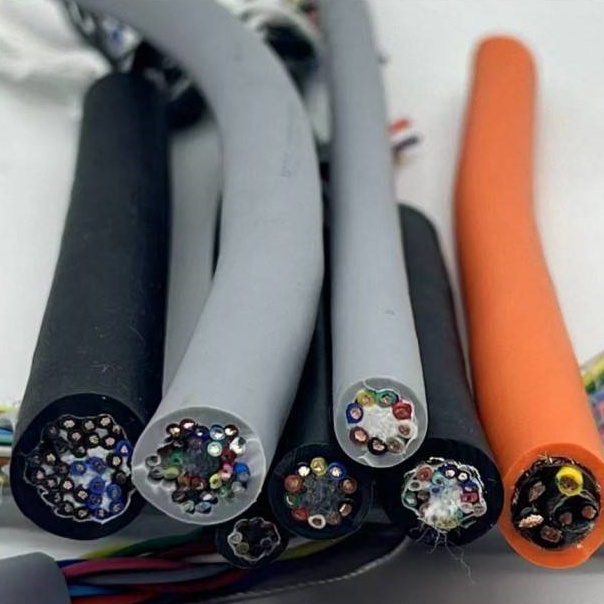
Detailed Description
What Makes a "High-Flex" PUR Cable Different?
A standard PUR drag chain cable is already a formidable performer — 10+ million cycles, 5×D bend radius, halogen-free. So what elevates it to "High-Flex"?
The answer lies in three engineering refinements that compound to deliver 3× the flex life and 33–50% tighter bend capability:
1. Ultra-Fine Conductor Stranding (Beyond Class 6)
Standard IEC 60228 Class 6 uses single-wire diameters of 0.08–0.12 mm. High-flex PUR cables go further — using wires as fine as 0.05–0.08 mm with even more strands per conductor. Each individual bending cycle imposes less stress on each wire because the deformation per wire is proportionally smaller.
2. Extra-Short Lay Length
The lay length — the distance over which a stranded conductor completes one full twist — is deliberately shortened in high-flex designs. A shorter lay length means any given point along the cable experiences bending stress that is distributed over a shorter relaxed section, reducing peak stress on any individual point. The trade-off: slightly higher conductor resistance per meter (more copper length per cable meter). For signal and control applications at 300/500V, this resistance difference is negligible.
3. PP Core Insulation — The Gliding Factor
Unlike PVC or PE, polypropylene (PP) has a naturally low coefficient of friction and excellent dimensional stability. In a high-flex cable where cores move against each other millions of times, this low friction directly translates to reduced internal wear. PP also resists compression set — it springs back after being squeezed, unlike PVC which can take a permanent set over time.
The combination: ultra-fine wires that barely notice each bend + short lay lengths that distribute stress evenly + PP insulation that glides without wearing = a cable that survives environments where standard drag chain cable fails prematurely.
Bend Radius — How Small Can You Go?
The headline specification for high-flex PUR is 5×D moving. But there is important context:
| Travel Distance | Recommended Bend Radius | Flex Life Impact |
|---|---|---|
| < 2 m (short stroke) | 5 × D | Full rated life (30M+ cycles) |
| 2–5 m (medium stroke) | 6 × D | Full rated life |
| 5–10 m (long stroke) | 7.5 × D | Full rated life |
| > 10 m (extended stroke) | 10 × D | Consult engineering — long travel may require additional tensile reinforcement |
High Acceleration — Designed for Pick-and-Place
High-flex PUR cables are engineered for high-acceleration environments where standard cables develop internal fatigue from rapid start-stop forces:
- Acceleration: Up to 50 m/s² (approximately 5g)
- What this means: A pick-and-place robot moving at 3 m/s and reversing direction in 60 milliseconds imposes 5g deceleration on the cable inside the carrier
- The risk: At these forces, loosely stranded conductors can migrate ("corkscrew") through the cable structure, causing hot spots and eventual failure
- The solution: Extra-short lay lengths, tight fleece wrapping between layers, and Kevlar-fiber tensile elements lock the core assembly in place
Cleanroom and Silicone-Free Compliance
High-flex PUR cables are routinely specified for cleanroom and medical applications because:
- Silicone-free: Silicone outgassing can contaminate semiconductor wafers and optical surfaces. Every material in this cable — conductor, insulation, fleece wrap, PUR jacket — is verified silicone-free
- Cadmium-free: No cadmium in any component — required for medical device certification
- Halogen-free: No chlorine, fluorine, bromine — no corrosive gas if burned in an enclosed machine
- Low particle emission: The PUR jacket's abrasion resistance means it sheds fewer particles than PVC when rubbing against carrier walls — qualified for ISO Class 5 (Fed Std 209E Class 100)
Installation Guidelines for Maximum Life
- Carrier type: Use carriers with smooth interior walls. Avoid carriers with internal ribs or dividers that create localized pressure points on the cable.
- Fill ratio: ≤ 50% of carrier internal cross-section (more conservative than the 60% for standard cables — the additional space allows individual cables to move independently during rapid acceleration).
- Cable arrangement: Lay cables side-by-side in a single layer. Stacking cables in multiple layers creates vertical compression on the bottom layer, reducing flex life.
- Strain relief: Clamp at both ends using rubber-lined PUR-compatible clamps. Do NOT use standard metal P-clips — they will cut into the jacket over time.
- Pre-conditioning: For very cold environments (< -20°C), allow the cable to warm up to at least -10°C before initiating rapid movement. While PUR retains flexibility at -30°C, its elasticity is reduced and the first few cycles generate higher internal stress.
Why Choose Yichi Cable PUR High-Flex?
- Verified flex life: Every design is tested to 30+ million cycles in our CNAS-accredited lab before we publish its rating
- Cleanroom documentation: Silicone-free, cadmium-free, and halogen-free certificates provided with every shipment
- Short-stroke optimization: We help you select the correct minimum bend radius based on your actual travel distance — not a one-size-fits-all number
- Custom stranding: Need even finer conductors for an ultra-compact 4×D bend radius? We can build it — contact our engineering team
- Rapid prototyping: Custom high-flex designs delivered in 2–3 weeks with full bend test documentation