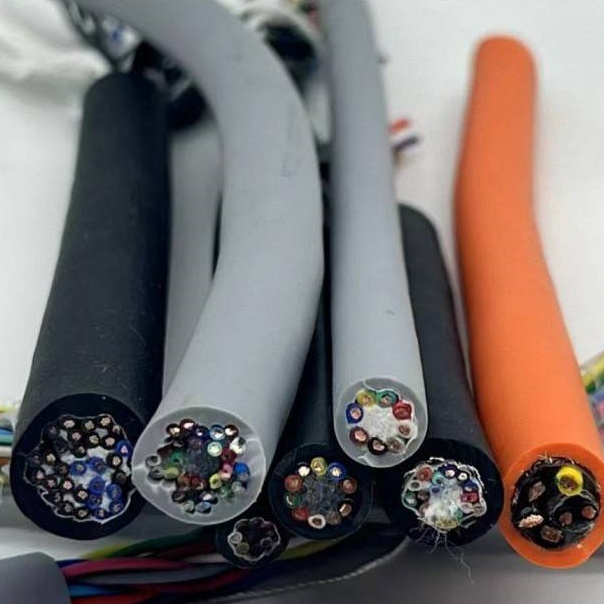
Detailed Description
The Dual Challenge — EMI and Aggressive Chemicals in the Same Machine
Most drag chain cable selection involves a trade-off:
- Choose PVC shielded — get EMI protection, but sacrifice chemical resistance, cold flexibility, and halogen-free safety
- Choose PUR unshielded — get unmatched environmental resistance, but leave signals unprotected from VFD and motor noise
Why Shielded PUR Matters — Real-World Failure Modes
Without shielded PUR, two common failure patterns emerge in combined EMI + chemical environments:
Failure Mode 1: Shielded PVC Cable + Coolant Exposure
A CNC machining center with VFD spindle drive needs shielded cable for encoder feedback. Standard solution: shielded PVC (TRVVP). But the cable carrier sits directly under the coolant nozzles. After 18 months:
- PVC jacket swells and softens from coolant absorption
- The braid shield, now embedded in softened PVC, fractures at bend points
- Encoder signal degrades → spindle faults → unscheduled downtime
Failure Mode 2: Unshielded PUR + EMI in Servo Drives
An injection molding machine with PUR cable for its oil resistance. But the mold heater switching and hydraulic pump VFD generate intense EMI that couples into the PUR cable's unshielded signal pairs. Result:
- Sporadic encoder position errors
- Machine cycle stops mid-mold (risk of material curing in barrel)
- Diagnostics point to "intermittent encoder fault" — notoriously hard to reproduce
Shielded PUR vs Alternatives — Side by Side
| Cable Type | EMI Protection | Chemical Resistance | Cold Flex | Halogen-Free | Flex Life | Best Application |
|---|---|---|---|---|---|---|
| PUR Shielded | ✅ 85%+ braid | ✅ Excellent | ✅ -30°C | ✅ Yes | 10M+ cycles | EMI + chemical dual challenge |
| TRVVP (PVC Shielded) | ✅ 80%+ braid | ❌ Swells in oil | ❌ -5°C only | ❌ Contains Cl | 5M cycles | Dry indoor EMI environments only |
| PUR Unshielded | ❌ None | ✅ Excellent | ✅ -30°C | ✅ Yes | 10M+ cycles | Non-EMI harsh environments |
| TRVV (PVC Unshielded) | ❌ None | ❌ Swells | ❌ -5°C | ❌ Contains Cl | 5M cycles | Budget general purpose only |
Internal Construction — Layer by Layer
1. Conductor — IEC 60228 Class 6
Ultra-fine stranded bare copper, single-wire diameter 0.08–0.12 mm. Tinned copper available for marine/offshore environments.
2. Core Insulation — Special PP
Polypropylene insulation with low dielectric constant (εr ≈ 2.3) for stable electrical performance during flexing. The PP's naturally low friction coefficient minimizes internal stranding friction — critical because with a braid shield, internal core movement is the dominant wear mechanism.
3. Core Assembly
Cores are stranded in layers with matched lay lengths. A PET fleece wrapping separates each layer to prevent core-to-core abrasion. Kevlar or high-tenacity PET tensile fillers carry axial loads.
4. Inner Wrap
A flexible non-woven or PET tape layer provides a uniform cylindrical substrate for the braid shield. This wrap is essential in PUR cables because the shield must not directly contact PP insulation — the PP's low surface energy makes any mechanical coupling unstable over millions of cycles.
5. Shield — Tinned Copper Braid
Full-coverage tinned copper wire braid with ≥85% density applied over the inner wrap. Tinned copper ensures corrosion resistance in humid and marine environments. The braid is mechanically isolated from both the core assembly (by the inner wrap) and the environment (by the PUR jacket).
6. Outer Sheath — Full Polyurethane (TMPU)
Halogen-free PUR compound per DIN EN 50363-10-2. Unlike PVC jackets that degrade under UV and chemical exposure, PUR maintains its mechanical properties — including its crucial role as the shield's environmental barrier — throughout the cable's entire service life.
Shield Grounding with PUR — Special Considerations
PUR's low surface energy and excellent chemical resistance create an engineering challenge for shield termination: standard self-amalgamating tapes and heat-shrink do not adhere as reliably to PUR as they do to PVC.
Best practice for PUR shielded cable termination:- Use PUR-compatible 360° EMC cable glands with silicone or EPDM sealing gaskets — these mechanically grip both the jacket and the exposed braid
- For pigtail terminations: expose 25–30 mm of braid, fold it back over a ferrule, and clamp inside the EMC gland body — do NOT attempt to solder-drain the braid to a wire and tape over the jacket
- If heat-shrink termination is unavoidable: use double-wall adhesive-lined heat-shrink specifically rated for polyolefin-to-polyurethane bonding
- Always ground both ends of the shield for frequencies above 1 MHz (encoder and fieldbus signals). For 50/60 Hz power cables, single-end grounding may be preferred to avoid ground loops.
Why Choose Yichi Cable PUR Shielded?
- Dual certification: UL/CSA for North America + CE/EAC for Europe/Eurasia — one cable for global equipment builds
- CNAS-accredited testing: Shield continuity and halogen content verified on every production batch
- Material transparency: We specify the PUR chemistry (ether/carbonate-based) based on your environment — no generic "PUR" that fails in your specific application
- Custom configurations: Core count, cross-section, braid density, jacket color, and tensile strength — built to your specification
- Field support: Pre-installation technical review for critical applications — we check your carrier dimensions, bend radii, and termination plan