Detailed Description
What Makes a PUR Drag Chain Cable Different?
PVC — the most common drag chain cable jacket — is a cost-effective performer under standard conditions. But in harsh industrial environments, standard PVC reaches its limits: it swells in mineral oil, hardens under UV, loses flexibility in cold, and can burn with toxic halogen gases.
PUR (polyurethane) is an upgrade in every mechanical and chemical dimension:| Property | Standard PVC Jacket | PUR Jacket |
|---|---|---|
| Abrasion resistance | Baseline | 5× better (Taber ≤5 mg/1 000 cycles) |
| Oil resistance | Moderate swelling | No swelling — resistant to mineral/hydraulic/cutting oils |
| Low temperature flexibility | -5°C (moving) | -30°C to -40°C (moving) |
| UV / weathering | Degrades with exposure | Certified UV/weather resistant (ISO 4892-2) |
| Halogen content | Contains chlorine | Halogen-free — no toxic HCl gas if burned |
| Hydrolysis resistance | Degrades in humid conditions | Resistant to water, seawater, and humidity |
| Bend radius | 7.5 × D | 5 × D (moving) — 33% smaller, saves installation space |
| Flex life | 5 million cycles | 10+ million cycles |
| Notch/tear/cut resistance | Moderate | High — jacket resists sharp metal edge damage |
The bottom line: PUR cables cost 20–35% more than PVC, but in the environments they are designed for, they last 2–3× longer and prevent the downtime cost of a failed cable inside a machine.
When to Specify PUR Over PVC
Use PUR when any of these conditions apply:
- Oil or coolant is present — CNC machines, injection molding, hydraulic equipment
- Outdoor installation — UV, rain, wide temperature swings
- Cold operation — Freezer warehouses, outdoor cranes in winter, Arctic applications
- Cleanroom or food-grade — Halogen-free and silicone-free is mandatory
- Long travel / high cycle — 10+ million cycle designs where PVC would be the weak link
- Tight bend radius — 5×D vs 7.5×D saves significant carrier space in compact machines
- Contact with chemicals — Acids, alkalis, greases, seawater, cutting fluids
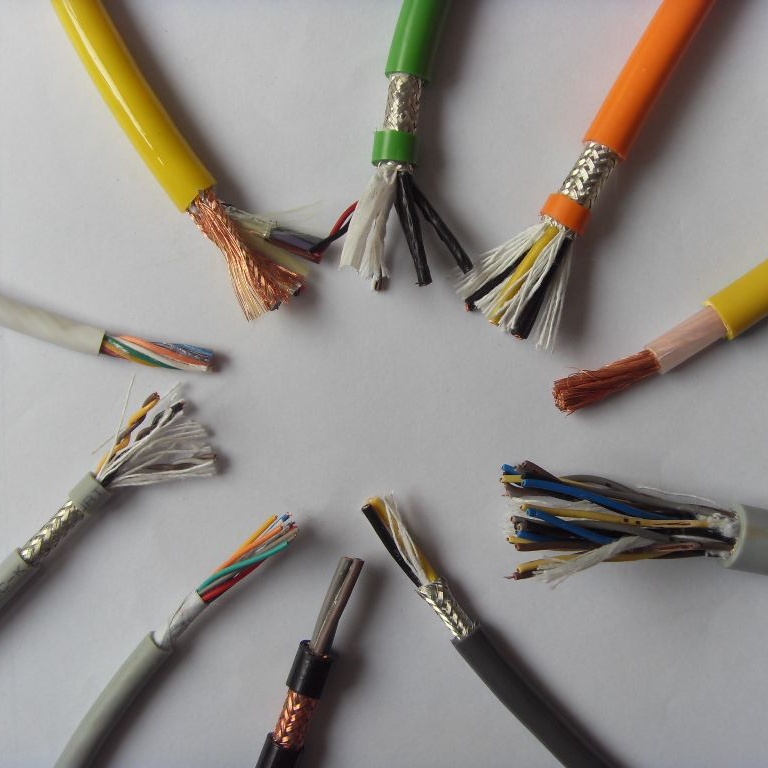
Internal Construction
1. Conductor — IEC 60228 Class 6
Bare copper (Cu-ETP), extra-fine stranded. Tinned copper optional for humid/offshore environments. Single wire diameter 0.08–0.12 mm.
2. Core Insulation — Special PP
Unlike the PVC insulation used in TRVV/TRVVP power cables, PUR drag chain cables use polypropylene (PP) as the core insulation material. PP provides:
- Lower coefficient of friction: Cores glide against each other with minimal resistance during flexing — critical because PUR's low-adhesion jacket eliminates external friction, leaving internal core friction as the dominant wear mechanism
- Lower dielectric constant (εr ≈ 2.2–2.3) vs PVC (εr ≈ 3.5–4.5): Enables thinner insulation walls for the same voltage rating, reducing overall cable diameter
- Higher dielectric strength: Allowing compact designs without compromising electrical safety
3. Core Stranding
Cores are stranded in layers with optimally matched lay lengths. A non-woven fleece wrapping separates each stranding layer, preventing core-to-core abrasion (this wrapping is omitted for cores ≥ 4 mm² where individual core stiffness provides natural separation).
4. Outer Sheath — Full Polyurethane (TMPU)
The jacket is a thermoplastic polyurethane (TMPU) compound per DIN EN 50363-10-2. Key characteristics:
- Taber abrasion: ≤5 mg per 1 000 cycles — the main reason PUR cables last longer in carriers
- Shore hardness: 85–90 A (comparable to PVC, but with superior elasticity)
- Tear strength: Much higher than PVC — resistant to cutting when dragged over metal edges
- Low adhesion: Smooth surface glides through carriers with minimal friction — no carrier lining required
- Meter marking: Continuous length marking on jacket surface for easy cut-to-length management
Certification and Compliance
PUR drag chain cables from Yichi are tested and certified to:
- UL AWM Style 21209 — Appliance Wiring Material, 1 000 V AC, 90°C conductor temperature
- CSA AWM I/II A/B — Canadian Standards Association
- CE — European Conformity
- EAC — Eurasian Conformity
- IEC 60332-1-2 / UL VW-1 / CSA FT1 — Flame retardant
- IEC 60754-1 — Halogen-free verification
- IEC 60811-404 — Oil resistance
- DIN EN ISO 4892-2 — UV and weathering resistance
- RoHS 2.0 / REACH — Environmental compliance
PUR vs PUR — Not All Polyurethane Is Equal
"PUR cable" is a category, not a specification. Different manufacturers use different PUR grades with significantly different performance:
- Ester-based PUR: Good mechanical properties, poor hydrolysis resistance — degrades in humid/wet environments. Suitable for dry indoor applications only.
- Ether-based PUR: Excellent hydrolysis resistance, good low-temperature flexibility, moderate mechanical properties. Suitable for wet and outdoor applications.
- Carbonate-based PUR: Best overall — excellent hydrolysis resistance AND mechanical properties. Suitable for the most demanding applications.
Installation Notes
- Carrier fill ratio: ≤ 60% — same as PVC, but PUR's smaller bend radius may allow a smaller carrier
- Clamping: Use PUR-compatible strain relief clamps. Avoid metal clamps directly on the jacket — use rubber-lined clamps
- Minimum bend: 5 × outer diameter moving, 3 × fixed. Going below these values will reduce flex life
- Chemical exposure: While PUR resists most industrial chemicals, prolonged immersion in concentrated strong acids or ketone solvents should be verified — contact us for chemical compatibility data
- Outdoor UV: No special precautions needed — PUR is inherently UV-stable (unlike PVC which requires carbon black or UV stabilizers)
Why Choose Yichi Cable PUR Drag Chain?
- PUR grade transparency: We tell you which PUR chemistry (ether/carbonate) goes into your cable based on your application — no generic "PUR" mystery
- Fully certified: UL/CSA for North America, CE/EAC for Europe/Eurasia — one cable suits multiple markets
- CNAS-accredited testing: Every batch tested for abrasion (Taber), flexibility, and electrical performance
- Halogen-free verification: Test report available with every shipment for cleanroom/food-grade compliance
- Meter marking: Every meter is traceable — reduces waste during installation
- Fast delivery: Standard configurations 7–15 days; custom PUR formulations prototyped within 2–3 weeks