Detailed Description
What Is a TRVVP Double-Jacket Cable — and Why Two Sheaths?
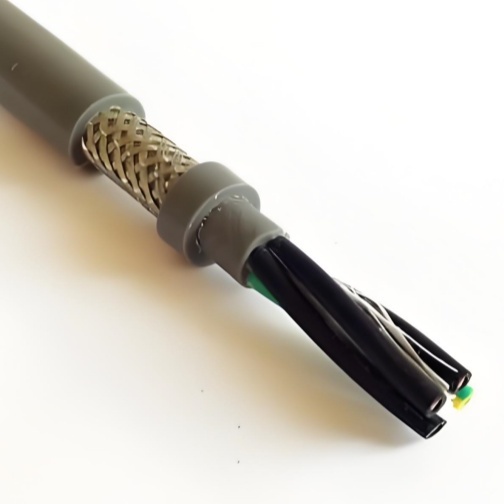
TRVVP is the shielded variant in the TRVV family: T-drag chain, R-flexible conductor, V-PVC insulation, V-PVC inner jacket, P-shielded. The "double-jacket" designation refers to a construction with two distinct protective sheaths — an inner jacket between the core assembly and the braided shield, and an outer jacket that encases the entire cable.
This dual-sheath architecture addresses a critical failure mode in single-jacket shielded cables: shield abrasion. During millions of bending cycles, if the copper braid is applied directly over the insulated cores, the braid wires rub against the insulation layers, causing micro-fractures in both shield and insulation — the leading cause of premature shield failure and short circuits in EMI-critical applications.
The TRVVP double-jacket design inserts a low-viscosity extruded inner jacket (modified NBR/PVC blend) between the core assembly and the shield, creating a smooth separation layer that:
- Decouples the shield from the bending motion of the individual cores
- Distributes mechanical stress evenly across the shield circumference
- Prevents braid strands from cutting into insulation during tight-radius bends
- Improves cable roundness, reducing friction inside the carrier
TRVVP Double-Jacket vs Standard Shielded — When to Upgrade
| Criteria | Standard Shielded Cable | TRVVP Double-Jacket |
|---|---|---|
| Flex cycle rating | 1–3 million | 5–20 million |
| Shield durability | Braid strands abrade insulation after ~50% of rated life | Inner jacket isolates shield from core movement |
| EMI protection | Degrades over flex life | Stable ≥80% coverage throughout entire service life |
| Bend radius tolerance | 10–12.5 × D typical | 7.5 × D (dynamic, <10 m travel) |
| Ideal for | Low-cycle, short-travel OEM equipment | High-cycle CNC, robot, and 24/7 automation lines |
| Cost premium | Baseline | ~15–25% higher; recovered through reduced downtime |
Internal Construction — Layer by Layer
1. Conductor — IEC 60228 Class 6
Multi-stage bunch-stranded bare copper (oxygen-free, Cu-ETP) with single-wire diameters of 0.08–0.12 mm. Short lay length stranding ensures bending stress is distributed evenly across all wires. Tinned copper available for humid environments.
2. Core Insulation
Special modified PVC/elastomer blend with dielectric strength ≥ 20 kV/mm and insulation resistance ≥ 20 GΩ·cm. PE or TPE insulation optional for signal pairs requiring controlled impedance.
3. Core Assembly
Anti-torsion layered stranding with group spacing and Kevlar / high-tenacity PET fillers. Short-lay optimized to minimize internal friction during bending.
4. Inner Wrap (Optional)
Flexible non-woven fabric tape or PET film. In some configurations, an aluminum foil Mylar wrap provides a secondary electrostatic shield for individually shielded pairs.
5. Inner Jacket — The Key Differentiator
Extruded modified NBR/PVC blend, applied as a smooth cylindrical layer over the core assembly. This jacket prevents braid wires from embedding into core insulation, provides a uniform substrate for shield application, and adds mechanical stability. Shore hardness: 80–85 A.
6. Shield — Tinned Copper Braid
Full-coverage tinned copper wire braid applied over the inner jacket. Braid density ≥ 80% as standard (85%+ custom). Tinned copper ensures corrosion resistance and is bonded to the inner jacket to prevent telescoping during repeated flexing.
7. Outer Jacket
Modified PVC (standard) or PUR (for oil/UV/cold environments). Shore hardness 85–90 A. Low surface friction minimizes carrier wear. Available in Black RAL 9005, Gray RAL 7001, and Orange RAL 2003.
Application Guidelines for Maximum Service Life
- Cable carrier fill ratio: ≤ 60% of internal cross-section to avoid friction-induced wear
- Minimum bend radius: 7.5 × cable outer diameter for travel under 10 m; 10 × for travel ≥ 10 m
- Strain relief: Clamp at both ends of the carrier only; never clamp within the moving section
- Cable separation: Maintain at least 1 × cable diameter spacing between adjacent cables
- Shield grounding: Terminate shield at both ends via 360° EMC cable glands. For runs over 30 m, consider single-end grounding to avoid ground loop interference
- Avoid: Using double-jacket TRVVP for pure torsional (twisting) applications — consult us for torsion-rated robot cables
Why Choose Yichi Cable TRVVP Double-Jacket?
- Proven inner jacket formulation: Tested in our CNAS-accredited lab — no delamination between inner jacket and shield after 10+ million cycles
- Custom engineered: Specify core count (2–38), cross-section (0.1–25 mm²), braid density, jacket material, and color — we manufacture to your requirements
- Full traceability: Every reel carries a unique batch number with complete test report including conductor resistance, insulation resistance, and shield continuity
- Factory-direct value: No distributor margins — competitive pricing with full compliance documentation (CE, RoHS, test certificates)
- Fast lead time: Standard configurations 7–15 days; custom designs prototyped within 2–3 weeks