Heavy Duty Reeling Cable — High-Tensile Drum-Wound Power and Control Cable for Cranes, Mining, Marine, and Industrial Reeling Applications
Reeling & Drum Cables /Heavy Duty Reeling Series

Heavy Duty Reeling Cable — High-Tensile Drum-Wound Power and Control Cable for Cranes, Mining, Marine, and Industrial Reeling Applications

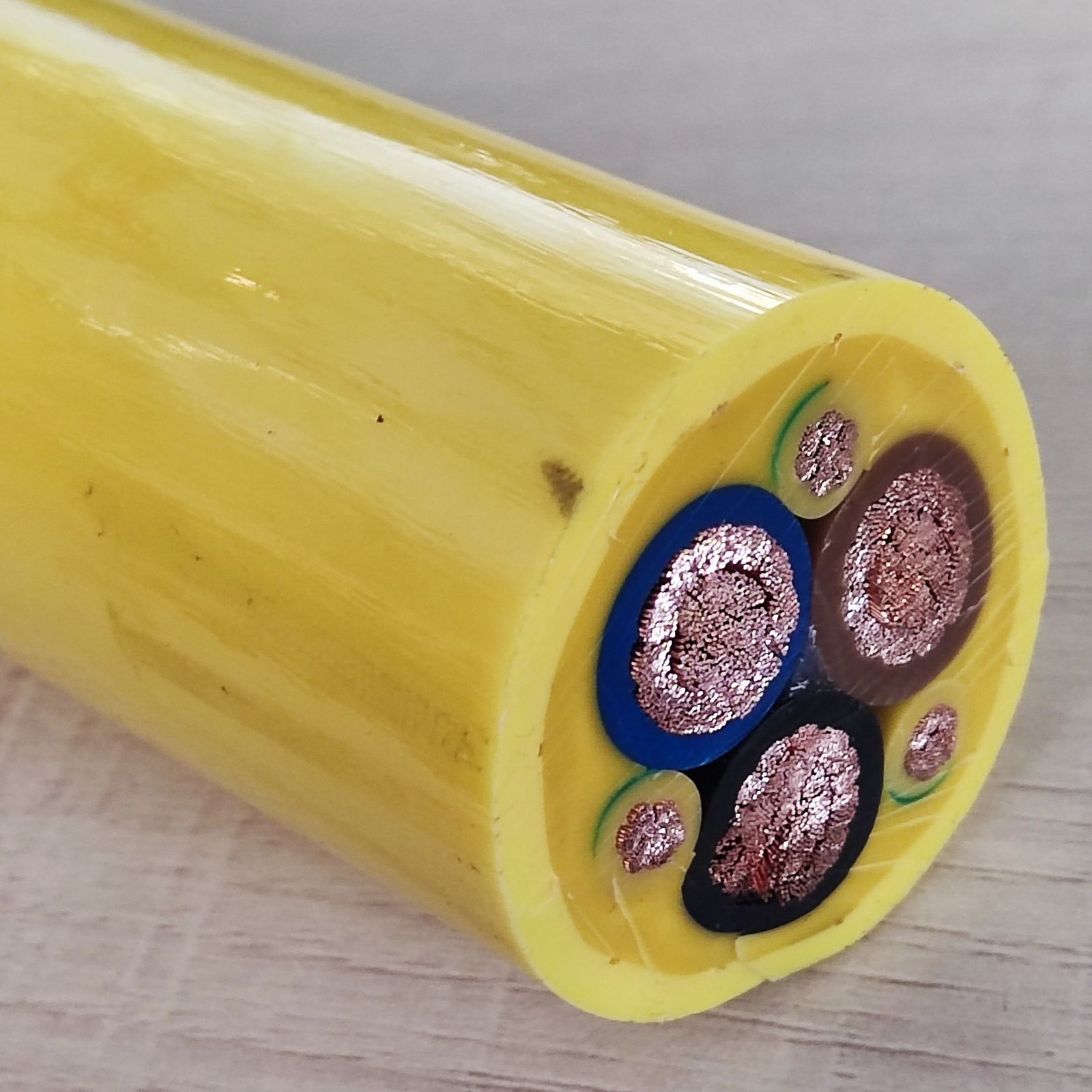
Heavy duty reeling cable engineered for spring-driven and motorized cable reels: IEC 60228 Class 5/6 fine stranded copper, integrated tensile reinforcement (steel wire or Kevlar), CR (neoprene) or PUR jacket for maximum abrasion resistance. 0.6/1 kV to 3.6/6 kV rated, cross-sections 1.5–240 mm², drum-to-cable diameter ratios from 10:1. Compression-resistant core construction prevents drum crushing. Oil, UV, flame, and weather resistant. For container cranes, mining equipment, ship-to-shore gantry, and heavy industrial reeling.

Key Features

Integrated tensile reinforcement: galvanized steel wire rope (500–1 770 N/mm²) or Kevlar (300 N/mm²)
Tensile load capacity: up to 15 kN — supports cable weight on deep-drum reels up to 500 m
Compression-resistant construction: filler-stranded core resists crushing from multiple drum layers
CR (neoprene) jacket: heavy-duty abrasion, oil, flame, and weather resistant — mining industry standard
PUR jacket option: superior abrasion (Taber ≤5 mg), halogen-free, cold-flex to -40°C
0.6/1 kV (standard), 3.6/6 kV (medium voltage for large cranes and mining equipment)
Drum diameter ratio (D/d) from 10:1 — verified reeling life up to 500 000 cycles
CE, RoHS compliant; MSHA and ATEX configurations available for mining and hazardous areas

Applications

Container cranes (STS) — main hoist, trolley traverse, and boom hoist cable reelsShip-to-shore gantry cranes — high-voltage reeling for spreader and trolley powerMining draglines and shovels — trailing and reeling cable for open-cut mining equipmentStacker/reclaimer reels — bulk material handling in ports, steel mills, and power plantsUnderground mining (LHD loaders) — MSHA-compliant reeling cable for mobile equipmentOffshore and marine — deck crane and mooring winch reeling cablesTunnel boring machines (TBM) — high-voltage reeling cable for continuous advanceIrrigation pivot reels — large-diameter reeling for center-pivot and linear-move agricultural systems

Technical Specifications

Conductor — Power Bare copper or tinned copper, IEC 60228 Class 5 (flexible) or Class 6 (extra-flexible)
Conductor — Control Bare copper, IEC 60228 Class 5; 0.75–2.5 mm²
Conductor Cross-Sections (Power) 1.5–240 mm²
Core Insulation EPR (ethylene propylene rubber) for high-voltage; PVC/NBR for low-voltage
Core Identification (Power) Color coded or black with numbers + green-yellow protective conductor
Core Identification (Control) Numbered per VDE 0293 or color coded per DIN 47100
Core Stranding Layered with anti-torsion design; filler elements prevent compression deformation
Tensile Reinforcement Galvanized steel wire rope (central or distributed) or Kevlar aramid fiber
Tensile Load Rating Up to 15 kN (steel); up to 5 kN (Kevlar)
Inner Sheath (Optional) CR or NBR rubber — additional mechanical protection before outer jacket
Outer Jacket — CR (Neoprene) CR, Shore 60–70 A; -25°C to +70°C; heavy-duty oil, flame, weather resistance
Outer Jacket — PUR PUR, Shore 85–90 A; -40°C to +80°C; halogen-free; superior abrasion
Jacket Color — CR Black (standard); yellow RAL 1021 for mining visibility
Jacket Color — PUR Black RAL 9005, Orange RAL 2003
Jacket Surface Smooth or ribbed — ribbed reduces drum-to-drum sticking in wet conditions
Rated Voltage — Standard 0.6/1 kV
Rated Voltage — Medium 3.6/6 kV (for large STS cranes and draglines)
Test Voltage — 0.6/1 kV 3 500 V AC / 5 min
Test Voltage — 3.6/6 kV 11 000 V AC / 5 min
Temperature Range (CR · Moving) -25°C to +70°C
Temperature Range (CR · Fixed) -30°C to +80°C
Temperature Range (PUR · Moving) -40°C to +80°C
Temperature Range (PUR · Fixed) -50°C to +90°C
Drum Diameter Ratio (D/d) 10:1 (minimum); 15:1 (recommended for >50 000 cycles)
Reeling Speed Up to 120 m/min (motorized); up to 60 m/min (spring-driven)
Reeling Life at 15:1 D/d >100 000 cycles (CR jacket); >300 000 cycles (PUR jacket)
Maximum Reel Length Up to 500 m (single-layer equivalent; multi-layer limited by drum capacity)
Abrasion Resistance (PUR) ≤5 mg/1 000 cycles (Taber CS-17, 1 000 g)
Abrasion Resistance (CR) ≤15 mg/1 000 cycles — good, self-extinguishing
Flame Retardant IEC 60332-1-2; VDE 0482-332-1-2; MSHA 30 CFR Part 18 (CR jacket)
Oil Resistance (CR) Good — mineral oil, hydraulic fluid, and grease
Oil Resistance (PUR) Excellent — IEC 60811-404
UV Resistance (CR) Excellent — carbon black reinforced, outdoor rated
UV Resistance (PUR) Excellent — DIN EN ISO 4892-2
Halogen-Free (PUR) IEC 60754-1
Certifications CE, RoHS; MSHA, ATEX on request

Detailed Description

Reeling Cable vs Drag Chain Cable — Fundamentally Different Physics

A drag chain cable is pushed and pulled by the carrier — the cable itself carries near-zero tension. It is guided through a defined bend radius and does not experience compression from being stacked on itself.

A reeling cable is wound onto a drum under mechanical tension. With every winding cycle, the cable:

  • Is pulled from the reel under tension (the weight of the unwound cable + the mechanical drag of the reel)
  • Is bent around the drum at the take-off point
  • Is compressed against the drum by the tension of each subsequent layer wound on top of it
This third force — compression — does not exist in drag chain applications. On a deep-drum reel with 5–10 layers, the innermost cable layer experiences compressive force equal to the tension of all the layers above it. A cable wound at 50 N tension, 10 layers deep on a 500 mm drum, experiences approximately 500 N of radial compressive force on the innermost layer — equivalent to a 50 kg weight pressing on a short section of cable.

Without compression-resistant construction, the cable's core assembly deforms — the round cross-section becomes oval, conductors are crushed, and insulation is permanently compressed. The cable fails from the inside out, with no visible damage to the outer jacket.

Tensile Reinforcement — The Steel Wire Core

Heavy duty reeling cable incorporates tensile reinforcement as a structural component, not an optional add-on. Two options:

Galvanized Steel Wire Rope

  • Embedded as a central core element or distributed strands
  • Tensile capacity: 500–1 770 N/mm² (standard to high-tensile grades)
  • Typical cross-section: 2–10 mm² of steel per 50 mm² of copper conductor
  • Carries the entire tensile load — the copper conductors carry zero tension
  • Galvanized for corrosion resistance in wet and marine environments
  • Reeling cable MUST use steel core: Kevlar is insufficient for heavy-duty reeling

Kevlar Aramid Fiber (Light-Duty Only)

  • Tensile capacity: 300 N/mm²
  • Sufficient for lighter reeling applications (spring-driven reels, <100 m, small cross-sections)
  • Non-conductive — no electrical hazard if it contacts a conductor
  • Lighter than steel — reduced reel drive motor sizing
  • Not suitable for heavy-duty reeling (> 200 m, > 25 mm² conductors, motorized reels)

CR (Neoprene) vs PUR Jacket — The Reeling Decision

PropertyCR (Neoprene)PUR
Abrasion resistanceGood (≤15 mg Taber)Excellent (≤5 mg)
Oil resistanceGoodExcellent
Flame retardantSelf-extinguishing, MSHA approvedIEC 60332-1-2
Cold flexibility-25°C-40°C
Shore hardness60–70 A (softer, rubbery)85–90 A (firmer)
Drum adhesionHigher — less slipping on polished steel drumsLower — smooth surface can slip
WeightHeavier (density ~1.4 g/cm³)Lighter (~1.2 g/cm³)
Mining approvalMSHA 30 CFR Part 18 compliantRequires additional certification
Color optionsBlack (standard), yellow (mining safety)Black, orange
Reeling life at 15:1 D/d>100 000 cycles>300 000 cycles
CR is the traditional mining and heavy crane reeling standard — it has decades of proven field performance, MSHA compliance, and excellent flame safety. PUR is the modern upgrade — it offers 2–3× longer reeling life and better chemical resistance, but may not meet all mining certification requirements.

D/d Ratio — The Critical Design Parameter

The drum-to-cable diameter ratio (D/d) determines reeling life:

D/d RatioReeling Life ExpectancyTypical Application
10:1>10 000 cyclesLow-cycle utility reels, occasional use
12:1>50 000 cyclesModerate-cycle industrial reels
15:1>100 000–300 000 cyclesStandard industrial and crane reeling
20:1>500 000 cyclesHigh-cycle container crane and mining
25:1>1 000 000 cyclesPremium — where reel space and cost permit
Always design for the largest practical drum diameter. The bending stress at the drum take-off point is proportional to 1/(D/d). Doubling the drum diameter cuts the bending stress in half — and can more than double the cable's reeling life.

Why Choose Yichi Cable Heavy Duty Reeling?

  • Steel wire core expertise: We specify the correct steel wire tensile reinforcement for your reel length, cable weight, and winding tension — calculated, not guessed
  • D/d application review: Send us your drum diameter and cable specification — we verify that the D/d ratio meets our recommended minimum for your target reeling life
  • MSHA and ATEX configurations: Mining-approved CR jacket construction for underground and surface mining — with full certification documentation
  • Compression-tested core design: Our filler-stranding system is tested for dimensional stability under simulated multi-layer drum compression — not just in free air
  • Ribbed jacket option: For wet or marine reeling applications where smooth jackets can stick to adjacent drum turns, causing uneven spooling — ribbed surface breaks surface tension

Product Inquiry

Product: Heavy Duty Reeling Cable — High-Tensile Drum-Wound Power and Control Cable for Cranes, Mining, Marine, and Industrial Reeling Applications

Add technical specifications (optional)

The more detail you provide, the faster and more accurate our quotation.

No file chosen

PDF, Office, image or CAD file — up to 5 MB

Need Help?

Certifications

ISO 9001
Quality
CE
European
RoHS
Environmental
TÜV
Certification

Need a Quote for This Product?

Send us your requirements and receive a detailed quotation within 24 hours.