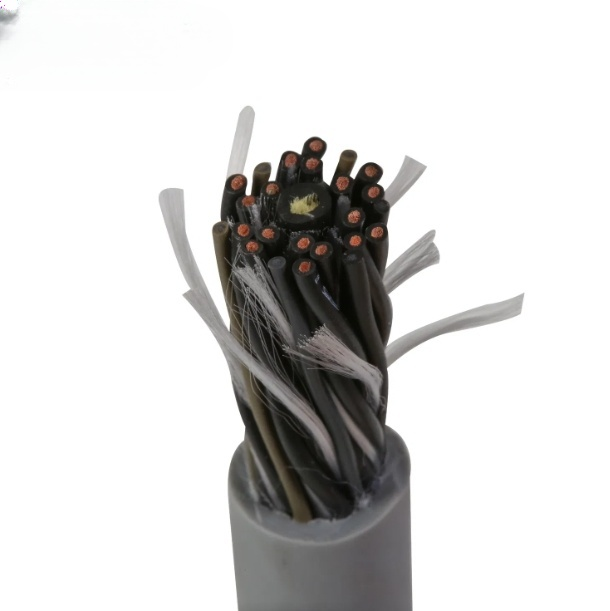
Detailed Description
Mobile Means More Than Bending — Understanding Real-World Motion Profiles
A drag chain cable bends in a controlled, predictable arc. The bend radius is known, the travel distance is fixed, and the speed is programmed. This makes drag chain cable engineering a solvable problem with well-established solutions.
A mobile flexible cable faces fundamentally different challenges:
Festoon Systems — Gravity + Acceleration
In a festoon system, the cable hangs in loops between trolleys. Each loop is a section of cable suspended under its own weight. When the trolley moves, the loops expand and contract. The cable experiences:
- Constant tensile load from its own weight (a 50 m span with 10 loops at 1.5 kg/m cable = 75 kg of suspended weight, distributed across the loops)
- Cyclic bending as loops open and close with trolley movement
- Wind loading (outdoor installations) that causes lateral swing and additional dynamic tension
Cable Reels — Winding Under Tension
On a cable reel, the cable is wound onto a drum under mechanical tension. Each winding/unwinding cycle:
- Compresses the cable against the drum (the inner layers are crushed by the tension of the outer layers — a 100 m drum at 50 N winding tension creates approximately 500 N of compressive force on the innermost layer)
- Bends the cable to the drum radius, which is typically 10–20× the cable diameter (much larger than drag chain bend radii)
- Abrades the jacket against adjacent cable turns and the drum flange
Portable and Handheld — Random Flex
Portable cables are bent, twisted, and pulled in unpredictable ways by human operators and moving machinery. There is no defined bend radius, no predictable cycle count, and no guarantee that the cable is not being stepped on, run over, or caught in pinch points.
A mobile flexible cable must handle all of these — not just one.
Tensile Reinforcement — The Hidden Engineering
The single most important design feature that separates a mobile flexible cable from a drag chain cable is tensile reinforcement. In a drag chain, the cable is pushed and pulled by the carrier — the cable itself carries near-zero tensile load. In mobile applications, the cable IS the load-bearing element.
Option 1: Integrated Kevlar (Aramid) Fiber
Kevlar fibers are stranded into the cable core or laid parallel under the jacket. Key properties:
- Tensile strength: 300 N/mm² — equivalent to carrying a 30 kg weight per square millimeter of Kevlar cross-section
- Elongation at break: 2.4% — very low stretch, maintains cable geometry under load
- Non-metallic: No corrosion, no electrical hazard, lighter than steel
- Application: Festoon systems, portable cables, stage equipment — where weight matters and electrical isolation is required
Option 2: Integrated Galvanized Steel Wire
Steel wire strands are embedded in the cable core or laid as a central messenger. Key properties:
- Tensile strength: 500 N/mm² (standard) to 1 770 N/mm² (high-tensile)
- Elongation: ~1% (even less stretch than Kevlar)
- Larger spans: The higher tensile strength enables self-supporting spans up to 80 m
- Application: Long-span festoon systems, cable reels, mining trailing cables — where maximum strength-to-cost ratio matters
Option 3: External Steel Wire Messenger (Flat Cables)
For flat festoon cables, a separate galvanized steel wire rope is vulcanized into the cable's edge. The steel wire carries 100% of the tensile load; the cable conductors carry zero tension. This is the most reliable long-span solution.
Flat vs Round — Geometry Dictates Application
| Cable Geometry | Best For | Advantage | Disadvantage |
|---|---|---|---|
| Round | Cable reels, portable, general mobile | Universal; fits standard cable glands; coiling naturally follows drum curvature | Higher wind profile in festoon; stacks poorly on drums |
| Flat | Festoon systems, suspended arrays | Stacks neatly in festoon loops; lower wind profile; external steel messenger possible; organized conductor arrangement | Not suitable for reeling (twists on drum); limited to specific connector types |
Jacket Selection for Mobile Applications
The jacket material for mobile cables must balance flexibility, abrasion resistance, environmental resistance, and weight:
| Jacket | Flexibility | Abrasion | Oil | UV | Weight | Flame | Best Application |
|---|---|---|---|---|---|---|---|
| NBR-PVC | Good | Good | Moderate | Good (w/ CB) | Medium | Yes (self-ext.) | General festoon, portable |
| PUR | Excellent | Excellent | Excellent | Excellent | Light | Yes (halogen-free) | Outdoor festoon, harsh environments |
| CR (Neoprene) | Good | Good | Good | Good | Heavy | Yes (self-ext.) | Mining, welding, high-heat |
| EPR (Rubber) | Excellent | Moderate | Poor | Poor (needs jacket) | Heavy | Yes | Reeling, torsion applications |
Reeling Cable Specifics — Drum Diameter Ratio
For cable reel applications, the most critical parameter is the drum-to-cable diameter ratio (D/d):
- D/d ≥ 20: Standard reeling — most mobile flexible cables perform well
- D/d 15–20: Frequent reeling — specify enhanced flexibility construction
- D/d 10–15: High-cycle reeling — specify premium construction with finer stranding and optimized lay lengths
- D/d < 10: Not recommended without custom engineering — contact us
Why Choose Yichi Cable Mobile Flexible?
- Application-matched design: We do not sell a single "mobile cable." We configure conductor stranding, tensile reinforcement type, jacket material, and cable geometry (flat/round) based on your specific application — festoon, reel, or portable
- Tensile load calculation: For festoon and suspended applications, our engineering team calculates the required tensile reinforcement based on your span length, cable weight, and wind loading (outdoor installations)
- Drum ratio review: For reeling applications, we verify that your drum diameter is compatible with the selected cable construction — preventing premature failure from excessive bending stress
- Flat cable integration: We can vulcanize steel wire messengers directly into flat cable edges — eliminating the need for separate support cables and trolley clamps
- Mining and hazardous area variants: CR jacket and enhanced flame retardant options available for underground mining (MSHA-compatible) and ATEX Zone 2 applications