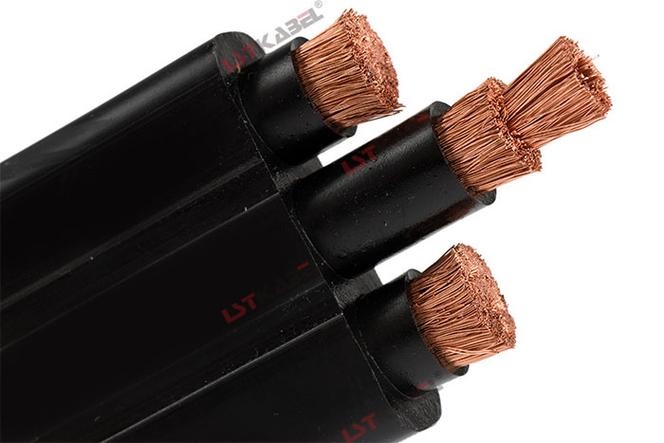
Detailed Description
Why Flat? — The Drum Space Economics
A round cable wound onto a drum creates unavoidable voids — the triangular gaps between adjacent turns where three circular cross-sections meet. These voids occupy approximately 10–15% of the drum's winding volume — space that could be filled with cable but is instead wasted on air.
A flat cable wound onto the same drum has zero voids — each turn sits flush against the turn below and adjacent to it, like stacking sheets of paper. For the same drum dimensions, a flat cable packs 30–50% more cable length than round cable of equivalent copper cross-section.
This matters when:
- Drum diameter is fixed (existing equipment, limited space) and you need to increase cable length
- Cable length is fixed (required reach) and you want to use a smaller drum to save space and cost
- Multiple cables share one drum — flat cables separate cleanly with no tangling
Turn-to-Turn Compression — Why Flat Is Gentler on the Cable
In a round cable reel with multiple layers, each upper layer presses on the lower layer at point contacts — the curved surface of one round cable touching the curved surface of the one below. All the compressive force concentrates on a tiny contact patch. On a deep-drum reel with high winding tension, this point loading can crush the core assembly and deform the conductors.
A flat cable distributes the same compressive force across the entire width of the cable's flat surface — not a point, not a line, but a full surface contact area equal to the cable width × the turn-to-turn overlap. The compressive stress (force ÷ area) is an order of magnitude lower. The core assembly experiences much less deformation for the same drum winding tension.
Integrated Steel Messenger — The Edge That Carries the Load
Flat reeling cable incorporates galvanized steel wire ropes vulcanized into both edges of the flat profile. These steel messengers serve two functions:
1. Tensile Load Carrier
The steel wires carry 100% of the tensile load during winding and unwinding. The copper conductors carry zero mechanical tension — they only carry electrical current. This separation of electrical and mechanical functions is the defining feature of a properly engineered reeling cable.
2. Anti-Twist Stabilizer
The dual-edge messenger design prevents the flat cable from twisting as it spools onto the drum. A round cable can rotate around its longitudinal axis during winding — causing uneven layering and abrasion. The flat geometry + edge messengers makes this physically impossible.
Flat vs Round — Reeling Comparison
| Round PUR Reeling Cable | PUR Flat Reeling Cable | |
|---|---|---|
| Drum packing density | 85–90% (10–15% void) | 100% (zero void) |
| Cable length on same drum | Baseline | +30–50% more |
| Turn-to-turn compression | Point contact — high stress | Surface contact — low stress |
| Tensile load carrier | Central steel core | Dual edge messengers |
| Twist during spooling | Possible — round geometry can rotate | Impossible — flat geometry + edge wires |
| Bend direction | Any direction | Flat plane only — bends like a ribbon |
| Multiple cables on one drum | Can tangle | Stack neatly — no tangling |
| Cost | Lower | Higher — flat extrusion + dual messengers |
| Best for | Standard reeling, deep drums | Space-limited drums, multiple cables |
Why Choose Yichi Cable PUR Flat Reeling?
- Edge messenger engineering: We calculate the required steel wire cross-section based on your drum depth, cable weight, and winding tension — the messengers are sized to your application, not a generic one-size standard
- Vulcanized messenger bonding: The steel wires are vulcanized (chemically bonded) into the PUR jacket — not mechanically trapped. Vulcanization prevents the messenger from slipping relative to the jacket under sustained tension
- Flat jacket extrusion expertise: Extruding a flat PUR jacket with uniform thickness across a wide profile requires precise die design and process control — it is more difficult than round extrusion. We have the expertise
- Drum compatibility review: Send us your drum diameter, width, flange height, and required cable length — we calculate the exact flat cable dimensions that optimize your drum's capacity