Detailed Description
Waste Environment — The Chemical Challenge
A waste bunker is a chemically aggressive environment unlike any other industrial application:
- Leachate: Liquid that percolates through waste — contains organic acids (acetic, propionic, butyric), ammonia, and dissolved metals. pH typically 3–6. Attacks standard cable jackets
- Methane and H₂S: Anaerobic decomposition generates methane (flammable) and hydrogen sulfide (corrosive to copper). The cable must not contribute to explosion risk — halogen-free materials, anti-static jacket
- Constant moisture + heat: Biological activity generates heat (30–50°C typical in waste bunkers) and moisture. The cable is essentially in a warm, humid, acidic atmosphere continuously
- Abrasive debris: Mixed waste contains glass shards, metal fragments, and construction debris — the cable jacket must resist both chemical attack AND mechanical abrasion simultaneously
Why Standard Cable Materials Fail
| Material | Waste Environment Performance | Failure Mode |
|---|---|---|
| PVC | ❌ Degrades in weeks | Plasticizer extraction by organic acids → embrittlement |
| CR (neoprene) | ⚠️ Degrades in months | Swells in organic acids, loses mechanical properties |
| Polyester PUR | ❌ Degrades in months | Hydrolysis from constant moisture + heat → jacket disintegration |
| Polyether PUR (this cable) | ✅ >5 years | Chemically stable, hydrolytically resistant, microbe resistant |
Material and Design Choices
- Polyether PUR only: We default to polyether PUR for waste applications — polyester PUR will fail in this environment
- Stainless steel tensile core: Galvanized steel corrodes in acidic leachate — stainless steel eliminates this failure mode
- Tinned copper throughout: Every conductor is tinned — H₂S in waste bunkers attacks bare copper, forming non-conductive copper sulfide
- Smooth, low-adhesion jacket: Solid lubricant additives reduce waste debris sticking to the cable — easier to clean, less abrasive drag
Combined Power and Control in a Single Cable
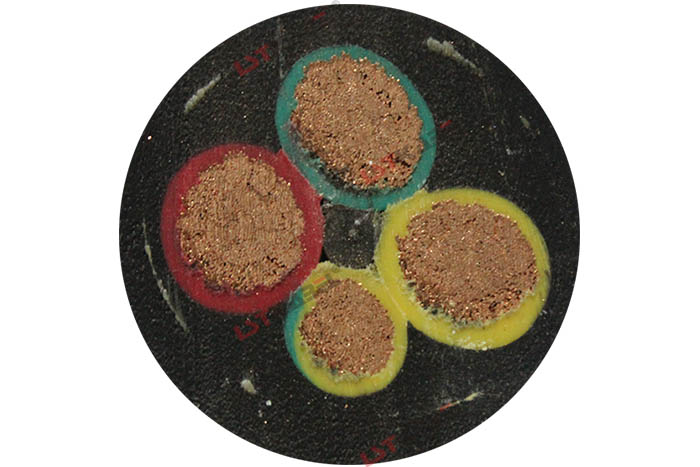
This cable integrates the power cores and the control cores in one construction rather than running them as separate cables. The power cores, supplied in 10-95 mm², feed the grab hoist motor and the grab open/close motor. The control cores, supplied in 0.75-2.5 mm² with 4-18 cores, carry the signals for the limit switches and the directional valves that operate the grab. Keeping power and control together means one cable is reeled on the drum, one termination at the crane junction box, and one specification to maintain. In the waste environment a single corrosion-proof cable is simpler to inspect and clean than several separate cables.
The EPR core insulation is used because it resists the moisture and chemical exposure found in waste bunkers while keeping the flexibility needed for continuous reeling. The polyether-based PUR outer jacket carries solid lubricant additives that lower waste debris adhesion and give a smooth surface that is easier to wash down during maintenance.
Reeling Geometry and Mechanical Construction
The cable is reeled on a drum with a minimum D/d ratio of 10:1. At this bending diameter the conductors and the stainless steel tensile core are flexed repeatedly with every grab cycle. The tensile core carries the mechanical tension of the hanging cable loop and also serves as the equipment earth path. Stainless steel is specified because galvanized steel would corrode in acidic leachate, and the same reasoning applies to the tinned copper conductors, which resist the copper sulfide that hydrogen sulfide forms on bare copper.
The stated grab cycle life exceeds 150 000 cycles. This reflects the combined effect of the flexible Class 6 conductor stranding, the EPR insulation compression recovery, and the abrasion-resistant PUR jacket surviving glass, metal, and construction debris in mixed waste streams.
Installation Environment and Safety
The halogen-free jacket per IEC 60754-1 limits corrosive and toxic gas emission if the cable is involved in a fire inside an enclosed waste handling building where personnel and equipment are concentrated. The operating temperature range is -30 °C to +80 °C, which covers cold outdoor bunker tops as well as the warm, humid atmosphere generated by biological activity in the waste mass.
For waste bunkers where the grab duty is combined with submerged or marine exposure, other grab crane cable variants in the same product family address those conditions.