Detailed Description
Grab Crane — Two Motors, One Cable
A grab crane operates two independent motor groups through a single suspended cable:
- Hoist motor: Raises and lowers the entire grab assembly — typically the larger motor (50–200 kW)
- Grab open/close motor: Operates the clamshell bucket or orange-peel grab — opens to release material, closes to grip it
The combined power cable typically has 7 power cores (3 hoist + 3 grab + 1 PE) or 8 (3 + 3 + 1 PE + 1 additional), plus 4–24 control cores for limit switches, position sensors, and grab status feedback.
Why Grab Cables Fail Faster Than Standard Hoist Cables
| Stress Factor | Standard Hoist Cable | Grab Cable |
|---|---|---|
| Bend cycles per hour | 10–20 | 40–120 |
| Number of powered functions | 1 (hoist) | 2 (hoist + grab) |
| Core count | 4–5 | 11–30+ |
| Cable dynamics | Linear up/down | Up/down + grab open/close oscillation |
| Material contact | None (suspended) | Bulk material dust, scrap edges |
The grab cable's higher core count, faster cycling, and grab mechanism oscillation create internal core movement that accelerates insulation wear. The PET fleece inter-layer separation between power and control core groups is essential for preventing control core failures.
Grab Cable Construction Notes
- Grab-specific core arrangement: Power and control cores physically separated by PET fleece layer — prevents control core damage from adjacent power conductors
- Class 6 conductor standard: Finer stranding than Class 5 — the additional flexibility is necessary for grab cycle frequencies
- Grab cycle tested: Our rated life is based on simulated grab cycle testing — hoist + open/close combined motion, not just linear reeling
- PUR jacket standard for bulk material: Coal, ore, grain, scrap — PUR handles the abrasive dust better than CR
Power and Control Core Layout
The combined cable carries power for two motor groups and the signals that coordinate them. The power group uses between 7 and more typical power cores: three for the hoist motor (U or V or W), three for the grab motor (U or V or W), and one protective earth. The control group uses 4 to 24 cores, sized 0.75 to 2.5 mm², carrying limit-switch and position-sensor feedback and grab-status signals between the crane controller and the grab mechanism. Power conductors use IEC 60228 Class 6 copper in cross-sections from 10 to 120 mm².
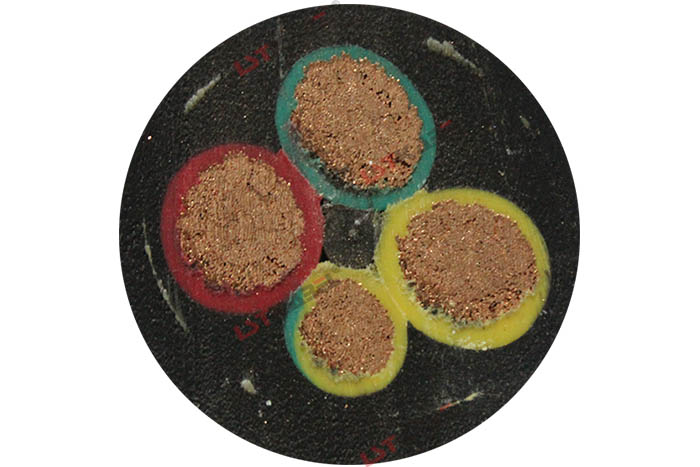
The two core groups are not mixed at random. They are laid in concentric formations with a PET fleece layer between the power and control groups. That separator is functional: during the grab cycle the power cores carry switching currents and move as the cable flexes, and without the fleece the control-core insulation would be abraded by the adjacent larger conductors. Core insulation is ethylene propylene rubber for the power cores and polypropylene for the control cores, both chosen for flexibility and abrasion resistance under continuous cyclic bending.
Jacket Selection and Mechanical Loading
The outer jacket is either PUR or CR. PUR is the standard for bulk-material service: coal, ore, grain, and scrap expose the cable to abrasive dust and sharp scrap edges, and the PUR compound is rated for Taber abrasion of 5 mg or less. CR neoprene is offered for heavy-duty service and, on request, with MSHA recognition for mining environments. Both jackets resist oil and weather. PUR is rated -40 °C to +80 °C and CR -25 °C to +70 °C, so the choice also follows the lowest ambient temperature at the installation.
Suspended weight and dynamic grab loading are carried by a central galvanized steel wire rope tensile core, which keeps the copper conductors from stretching. An optional CR rubber inner sheath can be applied over the core assembly for additional mechanical protection.
Drum Geometry and Cycle Life
The cable is designed for motorized drum reeling at a drum-to-cable diameter ratio (D or d) of at least 10 to 1, with 12 to 1 recommended. A larger D or d reduces the bend curvature at the drum and is the single biggest factor in extending flex life. The rated grab-cycle life is more than 200 000 combined open or close and hoist cycles, a figure that reflects the dual bending regime of a grab crane: the cable flexes on every hoist stroke and on every grab open or close stroke, at a bend-rate several times that of a standard single-function hoist cable. Rated voltage is 0.6 or 1 kV with a 3 500 V AC test voltage, and the jacket is flame retardant to IEC 60332-1-2.