Descrição Detalhada
What a Battery Connection Lead Has to Survive
A battery lead lives in a hostile place for a cable. It sits next to a lead-acid battery that vents acid mist, it is bent into a tight radius to reach the post, it carries the starter current for a few seconds at a time, and it is often exposed to engine heat or to the inside of a storage cabinet.
Four failure modes follow from that, and the construction addresses each one:
- Oxidation at the lug — acid mist and damp attack the copper at the crimp, raising the joint resistance until it heats. A tinned conductor and a tin-plated lug both resist that.
- Stiffening of the insulation — a PVC lead hardens at low temperature and cracks where it is bent. A silicone lead stays flexible across −60 °C to +200 °C.
- Abrasion against the tray — the lead rubs where it passes an edge. The PP conduit takes the wear instead of the silicone.
- Heating at the terminal — the lug is the narrowest part of the current path. A thickened copper lug carries the start current without a hot spot at the crimp.
Construction: Silicone, Tinned Copper, and the Lug Stack
The lead is built as an assembly rather than as bulk cable, and the layers run from the conductor out to the terminal hardware:
- Conductor — oxygen-free tinned copper in a fine stranding. The stranding is what allows the lead to be bent into a tight radius at the post without work-hardening the copper.
- Insulation — extra flexible silicone rubber, rated −60 °C to +200 °C. The silicone is what keeps the lead workable in a cold battery bay and stable next to engine heat.
- Conduit — PP flame retardant corrugated sleeve over the silicone. It is the abrasion barrier, and it also adds a layer of flame resistance along the run.
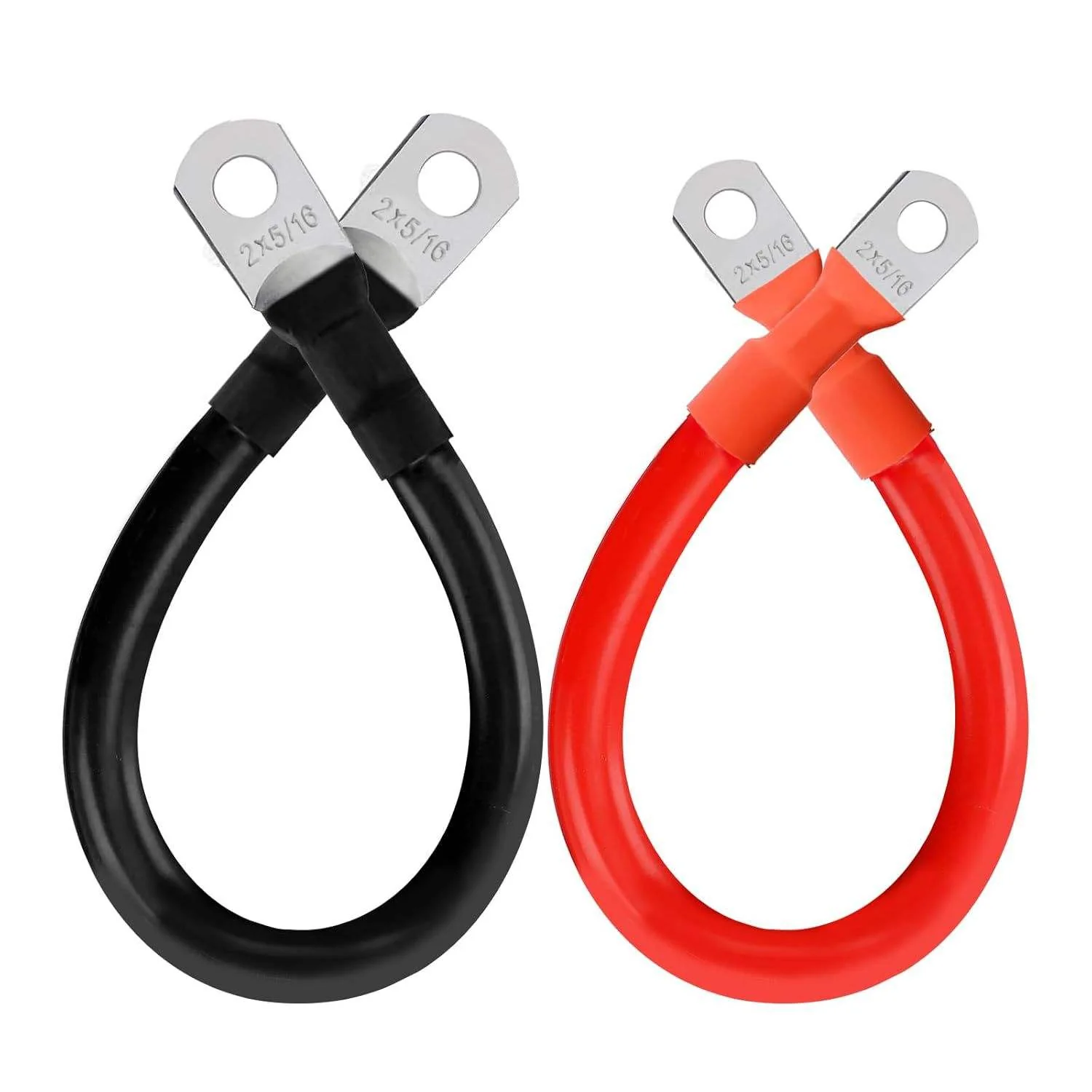
- Lug — SC series copper lug in thickened A-grade copper with a tin plating. The tin is there for the acid mist, not for conductivity.
- Clamp — brass terminal clamp, tin plated, with a steel screw. The brass body carries the current and the steel screw holds the clamp closed without stripping.
Ratings and Sizes
| Parameter | Value |
|---|---|
| Rated voltage | 600 V |
| Test voltage | 600 V |
| Temperature range | −60 °C to +200 °C |
| Sizes | 4 AWG (25 mm²), 3 AWG (33.7 mm²), 2 AWG (50 mm²) |
| Conductor | Oxygen-free tinned copper |
| Insulation | Silicone rubber |
| Outer protection | PP flame retardant conduit |
| Lug | SC copper, A-grade, thickened, tin plated |
| Lug matching | SC35-8 / SC50-8 / SC70-8 |
| Lug bore | M8 standard; M10, M12 on volume orders |
| Negative clamp | 15–17 mm internal diameter |
| Positive clamp | 17–19 mm internal diameter |
| Colours | Red and black |
| Standards | EN 50525-1, EN 50525-2-41, EN 50525-2-83; CE per 2014/35/EU |
The 600 V rating is worth noting for a lead that most people associate with a 12 V battery. It is the class required where the lead becomes part of a series string in a storage system, and it is what separates this assembly from a low-voltage automotive jumper lead.
Terminal Options and Custom Lengths
The lead is assembled to order, so three items are specified rather than selected from a stock list:
- Length, measured from lug face to lug face rather than along the cable
- Lug bore, M8 as standard, with M10 and M12 available for volume orders
- Clamp size, 15–17 mm for the negative post and 17–19 mm for the positive post
Certification and Ordering
The cable is built to EN 50525-1, EN 50525-2-41, and EN 50525-2-83, and carries CE under the Low Voltage Directive 2014/35/EU. A test report is available. For a project outside the EU, confirm which certification the destination market requires, because the marking follows the market rather than the construction.
Assembled leads are packed to order, and bulk cable is supplied on a 100 m coil with lengths below 100 m as measured cut lengths.
To specify the lead, send the length, the battery post size, the lug bore, and the nominal current the lead will carry. Those four items fix the conductor size, the lug, and the clamp, and the assembly is quoted against them through the enquiry form on this page.