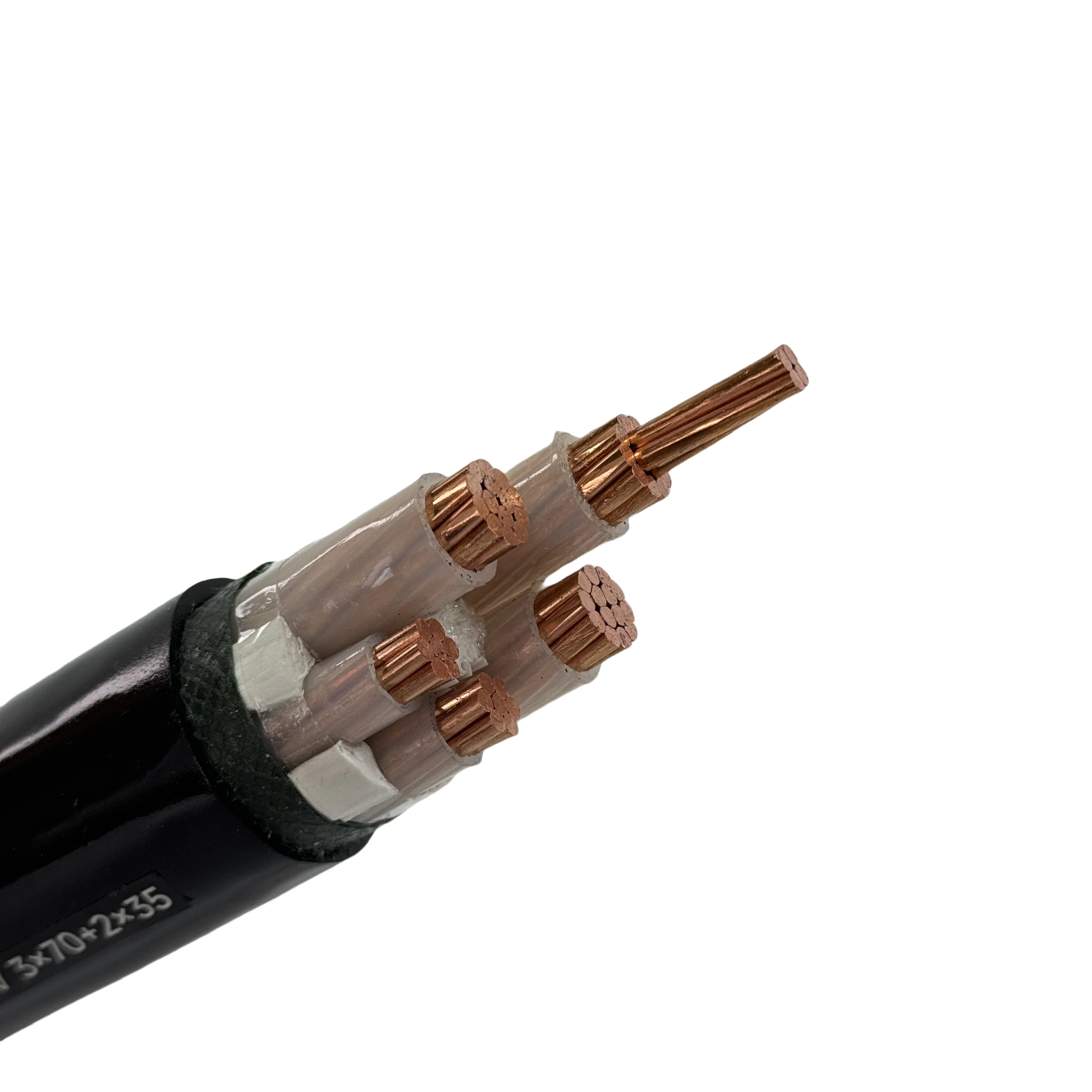
YJV XLPE Power Cable 0.6/1kV — Copper-Core XLPE Insulated PVC Sheathed Power Cable, 1 to 5 Cores, 2×10 to 4×400 mm², with Double Water Barrier for Distribution, Charging Piles, and Plant Power
Cabluri de Putere și Înaltă Tensiune /XLPE Power Cable

YJV XLPE Power Cable 0.6/1kV — Copper-Core XLPE Insulated PVC Sheathed Power Cable, 1 to 5 Cores, 2×10 to 4×400 mm², with Double Water Barrier for Distribution, Charging Piles, and Plant Power

YJV XLPE power cable 0.6/1kV: copper conductor, XLPE insulation, PVC sheath, 1 to 5 cores from 2×10 to 4×400 mm², double water barrier, for distribution and charging piles.

Caracteristici Principale

0.6/1 kV rating with a 1.2 kV maximum working voltage — the standard LV distribution class for plant power, building services, and charging pile supplies
XLPE insulation instead of PVC — cross-linked polyethylene holds 90 °C at the conductor where a PVC cable is limited to 70 °C, so the same cross-section carries more current or the same current runs cooler
Short-circuit withstand to 250 °C for up to 5 seconds — the XLPE insulation tolerates the fault current window that a PVC cable cannot, which matters on a circuit protected by a breaker with a definite trip time
99.9% oxygen-free copper conductor — low resistance along the run, which keeps the voltage drop inside the limits of a long distribution circuit
Double water barrier — an internal water-blocking wrap plus the outer sheath, so moisture travelling along the cable is stopped before it reaches the conductor
Tensile-resistant filler — the filler holds the core assembly together under pulling tension during installation in a duct or a trench
Low eccentricity extrusion — an even insulation wall around each core is what prevents the thin spot that becomes the breakdown point under impulse voltage
1 to 5 cores from 2×10 up to 4×400 mm² — the range covers a single-core feeder, a three-phase run, and a four-core plus neutral distribution cable

Aplicații

Charging pile supply — the fixed distribution cable feeding an AC or DC charging station from the switchboardPlant and factory distribution — sub-main and final circuit power cable in industrial buildings and workshopsStreet lighting circuits — outdoor lighting feeders where the cable is buried or run in a ductProject distribution — sub-main cabling in commercial and infrastructure projectsConstruction site power — temporary and semi-permanent distribution where the cable is exposed to weather and handlingHeavy industry and machinery — power feeders in energy, heavy engineering, and mechanical manufacturing plants

Specificații Tehnice

Product Type XLPE insulated PVC sheathed power cable
Type Designations YJV; YJV22 (steel tape armoured); YJLV; YJLV22
Rated Voltage (U0/U) 0.6/1 kV
Maximum Working Voltage 1.2 kV
Test Voltage 3500 V
Conductor Material Oxygen-free copper, 99.9% purity
Insulation XLPE (cross-linked polyethylene)
Sheath PVC (polyvinyl chloride), black
Core Count 1, 2, 3, 4, and 5 core
Cross-Section Range 2×10 mm² up to 4×400 mm²
Operating Temperature −5 °C to +70 °C (ambient); maximum conductor temperature 70 °C to 90 °C
Short-Circuit Temperature 160 °C to 250 °C, maximum 5 seconds
Minimum Installation Temperature 0 °C or above
Minimum Bending Radius 15 × cable diameter
Recommended Maximum Pulling Stress 50 N/mm²
Water Barrier Internal water-blocking wrap plus outer sheath, double barrier
Filler Tensile-resistant filler holding the core assembly
Eccentricity Low eccentricity, even insulation wall
Marking Metre marking and product designation printed on the sheath
Standards (as listed in source data) IEC 60227-5; GB/T 9330-2008; conductor per IEC 60228 — confirm the governing standard on the contract drawing
Certifications CE, ISO; national standard (GB) construction
Packing 100 m per coil; lengths below 100 m supplied as measured cut lengths
Application Charging pile supply, plant distribution, street lighting, project distribution, construction site power, heavy industry

Descriere Detaliată

What 0.6/1 kV XLPE Cable Is Used For

The 0.6/1 kV class is the working voltage of low-voltage distribution: the cable that runs from a switchboard to a sub-board, from a sub-board to a machine, or from a distribution board to a charging pile. It is not a transmission cable and not a control cable — it carries the load current at the voltage the equipment actually uses.

What separates this cable from a PVC distribution cable is the insulation. XLPE — cross-linked polyethylene — holds 90 °C at the conductor where PVC is limited to 70 °C, and it tolerates a short-circuit temperature of up to 250 °C. Both numbers translate into either more current for the same cross-section or a longer life for the same current.

Construction: Copper, XLPE, Filler, and Sheath

The cable is built in five layers, and the sequence matters as much as the materials:

  • Conductor — oxygen-free copper at 99.9% purity, stranded. The low resistance is what keeps the voltage drop inside the limit on a long distribution run.
  • Insulation — XLPE, extruded at a low-eccentricity wall around each core. The evenness of the wall is the property that resists impulse breakdown; a nominal thickness with a thin side fails at the thin side.
  • Filler — a tensile-resistant filler holds the core assembly together. It is what allows the cable to be pulled into a duct without the cores spreading.
  • Water barrier — an internal water-blocking wrap sits under the sheath, so moisture that enters through a sheath damage is stopped before it travels along the cable to the conductor.
  • Sheath — PVC in black, applied over the assembly. It is the mechanical and moisture barrier, and it carries the metre marking and the product designation.
The steel tape armour in the YJV22 variant sits between the inner layers and the sheath; it is specified where the cable is buried where digging or rodent damage is a risk.

Electrical and Installation Limits

ParameterValue
Rated voltage (U0/U)0.6/1 kV
Maximum working voltage1.2 kV
Test voltage3500 V
ConductorOxygen-free copper, 99.9%
InsulationXLPE
SheathPVC, black
Operating temperature−5 °C to +70 °C ambient; 70–90 °C conductor
Short-circuit temperature160–250 °C, max 5 s
Minimum installation temperature0 °C
Minimum bending radius15 × diameter
Maximum pulling stress50 N/mm²
Core count1 to 5
Cross-section2×10 to 4×400 mm²

Two of these limits are installation limits rather than electrical ones, and they are the ones that fail on site. The 0 °C minimum installation temperature means the cable should not be bent cold; the 15 × diameter bending radius means a tight pull around a corner needs a larger sweep or a pre-formed bend.

Reading the Cross-Section and Core Range

The range runs from 2×10 mm² to 4×400 mm² across one-, two-, three-, four-, and five-core builds. The pattern is straightforward: a single-core cable for a feeder run, a three-core cable for a three-phase circuit without a neutral, a four-core cable for three-phase plus neutral, and a five-core cable where a separate earth core is carried.

The cross-section is not selected from the current alone. A cable installed in air dissipates heat differently from a cable buried in soil, and a cable grouped with others in a duct runs hotter than a single cable. The load current, the run length, and the installation method are chosen together.

Standards, Lengths, and Ordering

The source data lists IEC 60227-5, GB/T 9330-2008, and a conductor to IEC 60228. Because acceptance on a project is measured against the standard named in the specification, the governing standard should be stated on the contract drawing before the order is placed rather than inferred from the cable type.

Supply is a 100 m coil, with lengths below 100 m as measured cut lengths. The sheath carries metre marking, so a cut length can be verified on site.

To specify the cable, five items decide the build: the number of cores, the cross-section, the installation method, the run length, and whether armour is required. Send them through the enquiry form on this page, together with the standard the project is inspected against, and the build is confirmed against those inputs.

Întrebări Frecvente

Why choose XLPE insulation instead of PVC for the same 0.6/1 kV duty?

The conductor temperature. A PVC insulated cable is limited to 70 °C at the conductor, and an XLPE cable holds 90 °C. For the same cross-section, that difference is additional current capacity; for the same current, it is a cooler conductor and a longer service life. XLPE also tolerates a short-circuit temperature of up to 250 °C, where PVC is limited well below that.

What do the YJV, YJV22, YJLV, and YJLV22 designations mean?

The letter pattern follows the Chinese cable naming convention: YJ for cross-linked polyethylene insulation, V for PVC sheath, L for aluminium conductor, and 22 for steel tape armour. So YJV is a copper-core XLPE cable with a PVC sheath, YJV22 adds steel tape armour, and the YJLV variants use an aluminium conductor instead of copper.

What is the minimum bending radius during installation?

Fifteen times the cable diameter, and the installation temperature must be 0 °C or above. Below that temperature the sheath becomes stiff and the insulation can crack at the bend. The recommended maximum pulling stress is 50 N/mm², which sets the limit for a duct pull.

How do I read the cross-section and core range for my circuit?

The range runs from 2×10 mm² to 4×400 mm² in one-, two-, three-, four-, and five-core builds. The cross-section is selected from the load current, the run length, and the installation method, because a cable in air and a cable buried in soil dissipate heat differently. State the load, the length, and whether the route is in air, in a duct, or direct buried.

Which standard governs this cable?

The source data lists IEC 60227-5, GB/T 9330-2008, and a conductor to IEC 60228. The standard a project is inspected against should be stated on the contract drawing before the order is placed, because acceptance is measured against the named standard rather than against the cable type.

Întrebare Produs

Produs: YJV XLPE Power Cable 0.6/1kV — Copper-Core XLPE Insulated PVC Sheathed Power Cable, 1 to 5 Cores, 2×10 to 4×400 mm², with Double Water Barrier for Distribution, Charging Piles, and Plant Power

Adăugați specificații tehnice (opțional)

Cu cât ne oferiți mai multe detalii, cu atât oferta noastră va fi mai rapidă și mai precisă.

Niciun fișier selectat

Fișier PDF, Office, imagine sau CAD — până la 5 MB

Aveți Nevoie de Ajutor?

Certificări

ISO 9001
Calitate
CE
Europeană
RoHS
De Mediu
TÜV
Certificare

Aveți Nevoie de o Ofertă pentru Acest Produs?

Trimiteți-ne cerințele și primiți o ofertă detaliată în 24 de ore.