Detaljerad Beskrivning
What EVR Cable Is, and Where It Sits in an EV Harness
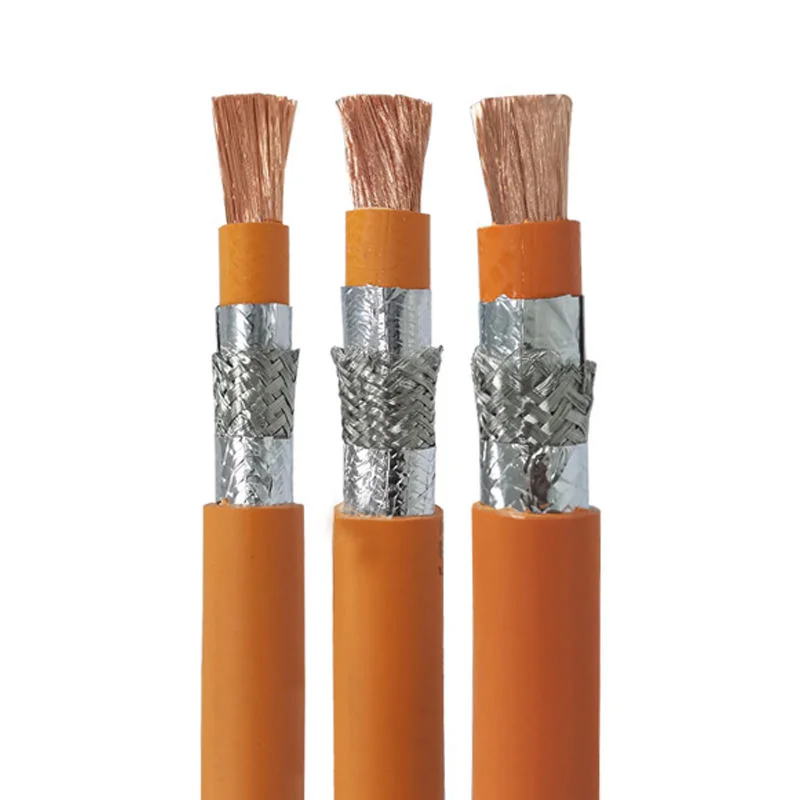
EVR is a single-core, unscreened high voltage cable rated 1500 V, built with an oxygen-free copper conductor and an XLPE sheath. It is the base cable of an electric vehicle high voltage harness: the conductor that carries the pack current, without the braid or foil layer that the screened EVRP type adds.
The distinction between the two is the point of this page. A screened cable is not automatically better — it is heavier, stiffer, and slower to terminate, and the screen only earns its place where there is an interference field to block. Inside a battery pack, or on a DC link that runs in its own enclosure, an unscreened cable is the simpler and more appropriate answer.
The construction range covers 2.5 mm² to 240 mm², so the same cable type serves a small control run and a 240 mm² main pack cable.
Construction: Oxygen-Free Copper and an XLPE Sheath
The cable is a two-layer build, and both layers are chosen for the temperature and the environment rather than for the voltage alone:
- Conductor — multi-strand high-purity oxygen-free copper. The stranding keeps the cable workable at large cross-sections, where a solid conductor of 240 mm² would be impossible to route.
- Sheath — XLPE, cross-linked polyethylene. The cross-linking is what allows the sheath to hold its dielectric strength and its shape at 125 °C; a thermoplastic polyethylene would soften at that temperature.
Two properties come from the XLPE compound rather than from the copper: resistance to oil, and resistance to ultraviolet light and water. The cable can sit in oil long term without hardening or cracking, and it survives sunlight and rain on an exposed route.
Electrical and Environmental Ratings
| Parameter | Value |
|---|---|
| Rated voltage | 1500 V |
| Cross-section range | 2.5–240 mm² |
| Conductor | Multi-strand oxygen-free copper |
| Sheath | XLPE |
| Temperature range | −40 °C to +125 °C |
| Low temperature | Flexible at −40 °C, no hardening |
| High temperature | Does not burn at 125 °C |
| Flame behaviour | Self-extinguishing |
| Oil resistance | Continuous immersion |
| Immersion test | Flexible after 60 days |
| Weather | UV, water, sunlight resistant |
| Standard colours | Orange, black |
| Standard length | 100 m per coil |
| Certification | IATF 16949 |
The low-temperature figure is worth reading alongside the high-temperature one. A sheath that stays flexible at −40 °C is what allows the cable to be installed and serviced in a cold climate without cracking at the bend, and it is the property that separates a cross-linked compound from a plasticised PVC.
Unscreened Versus Screened: Choosing Between EVR and EVRP
The choice between the two types is a question about the route, not about the voltage class — both are 1500 V cables.
Choose the unscreened EVR where the cable runs inside a pack enclosure, inside a screened cabinet, or on a DC link in a benign interference environment. In those places the screen has nothing to block, and the unscreened cable is lighter, more flexible, and cheaper to terminate.
Choose the screened EVRP where the cable runs alongside a drive output, a motor phase cable, or any switching source. There, an unscreened conductor behaves as an antenna, and the induced voltage appears as noise on the circuit.
Colours, Lengths, and Ordering
Orange and black are the standard sheath colours. Orange is the conventional high voltage identification colour in a vehicle harness; black is used where a colour code is not mandated, and other colours can be customized.
Supply is a 100 m coil, with lengths below 100 m as measured cut lengths. The sheath carries metre marking, so the installed length can be read from the cable rather than measured again.
The cable is produced under an IATF 16949 quality management system, which is the automotive sector requirement for a component supplier. Where a project needs a product certificate beyond the quality system — a national mark or a customer-specific approval — confirm that requirement with the enquiry, because the quality system and the product certificate are separate documents.
To specify EVR cable, four items decide the part: the cross-section, the circuit voltage and whether it is AC or DC, the maximum temperature at the installation point, and the length. Send them through the enquiry form on this page and the build is confirmed against them.