Mô Tả Chi Tiết
Why Low Smoke Zero Halogen Matters Inside a Train
A cable fire inside a train or a tunnel is not primarily a property-damage event. The hazard is the smoke and the gas, because the people inside have nowhere to go while the atmosphere fills. That is the reason rolling stock wiring specifies low smoke zero halogen constructions rather than ordinary PVC cable.
The difference is measurable in the two failure modes that matter. Smoke density determines whether an escape route stays visible. Halogen content determines whether the combustion gases are acidic and corrosive — hydrogen chloride from PVC attacks lungs, corrodes electronic equipment, and damages structural steel, and it does so at concentrations far below what a visible flame would suggest.
The WDZN-RYYP construction addresses both. The insulation and the sheath are halogen-free, the cable is self-extinguishing once the ignition source is removed, and smoke emission stays low.
Construction: Five Layers from Conductor to Sheath
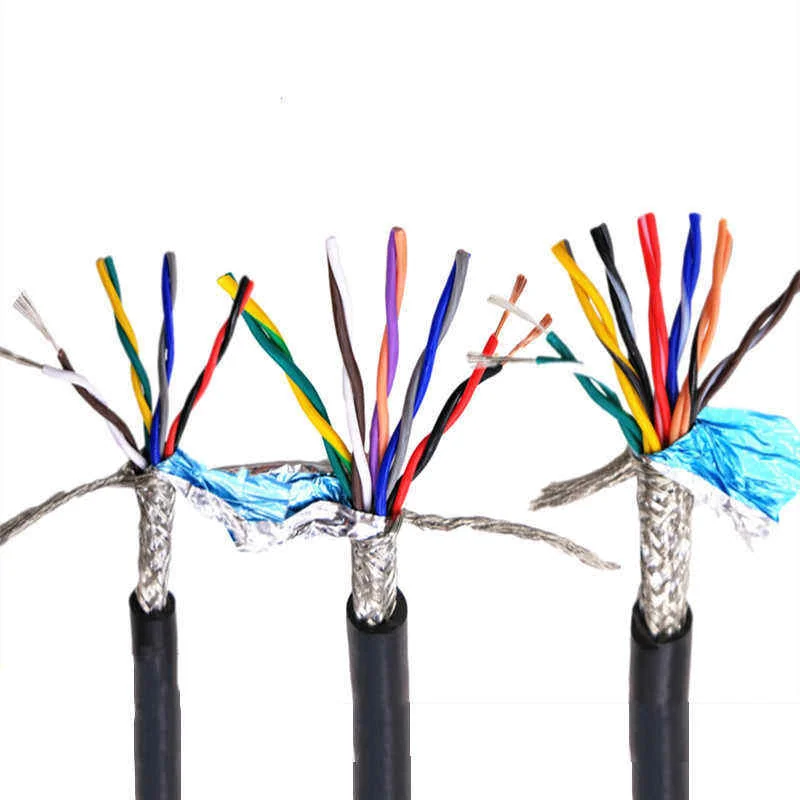
The cable is built in five layers, and each one has a separate function:
- Conductor — ultra-fine oxygen-free copper. The fine stranding keeps the core flexible for wiring inside a car body while holding the resistance low over a long run.
- Insulation — a halogen-free compound applied as a thin wall. The extrusion is controlled for low eccentricity, so the wall is even around the conductor rather than thin on one side, which is where insulation breakdown starts.
- Screen layer 1 — aluminium foil backing. It provides a continuous 360° barrier against electrostatic coupling along the length of the cable.
- Screen layer 2 — tinned copper braid. The braid carries the screen current and deals with the magnetic component of the interference; the tin coating keeps the braid from oxidizing, so the ground path stays stable.
- Sheath — a halogen-free, low smoke compound in black, applied over the screened assembly.
What the Two Screen Layers Do on a Long Signal Run
On a short jumper, a single screen is usually enough. On a long run through a vehicle or a tunnel, the two interference mechanisms have to be handled separately.
Electrostatic coupling is blocked by a continuous conductor around the cores, which is what the foil provides — a full wrap with no longitudinal gap. Magnetic coupling is not blocked by a thin foil, because the foil has too little cross-section to carry the induced current. That is the braid's job, and it is why the two layers are used together rather than choosing one.
The tinned finish on the braid is part of the same argument. The screen only works if it stays connected to ground along the entire run, and a braid that oxidizes develops a rising resistance at exactly the points where the connection matters.
Where WDZN-RYYP Cable Is Used
The construction is specified in four situations:
- High-speed rail and EMU car wiring — signal and control circuits inside the passenger envelope, where halogen-free materials are a safety requirement.
- Locomotive and passenger train wiring — inter-car and underfloor signal runs.
- Track-side and tunnel installations — signal runs where smoke in a fire is a life-safety issue.
- Long signal runs in high magnetic field environments — routes near traction converters, transformers, and traction motors, where an unscreened cable would pick up induced noise.
Certification and Ordering
The cable carries CCC, which is the relevant mark for the Chinese domestic market and for rolling stock built to Chinese standards. For an export project, confirm which certification the destination market requires before ordering, because the marking follows the market rather than the construction.
Supply is a 100 m or 200 m coil with a certificate, and lengths below 100 m as measured cut lengths. The sheath is printed with metre marking, so the installed length can be read directly from the cable at commissioning.
To specify the cable, state the core count (3 or 4), the cross-section, the route length, and whether the environment is a passenger compartment, an underfloor run, or a track-side duct. Send those through the enquiry form on this page and the construction is confirmed against them.