Shielded Twisted Pair (STP) Cable for Critical Industrial Signals
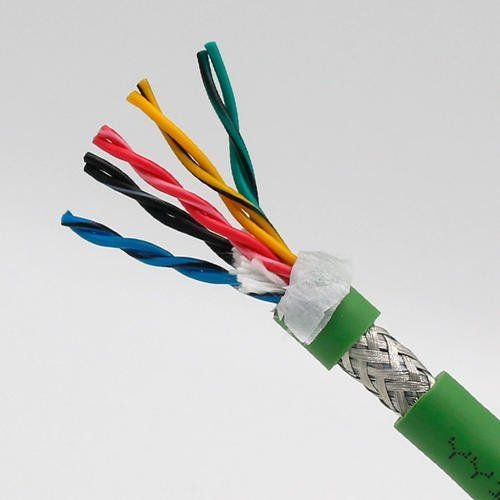
In electrically noisy environments, standard unshielded twisted pair cables often fail to deliver the data integrity your control systems demand. Our shielded twisted pair cable incorporates a metallic barrier between the twisted conductors and the outer jacket, suppressing radiated emissions, protecting against signal interception, and blocking incoming electromagnetic interference. This design provides a significantly more stable data channel than UTP alternatives, making it the preferred backbone for motor control, motion systems, and long-haul industrial communication links where data corruption is not an option.
Engineered for process control networks, industrial automation, remote SCADA nodes, building management, and security systems, the STP cable supports balanced signal transmission with wide common-mode range, moderate data rates, and true multipoint capability. In VFD-driven motor circuits, where high currents and fast switching generate extreme electrical noise, this shielded construction preserves controller-area communications that would otherwise be compromised. The cable also performs reliably in railway signaling and fixed audio distribution, thanks to its ability to transmit both low-level analog signals and DC power on separate pairs within the same jacket—simplifying field wiring without sacrificing noise immunity.
Key Performance Advantages
-
Proven EMI suppression – Aluminum/polyester composite tape with 85–100% tinned copper braid shield blocks radiated noise and cross‑talk, ensuring error‑free data in VFD, servo, and high‑current environments.
-
Signal integrity over distance – Supports transmission up to 1200 m; actual distance depends on the transceiver chipset and baud rate, but the low‑loss insulation and consistent twist‑lay keep bit errors to a minimum.
-
Multipoint and multi‑pair versatility – Use single pairs for RS-485/Modbus links or bundled pairs in multi‑core constructions for process instruments, encoders, and serial fieldbuses, with the option to carry limited DC power alongside signal.
-
Wide compliance and quality materials – 99.9999% ultra‑fine, annealed oxygen‑free copper stranded to VDE 0295 Class 6 guarantees exceptional conductivity and flex life.
Typical Applications
-
Process control networks (4–20 mA, HART, Modbus, Profibus DP)
-
Industrial automation and robotics – encoder, resolver, and serial feedback cables
-
Motor control centers and VFD communication loops
-
Building automation (BACnet MS/TP, LonWorks) and access/security systems
-
Remote terminal units (RTUs) and SCADA outstations
-
Fixed railway signal circuits and station audio distribution
Technical Specifications
| Parameter | Value |
|---|---|
| Conductor | 99.9999% ultra‑fine stranded, annealed oxygen‑free copper (acc. to VDE 0295 Class 6) |
| Insulation | Special signal‑grade compound optimized for data transmission |
| Shield | Aluminum/polyester composite tape + 85–100% coverage tinned copper braid |
| Outer jacket | PVC or oil‑resistant nitrile/PVC compound |
| Jacket colors | Black (RAL 9005), Grey (RAL 7001) – custom colors available on request |
| Rated voltage | 300/300 V |
| Test voltage | 2500 V |
| Temperature range | Fixed installation: -50 °C to +90 °C Flexing installation: -30 °C to +90 °C |
| Minimum bend radius | Fixed: 5 × outer diameter Flexing: 8 × outer diameter |
| Maximum transmission distance | Up to 1200 m (chipset‑ and rate‑dependent) |
Additional constructions – such as multi‑pair, individual-pair screened, or combined signal/power hybrids – can be engineered to your specification. Contact our team with your requirements.
Frequently Asked Questions
What is the real difference between STP and UTP for industrial controls?
STP cables contain an overall metallic barrier (aluminum/polyester tape plus dense tinned copper braid) that intercepts radiated noise before it reaches the signal pairs. UTP cables rely solely on twist balance and are far more vulnerable to EMI from motors, VFDs, and switching equipment. In any application where data errors can cause downtime or safety risk, STP is the recommended choice.
Can this cable be used for RS-485 and Modbus networks?
Yes. The shield, consistent characteristic impedance, and multipoint topology support make it ideal for RS-485, Modbus RTU, and similar differential serial buses. The up-to-1200 m range aligns with typical RS-485 link budgets when proper termination is applied.
Is the cable suitable for flexing applications and cable tracks?
The conductor stranding to VDE 0295 Class 6 and jacket compounds allow occasional flexing at -30 °C to +90 °C with a bend radius of 8 × diameter. For continuous high‑cycle track use, ask about our specialized flexible STP designs.
Which jacket material should I choose for harsh environments?
We supply standard PVC for general indoor/outdoor fixed installations and a nitrile/PVC compound for enhanced oil, fuel, and chemical resistance. The nitrile/PVC version is strongly recommended for machine‑tool and heavy industrial environments.
Do you offer multi‑pair configurations or custom shielding options?
Absolutely. From two‑pair fieldbus cables to 12‑pair marshalling trunk cables, we manufacture to your count, color code, and shielding arrangement (overall, individual, or both). UL, EAC, or country‑specific certification packages can also be integrated.
Ready to specify the right shielded twisted pair cable for your project? Contact our application engineers for a detailed data sheet, free sample, or a quotation tailored to your volume and delivery schedule.