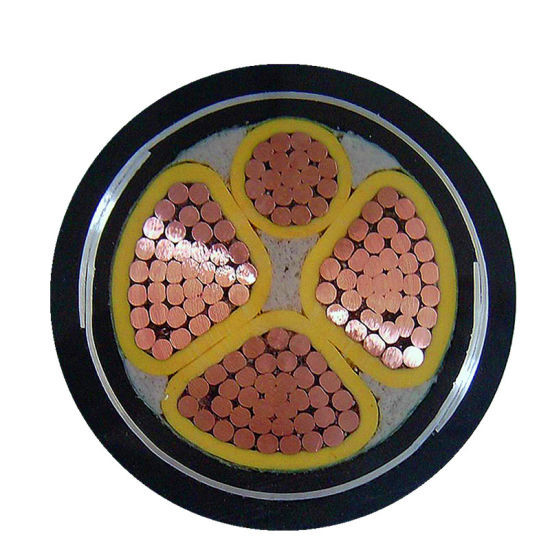
Detailed Description
Why 0.6/1 kV? — The Industrial Power Standard
0.6/1 kV is the most common voltage class for industrial power reeling — used for virtually every crane, hoist, dragline, and heavy equipment application from 10 kW to 5+ MW. The designation U₀/U = 0.6/1 kV means:
- U₀ = 600 V: Phase-to-ground (earth) rated voltage — the maximum continuous voltage between any phase conductor and ground
- U = 1 000 V: Phase-to-phase rated voltage — the maximum continuous voltage between any two phase conductors
- 400 V three-phase (standard European industrial power) — margin: 2.5× above operating
- 480 V three-phase (standard North American industrial power) — margin: 2.1× above operating
- 690 V three-phase (high-power European motors, wind turbines) — margin: 1.45× above operating
EPR Insulation — Why Rubber, Not Plastic
At 0.6/1 kV, two insulation materials are common: PVC and EPR (ethylene propylene rubber). For reeling applications, EPR is the correct choice:
| Property | PVC | EPR |
|---|---|---|
| Dielectric strength | 15–20 kV/mm | 20–25 kV/mm |
| Flexibility | Moderate — stiffens at low temp | Excellent — rubber-like across full temperature range |
| Heat resistance | 70°C (softens) | 90°C (stable) |
| Compression resistance | Poor — permanent deformation under sustained load | Excellent — recovers from compression on deep-drum reels |
| Aging resistance | Good | Excellent — >30 year design life |
| Water treeing resistance | Poor — susceptible | Excellent — inherently resistant |
On a deep-drum reel, the innermost cable layers are under sustained compressive load for the entire service life. PVC core insulation permanently deforms under this load — the insulation thins, reducing dielectric strength. EPR recovers — after the compressive load is removed, the insulation returns to near-original thickness.
For reeling applications with sustained drum compression, EPR is not an upgrade — it is the minimum requirement.
Mixed-Core Configurations — Power + Control + Fiber
Large crane reeling cables often combine multiple signal types with the power cores:
Power + Control
- Example: 3×35 mm² + 3×50 mm² + 3G25 mm² (power) + 12×1.5 mm² (control)
- Control cores carry limit switch, brake, and auxiliary contact signals
- Separated from power cores by PET fleece layer wrapping
Power + Fiber Optic
- Example: 4G16 mm² (power) + 6-fiber single-mode (data)
- Fiber for crane CMS (condition monitoring system) and remote diagnostics
- Fibers in gel-filled stainless steel loose tube for crush and moisture protection
- Integrated in the core assembly — one cable pull, no separate fiber installation
Power + Control + Fiber
- Example: 3×95 mm² + 3×70 mm² + 3G35 mm² (power) + 24×1.5 mm² (control) + 12-fiber SM (data)
- Complete crane connectivity in a single reeling cable
- Reduces drum count from 3–4 separate reels to 1–2
Drum Installation — Getting It Right
- D/d ratio verification: Measure the drum core diameter (not flange diameter). D/d = drum core diameter ÷ cable OD. Minimum 10:1; 15:1 for rated reeling life
- Winding tension: 2–5% of cable breaking strength for the first layer; decrease by 10% per subsequent layer. Excessive tension crushes inner layers
- Layer transition: The first layer must be wound tightly against the previous turn — no gaps. Gaps in the first layer propagate through all subsequent layers
- Drum flange clearance: Minimum 2× cable OD between the topmost cable layer and the flange edge. Less clearance risks the cable spilling over the flange edge during dynamic reeling
- Cable anchorage: The inner cable end must be securely anchored to the drum with a properly rated cable clamp. The clamp carries full cable tension during unwinding at the cable end
Why Choose Yichi Cable 0.6/1 kV Reeling?
- EPR as standard for all power cores: We do not offer PVC insulation for reeling applications — EPR is the minimum specification. PVC is cheaper but fails under sustained drum compression
- Partial discharge tested: Every production batch is tested for partial discharge at 1.73 U₀ — ensuring there are no voids in the EPR insulation that would cause progressive degradation
- Compression-cycle validated: Our core stranding system is tested under simulated 10-layer drum compression — conductor cross-section remains circular within ±5% after 100 000 cycle equivalents
- Mixed-core expertise: Power + control + fiber in one cable — we engineer the core assembly to maintain round cross-section and equal tension distribution across all conductor types
- Drum application review: Send us your drum dimensions, required cable length, and winding tension — we verify D/d compatibility and recommend the optimal construction