Detailed Description
Bend-Resistant Means Surviving the Unpredictable
Most industrial cables are designed for a defined, predictable motion — a drag chain with known bend radius, travel distance, and speed. The engineering is deterministic: apply X million cycles at Y bend radius and measure when failure occurs.
A bend-resistant cable faces a fundamentally different challenge: it must survive bending that is random in magnitude, direction, and frequency. A handheld power tool cable is bent sharply around corners, pulled tight, coiled for storage, stepped on, and dragged across concrete — all in a single shift. There is no "rated bend radius" that describes real-world use.
Bend-resistant cables are engineered not for a specific flex life number, but for resilience — the ability to recover from deformation and continue functioning.
The Difference Between Flexible and Bend-Resistant
| Property | Flexible Cable | Bend-Resistant Cable |
|---|---|---|
| Design philosophy | Optimized for defined, repetitive bending | Engineered for random, uncontrolled bending |
| Conductor focus | Maximum flex cycles at rated radius | Fatigue resistance + internal stress elimination |
| Jacket priority | Low friction for carrier gliding | High recovery — resists permanent kinking |
| Cross-section shape | Maintained round for carrier | Self-restoring to original shape after deformation |
| Compression recovery | Secondary concern | Primary design requirement (95%+ recovery) |
| Typical failure mode | Conductor fatigue at bend point | Jacket kink → conductor exposed OR core fracture at sharp bend |
| Test methodology | Cyclic bend test (known radius) | Random-flex + compression recovery + kink resistance |
How Kinking Destroys Cables
A kink is a localized, permanent deformation where the cable has been bent beyond its elastic limit. Unlike the smooth, distributed curvature of a drag chain bend, a kink concentrates all the bending stress in a 5–10 mm zone.
When a kink forms:
- The jacket on the inner side compresses permanently — creating a weak point
- The conductors on the outer side are stretched beyond their elastic limit — individual copper strands yield and thin
- The cable cross-section becomes oval/flat at the kink point — any subsequent bending concentrates stress at this weakened section
- After a few dozen additional bends, the thinned conductors fracture at the kink point
- High-recovery jacket: When bent beyond the elastic limit, the jacket springs back rather than taking a permanent set
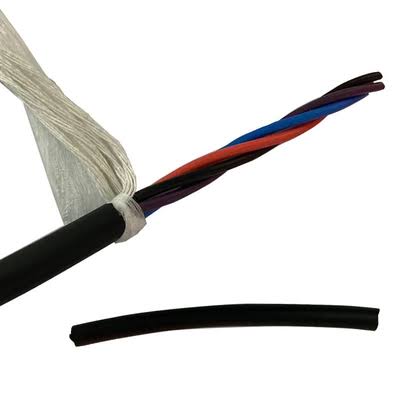
- Aramid anti-buckling reinforcement: Kevlar fibers in the core prevent the cable from being compressed so severely that conductors are crushed
- Controlled back-twist stranding: Eliminates the internal torsional stress that accumulates in standard stranded conductors during random bending
Anti-Buckling — The Hidden Failure Preventer
When a cable is bent sharply, the inner radius experiences compression. If the compression exceeds the conductor's buckling strength, the individual copper strands can buckle — forming a permanent "zigzag" deformation that concentrates stress and leads to rapid fatigue failure.
Aramid (Kevlar) fibers embedded in the cable core prevent this:
- High compressive stiffness: Kevlar fibers resist buckling forces that would otherwise deform copper strands
- Elastic behavior: Unlike steel wire (which can take a permanent set), Kevlar fully recovers after compressive loading
- Negligible weight penalty: Aramid fibers weigh approximately 40% less than steel for equivalent strength
- No electrical hazard: Non-conductive — unlike steel reinforcement, Kevlar does not create a short-circuit risk if it contacts a conductor
Jacket Material Science — Why TPE Outperforms Standard PVC
| Property | Standard PVC | Hi-Elast PVC | TPE |
|---|---|---|---|
| Compression set (72 h @ 23°C) | 30–50% | 15–25% | 5–10% |
| Flexural modulus | High (stiff) | Medium | Low (soft, springy) |
| Tear strength | Moderate | Good | Excellent |
| Low-temperature flexibility | -5°C | -10°C | -25°C |
| Surface feel | Hard, plastic | Softer | Rubber-like, grippy |
| Recovery speed | Slow (creeps) | Moderate | Fast (elastomeric) |
Practical Test — The Hand Coil Test
A simple way to understand the difference between standard and bend-resistant cable: take a 1 m sample of each and tightly coil it around your hand (approximately 60 mm diameter). Hold for 10 seconds, then release. The standard PVC cable will retain a visible coil shape — it has taken a set. The bend-resistant cable will spring back to near-straight.
This is not just a demonstration — it is a simulation of what happens to a handheld tool cable dozens of times per shift.
Why Choose Yichi Cable Bend-Resistant?
- Anti-buckling as standard: Aramid fiber reinforcement is included — not an extra-cost option for "enhanced" versions
- Compression recovery tested: Every batch is tested for dimensional recovery after compression cycling — we publish the results, not a catalog value
- TPE jacket recommendation: We default to TPE for bend-resistant cables — not because we want to upsell, but because PVC (even hi-elast formulations) cannot match TPE's compression recovery performance
- Application-matched stranding: We specify Class 5 vs Class 6 conductor based on whether the application involves predictable bends (Class 5) or completely random flex (Class 6)
- Orange and yellow safety colors: Standard stock for high-visibility portable equipment applications