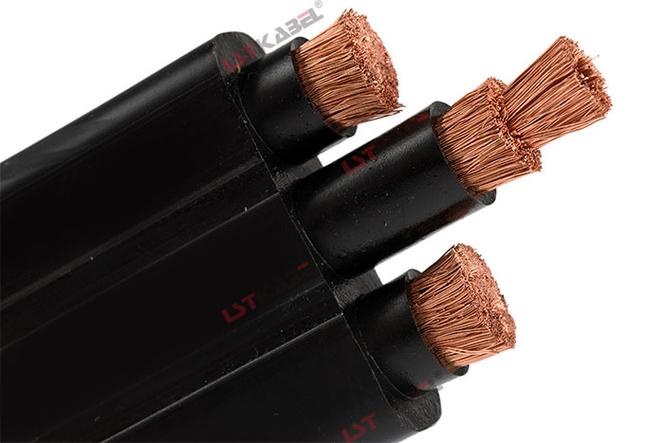
Detailed Description
Why Two Jackets? — The Mechanical Decoupling Principle
A single-jacket reeling cable is a solid mechanical assembly: the core, tensile reinforcement, and jacket are bonded into one structure. When the cable bends around the drum, the entire cross-section bends as a single unit. When the cable is compressed between drum layers, the force transmits directly from the outermost jacket surface to the conductor insulation.
This works for moderate reeling applications. But in severe conditions — deep drums, abrasive environments, heavy impact — single-jacket construction reveals three failure modes:
Failure 1: Compression Cracking
On a deep-drum reel, the jacket at the inner bend radius is compressed. Over thousands of cycles, micro-cracks form at the inner surface of the jacket (where stress is highest). These cracks propagate outward — invisible from the surface until the jacket is fully penetrated.
Double-jacket solution: The inner cushion layer (Shore 60–70 A, softer) absorbs compression without cracking. The outer jacket (Shore 85–90 A, harder) protects against abrasion. The compression stress that would crack a single thick jacket is safely absorbed by the compliant inner layer.Failure 2: Jacket-to-Core Delamination
During reeling, the jacket and the core assembly move slightly relative to each other — the jacket stretches more on the outer bend radius where the path length is longer. Over time, this differential movement causes the jacket to separate (delaminate) from the core, creating a trapped air gap that collects moisture and promotes corrosion.
Double-jacket solution: The inner jacket is bonded to the core assembly. The outer jacket is separated from the inner jacket by a PET fleece intermediate slip layer. The two jackets can move independently — the outer jacket flexes with the drum, the inner jacket stays with the core. No delamination because there is no single jacket-to-core bond to fail.Failure 3: Impact Penetration
A single thick jacket resists impact through material thickness alone. A sharp impact that exceeds the jacket's cut resistance penetrates directly to the core.
Double-jacket solution: The softer inner layer deforms under impact, absorbing energy before the force reaches the core. The harder outer layer initiates cut resistance. Together, they provide greater effective protection than a single jacket of equivalent total thickness — because the impact energy dissipates at the interface between the two layers (impedance mismatch).The Intermediate Slip Layer — Why It Matters
Between the inner and outer jackets is a thin PET fleece wrap. This layer prevents the two jackets from bonding during the outer jacket extrusion process. Without it, the inner and outer jackets would fuse into a single thick layer — negating the mechanical decoupling benefit.
The fleece also creates a defined slip plane — the outer jacket can move slightly relative to the inner jacket during bending, preventing the shear stress concentration that causes delamination in single-jacket cables.
Single vs Double-Jacket — Lifetime Economics
For a 95 mm² reeling cable in a 12-layer drum, abrasive mining environment:
| Single-Jacket CR | Double-Jacket CR+PUR | |
|---|---|---|
| Jacket thickness | 1.5–2.0 mm | 3.5–4.5 mm combined |
| Compression cracking | Occurs at ~30 000 cycles | No cracking at >100 000 cycles |
| Impact penetration resistance | Baseline | 50–80% higher |
| Service life | 2–3 years | 4–6 years |
| Cable cost premium | Baseline | +20–30% |
| Replacement cost (crane + downtime) | $5 000–15 000 per event | Avoided for additional 2–3 years |
The 20–30% cable cost premium is recovered in the first avoided premature replacement.
Double-Jacket Reeling Cable Construction Notes
- Engineered decoupling: Inner CR cushion + intermediate PET slip layer + outer CR/PUR jacket — each layer has a defined mechanical function
- Not just "two layers of the same thing": The inner and outer jackets use different materials, different Shore hardness, and different thicknesses — optimized for their specific role
- Compression and impact tested: Our double-jacket construction is tested under simulated deep-drum compression and impact — not claimed from material data sheets
- Application-matched outer jacket: CR for mining/coal (MSHA), PUR for marine/chemical/wet environments — the outer jacket protects against YOUR environment
Voltage Rating and Conductor Range
The double-jacket reeling cable is built for low-voltage duty at 0.6/1 kV as standard, with a medium-voltage option at 3.6/6 kV that uses semiconductive screens. The bare copper conductor is IEC 60228 Class 5 or Class 6, in cross-sections from 25-400 mm², with EPR compression-resistant insulation and a central galvanized steel wire tensile core at 1 770 N/mm² rated for 20-70 kN. The combined inner and outer jacket thickness is 2.5-5.0 mm, two to three times a standard single-jacket cable, supporting the more than 200 000 reeling cycles at a 15:1 drum ratio.