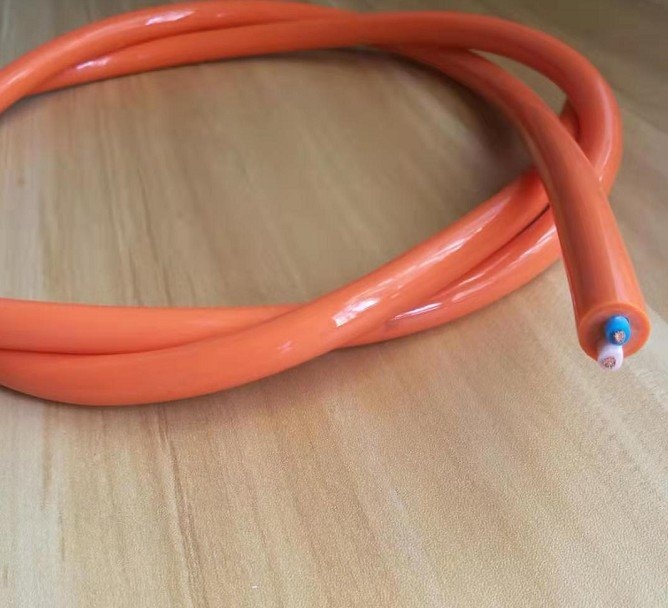
Detailed Description
Why Fiber in a Festoon System?
A festoon loop carrying a 3-phase power cable for a 55 kW hoist motor generates a strong 50/60 Hz magnetic field. Add a VFD (variable frequency drive) with a 4 kHz carrier frequency, and the electromagnetic noise spectrum extends from 50 Hz to several MHz. Any copper signal cable running alongside this power cable in the same festoon loop will be bombarded with electromagnetic interference.
Traditional solutions — twisted pairs, foil shields, braid shields — reduce this interference but do not eliminate it. For critical signals like real-time video, high-speed data, or safety-related communication, fiber optic cable is the only transmission medium that is completely immune to electromagnetic interference.
The Physics
A copper conductor carrying a current generates a magnetic field. A second copper conductor in that field has a voltage induced in it (Faraday's law). The shield around the second conductor provides a path for the induced current to flow to ground, but it does not block the magnetic field entirely — particularly at low frequencies (50/60 Hz) where the skin depth in copper (≈9 mm at 50 Hz) is larger than the shield thickness.
An optical fiber carries photons, not electrons. There is no conductor, no induced voltage, no ground loop, no common-mode noise. The data — whether it is a 1080p video stream from a CCTV camera, a PROFINET telegram at 100 Mbps, or a Modbus register read — arrives at the receiver exactly as it left the transmitter. This is why fiber is specified for crane applications where data integrity is non-negotiable.
Single-Mode vs Multi-Mode — Which Fiber for Which Application?
| Criterion | Single-Mode (G.652.D) | Bend-Insensitive SM (G.657.A2) | Multi-Mode (OM3/OM4) |
|---|---|---|---|
| Core diameter | 9 µm | 9 µm | 50 µm |
| Distance capability | 40–80 km at 1 Gbps | 40–80 km at 1 Gbps | 550 m (OM4) at 10 Gbps |
| Bend sensitivity | Moderate (D/d 15:1 min) | Low (D/d 10:1 min) | Moderate |
| Transceiver cost | Higher (laser diode) | Higher (laser diode) | Lower (VCSEL) |
| Best for | Long-haul crane-to-control room | Tight festoon loops | Short-haul; on-crane networks |
| Typical crane use | 500 m–2 km links | Festoon loops <100 m | CCTV, local Ethernet |
Loose Tube vs Tight-Buffered — Why Loose Tube for Festoon?
Fiber optic cables for festoon systems use loose tube construction rather than tight-buffered:
Loose tube: The fiber floats freely inside a gel-filled PBT (polybutylene terephthalate) tube with an inner diameter of 1.5–2.0 mm. The fiber is physically longer than the tube (0.1–0.3% excess fiber length, EFL). When the cable bends, stretches, or compresses, the fiber moves within the tube rather than being strained. The gel filling prevents water ingress and provides lubrication for fiber movement. Tight-buffered: A 900 µm tight buffer coating is applied directly to the 250 µm coated fiber. The fiber is mechanically coupled to the buffer — when the cable bends, the fiber bends in direct proportion. Tight-buffered cables are simpler to terminate (no gel to clean) but introduce more attenuation under repeated flexing because the fiber experiences the full bend strain.For a festoon application with thousands of bend cycles at trolley transitions, loose tube construction protects the fiber from fatigue by decoupling the fiber from the cable structure.
Yichi Festoon Fiber Manufacturing
- Excess fiber length (EFL) controlled: EFL is measured on every production length using an OTDR (optical time domain reflectometer) — target is 0.1–0.3%. Too little EFL means the fiber strains under cable tension; too much means the fiber buckles inside the tube, causing micro-bend attenuation
- Attenuation tested at two wavelengths per fiber: Every fiber in every production length is tested at 1 310 nm and 1 550 nm (single-mode) or 850 nm and 1 300 nm (multi-mode). Fibers exceeding the specified attenuation are rejected before cabling
- Gel fill verified: Tubes are filled under controlled pressure and temperature to ensure complete filling without air bubbles. An air bubble in the tube allows moisture condensation that degrades fiber strength over time
- PUR jacket for outdoor festoon: As with our tower crane and outdoor cable products, indoor versus outdoor jacket selection is clearly communicated — PUR for outdoor/exposed festoon, PVC or LSZH for indoor