Detailed Description
What Is a Festoon System?
A festoon system is a cable management method where electrical cables are suspended in U-shaped loops from a series of wheeled cable trolleys that ride on a track — typically a C-rail, I-beam, or square tube. As the moving equipment (crane, hoist, conveyor carrier) travels along the track, the loops open and close — the trolleys spread apart when the equipment moves away, and they bunch together when it moves closer.
Unlike a motorized cable drum — which actively winds and unwinds cable onto a rotating drum — a festoon system is entirely passive. There is no motor, no gearbox, no slip ring assembly. The cable manages its own travel by flexing at the trolley transition points. This simplicity is the festoon system's greatest advantage: fewer components to maintain, no electromechanical wear points, and easy visual inspection of the entire cable length.
Festoon Cable vs Standard Flexible Cable — The Differences
A standard flexible cable (such as H05VV-F or H07RN-F) can be installed in a festoon system. It will work — for a while. But standard flexible cables are not designed for festoon duty, and three differences matter:
1. Weight
In a festoon loop, the cable supports its own weight over the unsupported span between trolleys. A heavier cable sags more — requiring either shorter trolley spacing (more trolleys, more cost) or accepting deeper loops that may interfere with obstructions below the festoon track. Festoon system cables use lighter filler materials and optimized core stranding to reduce weight per meter by approximately 10–15% compared to a standard flexible cable of the same electrical specification.
2. Bend Radius
The cable bends at each trolley transition — a tight radius as the cable passes from the horizontal trolley saddle into the vertical loop. Standard flexible cables typically specify a D/d of 12:1 to 15:1 for flexing service. Festoon cables are designed for D/d 7.5:1 — they handle tighter bends without conductor fatigue or jacket cracking.
3. Loop Memory
When a festoon loop repeatedly opens and closes, the cable develops a "memory" — it wants to return to the shape it has been bent into thousands of times. Standard PVC compounds have poor memory recovery and will develop permanent kinks at the loop apex. Festoon-grade jacket compounds are formulated with better elastic recovery — the cable straightens when the loop opens and bends smoothly when it closes, without permanent deformation.
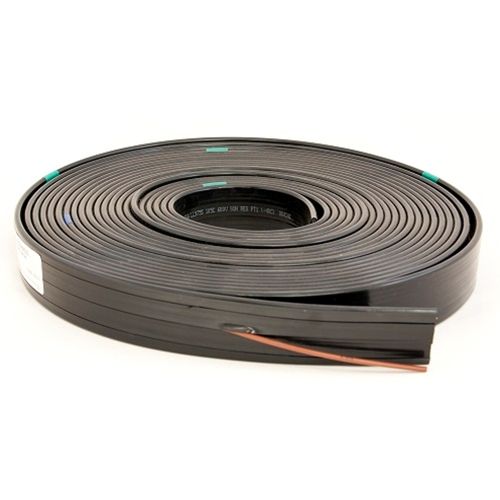
Round vs Flat Festoon Cable — Selection Criteria
| Factor | Round Festoon Cable | Flat Festoon Cable |
|---|---|---|
| Cost | Lower | Higher (10–20% premium) |
| Loop stacking height | Higher — thicker loops when compressed | Lower — flat stacking reduces compressed loop height by 30–50% |
| Trolley compatibility | Standard C-rail and I-beam trolleys | Requires flat-cable-specific saddle design |
| Core count capacity | Up to 30+ cores in concentric layers | Typically ≤24 cores in single-plane array |
| Twist resistance | Neutral (round is torsionally symmetric) | Requires edge reinforcement to prevent twisting |
| Installation | Easier — no orientation requirement | Edge-sensitive — must be installed flat-side parallel to trolley saddle |
| Best for | General festoon; long loops; high core counts | Space-constrained; low headroom; short-to-medium loops |
Festoon Loop Design Principles
A well-designed festoon system considers three parameters:
Trolley spacing: Typically 1.5–2.5 meters between trolleys. Closer spacing reduces loop sag but requires more trolleys. Wider spacing saves trolley cost but increases loop depth. The cable's weight per meter determines the maximum practical spacing — as a rule, the loop depth should not exceed 1.5× the trolley spacing. Loop depth: The vertical distance from the trolley saddle to the bottom of the U-loop. Determined by trolley spacing and cable stiffness. A deeper loop has more cable length per loop but may conflict with obstructions below the track. Typical loop depth is 0.8–1.2 meters for indoor festoon systems. Number of loops: Determined by the total travel distance. If the crane travels 20 meters and trolley spacing is 2 meters, 10 loops are needed — each loop contributes approximately 2× the loop depth in cable length. A 1-meter loop depth means each loop contributes 2 meters of cable, so 10 loops provide 20 meters of travel.Yichi Festoon Cable Manufacturing
- Lightweight filler material: We use expanded polypropylene (EPP) filler elements instead of traditional PVC fillers — reducing cable weight without compromising roundness or mechanical protection
- Jacket compound optimized for elastic recovery: Festoon-grade PVC and PUR compounds are formulated with higher plasticizer content and optimized molecular weight distribution — tested for loop memory recovery over 50 000 open/close cycles
- Loop life testing on request: For critical festoon applications, we can perform accelerated loop life testing at customer-specified loop depth and trolley spacing — providing a test report with cycle count to first visible jacket cracking or conductor resistance increase