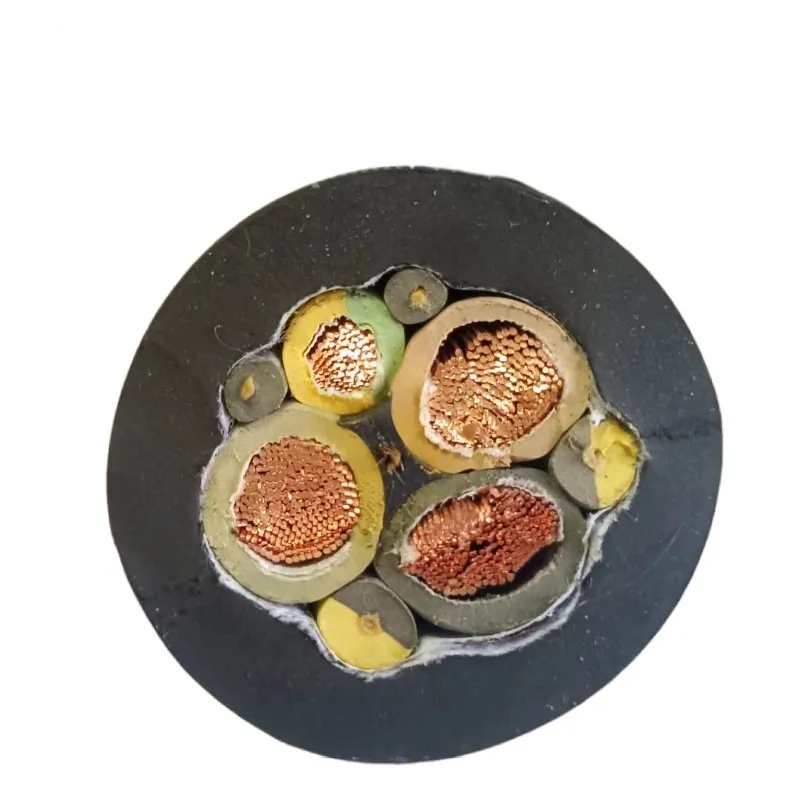
Detailed Description
Heavy Duty Drag vs Mining Drag — The Difference
| Mining Drag Cable | Heavy Duty Drag Cable | |
|---|---|---|
| Voltage | 3.6/6 kV to 25 kV | 0.6/1 kV to 3.6/6 kV |
| Cross-section | 95–630 mm² | 10–300 mm² |
| MSHA required | ✅ Mandatory | ❌ Not required for non-mining |
| Ground check | ✅ Mandatory | Optional |
| Jacket thickness | 3.0–6.0 mm | 2.0–5.0 mm |
| Cost | Higher (MSHA + larger) | Lower — right-sized for application |
| Typical application | 100+ ton electric shovel | 20 ton mobile crusher |
Mining drag cable is engineered for the most extreme conditions. Heavy duty drag cable is engineered for everything else that is still demanding — construction sites, quarries, portable equipment — where mining-grade would be over-specified and over-budget.
Five Environments — Five Cable Demands
| Environment | Primary Threat | Cable Requirement |
|---|---|---|
| Construction site | Vehicle run-over, rebar/debris puncture | Thick CR jacket, steel wire tensile core |
| Quarry | Sharp rock edges, abrasive dust | PUR jacket (Taber ≤5 mg), enhanced cut resistance |
| Portable pump | Water, mud, frequent relocation | PUR jacket (hydrolysis resistant), flexible for coiling |
| Event power | Temporary installation, pedestrian traffic | Yellow high-visibility jacket, lightweight for handling |
| Railway work site | Ballast abrasion, train wheel risk | CR jacket, high-visibility, oil/diesel resistant |
Design and Configuration Choices
- Right-sized for non-mining: 300 mm², not 630 mm². 3.6/6 kV, not 25 kV. Appropriate performance without overspend
- CR or PUR jacket: Two material options — choose based on environment, not forced into one
- Kevlar option: For applications where the tensile core must be non-conductive (portable generators, event power)
- Standard lengths in stock: 25/50/100 m — no minimum order, no long lead time for common configurations
Jacket Material: CR Versus PUR
The cable is offered with two outer jacket materials so the user can match the jacket to the site. CR neoprene jacket is supplied in thicknesses of 2.0-4.0 mm and in black or yellow. The yellow option supports high-visibility identification on busy sites such as railway maintenance corridors and outdoor event grounds where pedestrian and vehicle traffic share the same area. PUR (TMPU) jacket is supplied in thicknesses of 2.0-5.0 mm and is halogen-free. It provides excellent oil resistance and abrasion resistance for quarry and aggregate duty where sharp rock edges and abrasive dust are the dominant wear mechanism.
Both jackets meet the flame retardant requirement of IEC 60332-1-2 and are rated excellent for UV and weather exposure, so either can be used outdoors. The choice therefore comes down to chemical and oil exposure and the need for halogen-free material: PUR where oil and abrasion are severe, CR where cost and high-visibility colour are the priority.
Tensile Core and Ground Conductor Function
When the cable is dragged along the ground, the tensile load is carried by the integrated tensile core rather than by the copper conductors. The tensile core is either a galvanized steel wire rope or a Kevlar aramid. The steel wire rope option also serves as the equipment ground conductor path, which is why it is sized to carry fault current. The Kevlar aramid option is selected where a non-conductive tensile member is preferred, for example portable generator sets and temporary event power where the tensile element must not form part of the electrical ground.
The ground conductors are tinned copper, sized per application, and are supplied with or without a ground check core depending on the installation. The copper conductors follow IEC 60228 Class 5 or Class 6 stranding, which allows the cable to coil and straighten repeatedly during relocation between work areas.
Voltage Classes and Insulation
The cable covers two voltage classes. The standard class is 0.6/1 kV for construction, quarry, and general mobile power. The medium-voltage option is 3.6/6 kV for larger mobile equipment. For the medium-voltage option the EPR insulation is built with semiconductive screens per IEC 60502-2; for the low-voltage option EPR or PVC/NBR insulation is used, both oil resistant. Test voltages are 3 500 V for the low-voltage version and 11 000 V for the medium-voltage version.