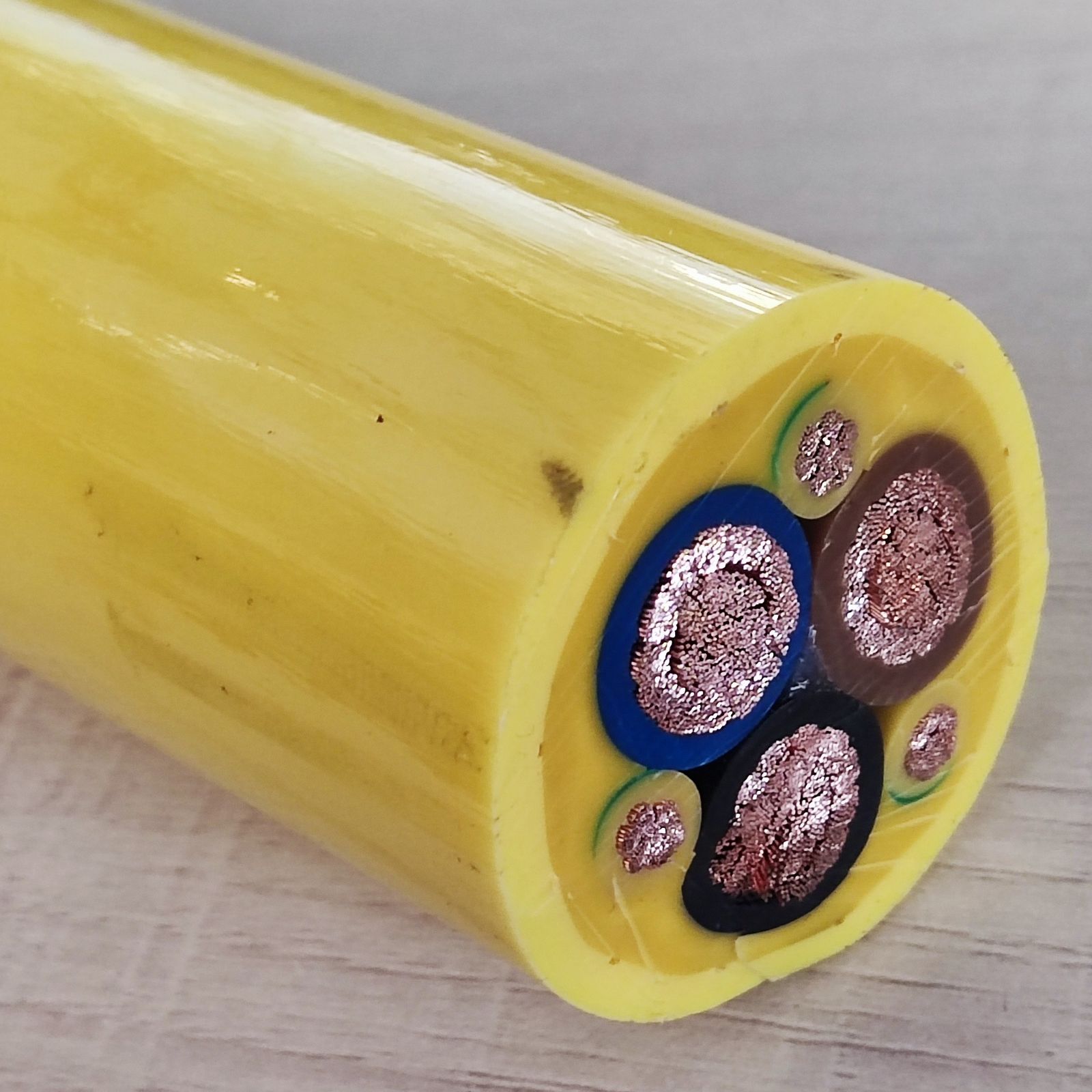
Detailed Description
What "General" Means — And What It Does Not
The term "general" in this product name does not mean "generic" or "low-specification." It means the cable is not constrained to a single crane type or installation method — it is designed to work across the full spectrum of industrial crane applications.
The specialized overhead crane dedicated cable is optimized for EOT crane motorized drum reeling with EPR insulation and a central steel wire core. That is the right cable when the application is specifically an EOT crane with motorized drum reeling. But many crane installations — a jib crane in a maintenance workshop, a mobile truck-mounted crane, a small portal crane in a scrap yard — do not need those specific optimizations and would pay for features they will not use.
The general industrial crane cable fills that gap: good flexibility, broad cross-section range, multiple jacket options, and proven performance across crane types. It is the cable you specify when the crane application is clear but the specific environmental and mechanical conditions do not require a purpose-optimized cable.
Jacket Selection — PVC, CR, or Rubber?
The three jacket options cover the full range of industrial crane environments:
| Criterion | PVC | CR (Neoprene) | Rubber |
|---|---|---|---|
| Cost | Lowest | Medium | Highest |
| Temperature range | –15°C to +70°C | –25°C to +70°C | –30°C to +70°C |
| Oil resistance | Limited | Good (IEC 60811) | Good |
| Abrasion resistance | Low | Good | Excellent |
| Flame retardancy | Good | Good | Moderate |
| Typical crane type | Indoor workshop jib/overhead | Indoor industrial EOT, foundry | Mobile, truck-mounted, outdoor portal |
| Service environment | Clean, dry, temperature-controlled | Oil mist, cutting fluid, moderate heat | Outdoor, rough handling, vibration |
Core Count Configuration
The broad core count range (2–36 for control) means the cable can be configured for almost any crane control scheme:
| Crane Type | Typical Control Signals | Recommended Control Cores |
|---|---|---|
| Single-girder, pendant control | Hoist U/D, trolley L/R, bridge F/R, E-stop | 8–12 |
| Double-girder, pendant + radio | Two hoists, trolley, bridge, E-stop, radio receiver power | 14–20 |
| Automated / PLC-controlled | VFD enable, speed reference, encoder feedback, limit switches, E-stop | 20–30 |
| Grab / magnet crane | Hoist, grab open/close or magnet on/off, trolley, bridge, E-stop | 12–18 |
For crane motor power, 4-core (3P+PE) is the standard configuration serving three-phase hoist, trolley, and bridge motors. 5-core (3P+N+PE) is available when single-phase auxiliary circuits require a neutral conductor.
Yichi Quality — General Cable, Specific Standards
Even a "general" cable must meet specific manufacturing standards:
- Conductor stranding verified: Each production batch is sampled for strand count and wire diameter — IEC 60228 Class 5 requires a minimum number of individual wires per cross-section, and we verify compliance
- Jacket concentricity controlled: Wall thickness measured at 4 points around the circumference on every production length — minimum wall thickness must be ≥90% of nominal; thin spots lead to premature failure in flexing applications
- Spark test at 2 500 V or 3 500 V (depending on voltage class): Every meter of finished cable is dry-spark-tested. Insulation defects trigger automatic line stop and rejection of the affected section
- Marking clarity: Cable identification printed on jacket at ≤500 mm intervals — type designation, core count, cross-section, voltage rating, and manufacturer identification