Detailed Description
What Makes It "Dedicated"?
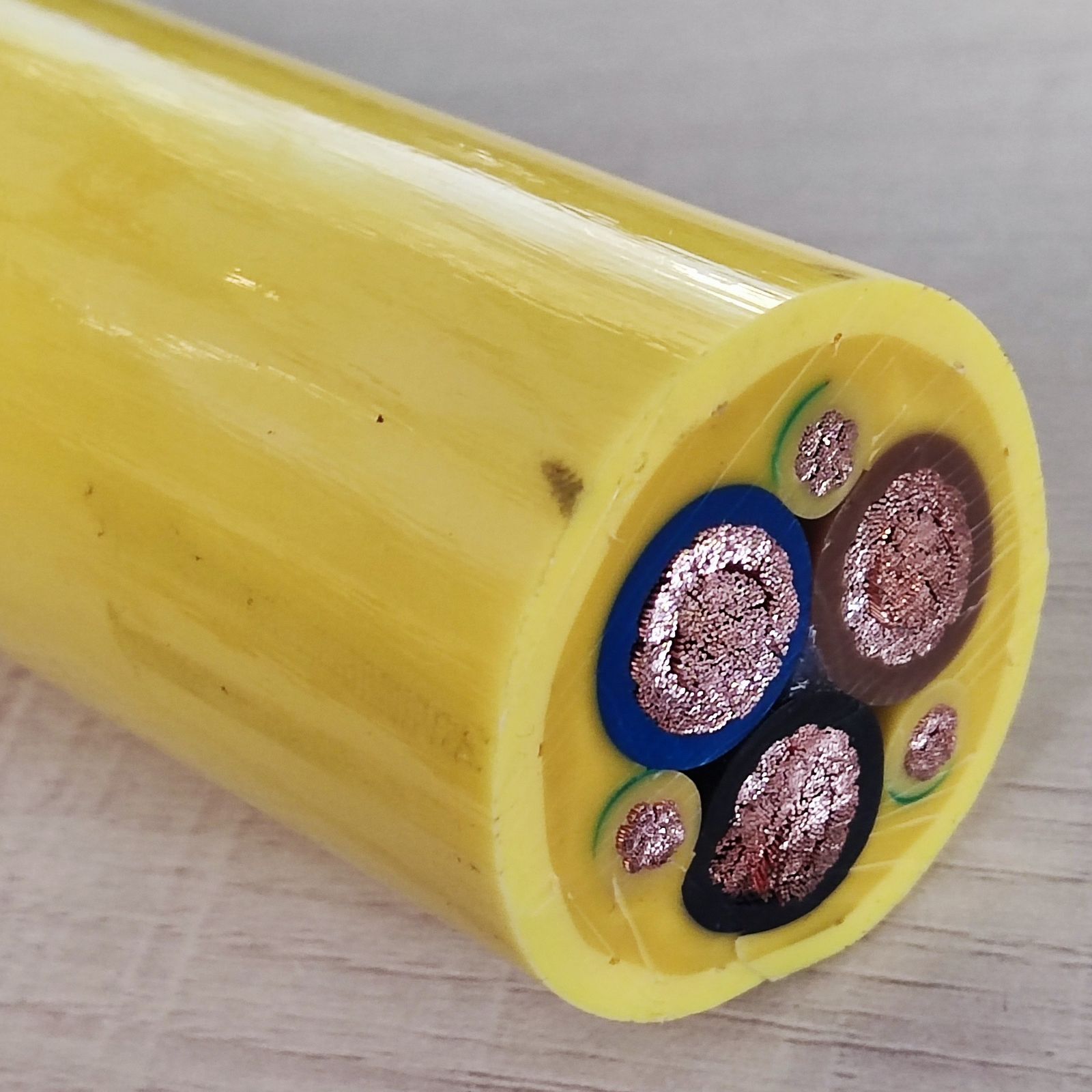
The term "dedicated" in this product name is not marketing language — it refers to a cable whose entire design — from conductor selection to core stranding pattern to jacket thickness — is optimized for one application: overhead crane motorized drum reeling.
A general-purpose reeling cable can be used on an overhead crane. It will work. But it will not account for the specific conditions of an overhead crane drum system:
- Lift height determines drum size: An EOT crane with a 12-meter lift and 6:1 reeving requires a drum that stores ~72 meters of cable. The bottom layers of cable on the drum are under significant compressive force from the layers above. A general-purpose cable's insulation may cold-flow under this sustained compression, leading to conductor-to-conductor shorts after months of service. The EPR insulation specified for dedicated overhead crane cables is specifically compression-resistant.
- Drum winding pattern affects cable life: Overhead crane drums typically use a single-layer helical winding pattern with a grooved drum. The cable must enter the groove cleanly on every revolution. A cable with an asymmetrical cross-section (core bunching on one side) will twist as it enters the groove, causing premature jacket wear at the groove edges. The dedicated cable's concentric stranding with fillers produces a near-perfect circular cross-section that tracks the groove without twisting.
- The duty cycle is intermittent but intense: An overhead crane in a steel service center may make 50–100 lifts per shift, each involving 20–30 meters of cable pay-out and take-up. This is not a continuous operation like a mining dragline, but the cumulative cycles add up — 50–100 thousand cycles per year. The cable's bend radius specification (D/d 10:1 minimum) and reeling life rating (>100 000 cycles at 12:1) directly address this cumulative fatigue.
Steel Wire Core — Why Central, Not Distributed
The central position of the steel wire is a deliberate design choice, not a manufacturing convenience:
1. Symmetrical Bending
When the cable bends over a drum, every point on the circumference experiences the same strain. A central tensile member ensures that strain distributes symmetrically. If the steel wires were distributed in the outer layers (as in some general-purpose reeling cables), the bending plane would be biased — the steel wires would force the cable to bend preferentially in certain orientations, concentrating fatigue on the copper conductors on the opposite side.
2. Direct Tension Transfer
The steel wire runs straight down the center of the cable. When tension is applied — either from the cable's own suspended weight during vertical lift or from the motorized drum's take-up torque — the steel wire takes the load directly. The copper conductors, stranded in concentric layers around it, are geometrically locked in place and experience primarily compressive stress from the outer layers, not tensile stress from the suspended load.
3. Ground Conductor Integration
The steel wire serves as the equipment ground (PE) conductor. In overhead crane motor circuits, the PE conductor must have sufficient cross-section to carry fault current and must be mechanically robust enough to survive a fault without breaking. A 2.5 mm diameter steel wire provides approximately 5 mm² of cross-section — adequate for the fault current of a typical 15–45 kW hoist motor protected by a motor protection circuit breaker. This eliminates the need for a dedicated copper PE core, reducing both cable diameter and cost.
CR vs PUR — Material Decision Matrix
For overhead cranes, the jacket material selection depends on the operating environment:
| Factor | CR (Neoprene) | PUR (TMPU) |
|---|---|---|
| Temperature range | –25°C to +70°C | –40°C to +80°C |
| Abrasion resistance | Good | Excellent (2–3× CR) |
| Oil resistance | Good (IEC 60811) | Excellent |
| UV / weather resistance | Moderate | Excellent (>720 h per ISO 4892-2) |
| Halogen content | Contains chlorine | Halogen-free |
| Cost | Lower | Higher |
| Weight (same OD) | Heavier | Lighter |
| Typical use case | Indoor factory EOT crane | Outdoor gantry, portal, and weather-exposed overhead cranes |
Yichi Manufacturing Notes
- EPR insulation extruded in-house: EPR requires precise temperature control during extrusion and continuous vulcanization. We run dedicated EPR extrusion lines — not shared with PVC — to avoid cross-contamination that compromises dielectric strength
- Steel wire tensile tested per DIN EN 10002-1: Each production batch of steel wire is tensile tested. Breaking load is verified before the wire enters the stranding process
- Concentric stranding monitored: Core lay length is controlled to ±2% tolerance. Excessive variation causes uneven bending and premature fatigue
- Spark test at 3 500 V AC: Every meter of finished cable passes through a dry spark tester. Any insulation defect triggers immediate rejection of the affected length
- Drum simulation test on request: For critical applications, we can perform a simulated drum winding test — 5 000 cycles at customer-specified D/d ratio — and provide a test report