Detailed Description
The Overhead Crane Cable Reel — How It Works
An overhead crane's hoist motor is not on the hook — it's mounted on the trolley, which travels along the bridge girder. The power cable must follow the hoist motion: when the hook goes down 15 meters, 15 meters of cable must pay out from the motorized drum. When it goes up, the same 15 meters must wind back, layer by layer, turn after turn.
The reeling cable is wound on a motorized drum that rotates to match the hoist speed — paying out as the hook descends, winding in as it rises. The cable specification is defined by the drum geometry:
- Drum diameter (D) ÷ cable diameter (d) = the D/d ratio — determines bending stress
- Number of winding layers — determines compression on the innermost cable layers
- Reeling speed — typically 10–30 m/min for overhead cranes — affects heat buildup from bending
Steel Wire Core — The Dual-Function Design
The central steel wire serves two purposes — one mechanical, one electrical. This dual function reduces the overall cable outside diameter and simplifies termination:
- Mechanical (primary): The steel wire carries the cable's own weight as it hangs vertically. For a cable weighing 0.8 kg/m on a 15-meter lift, the steel core supports 12 kg of suspended weight — negligible for steel but significant for copper conductors that would stretch and neck down under sustained tension
- Electrical (secondary): The steel wire serves as the equipment grounding (PE) conductor. Steel has higher resistance than copper, but for fault current — not continuous load — the cross-sectional area is more than adequate. The steel core is typically sized 50–100% larger than the equivalent copper PE conductor to compensate for the higher resistivity
Conductor and Insulation Construction
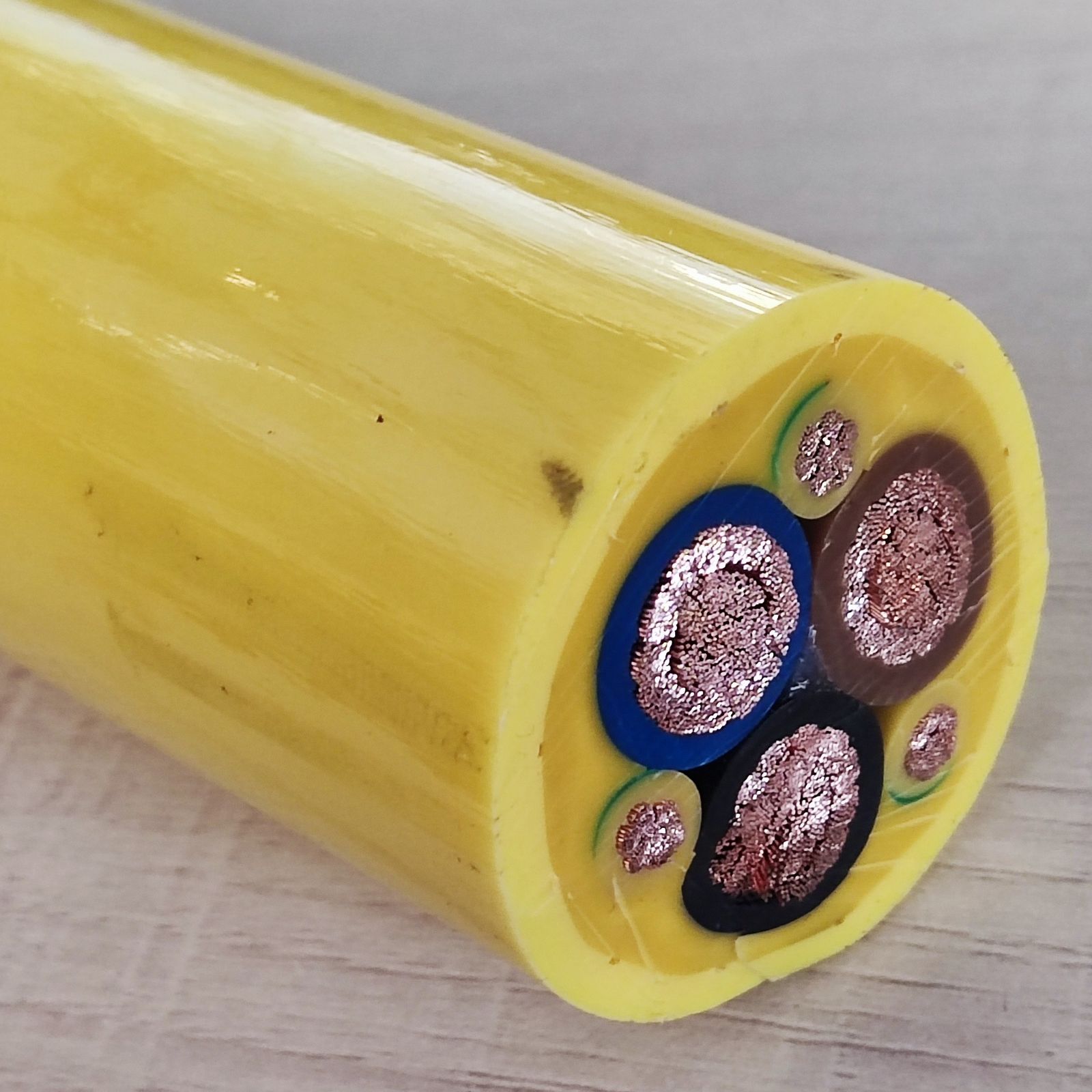
The power conductors are bare copper to IEC 60228 Class 5 or Class 6, sized 4 to 70 mm², and stranded concentric around the central steel wire core. Class 5 and Class 6 stranding is fine enough to wind and unwind smoothly on the motorized drum at the overhead crane reeling speed of up to 30 m per minute without work-hardening the copper. Core insulation is ethylene propylene rubber or PVC, selected for moisture resistance and flexibility.
Optional control conductors, 2 to 8 cores of 0.75 to 2.5 mm² bare copper to IEC 60228 Class 5, can be built into the same cable so that power and control reel from one drum. This eliminates the need for a separate control reel on the crane bridge. An optional CR or NBR inner sheath can be applied over the core assembly for additional mechanical protection.
Jacket Selection and Mechanical Rating
The outer jacket is CR neoprene at 1.5 to 2.0 mm in black, or a PVC or NBR compound at 1.5 to 2.0 mm in black. CR is rated -25 °C to +70 °C and PVC or NBR -15 °C to +70 °C, so the jacket selection follows the lowest ambient temperature at the installation. CR or PVC or NBR is the cost-effective standard for indoor factory overhead crane reeling.
The central galvanized steel wire core is rated at 1 770 N per mm² and carries a working load of 10 to 25 kN depending on the application. Its dual function is mechanical and electrical: it supports the suspended cable weight and serves as the equipment grounding conductor, removing the need for a separate copper earth core and reducing the cable outside diameter by roughly one core diameter.
Reeling Speed and Cycle Life
The cable is built for motorized drum reeling at a drum-to-cable diameter ratio (D or d) of at least 10 to 1, with 12 to 1 recommended. Rated voltage is 0.6 or 1 kV with a 3 500 V AC test for 5 minutes. At the recommended 12 to 1 D or d the cable is rated for more than 80 000 reeling cycles, a flex life determined by the bending curvature imposed by the drum and by the reeling speed of up to 30 m per minute, which sets the rate of heat buildup from repeated bending. The compact outside diameter fits standard crane cable glands and junction boxes without special connectors, and the jacket is flame retardant to IEC 60332-1-2.