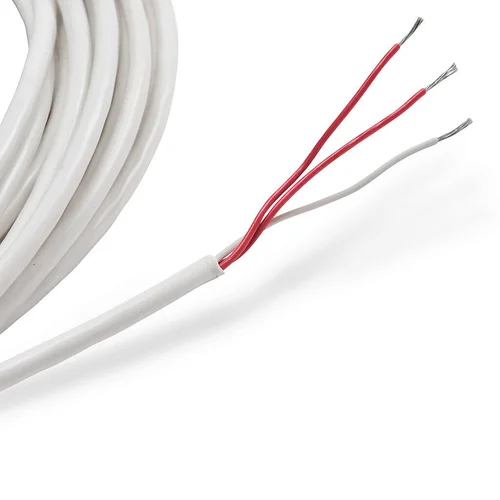
Medical & Industrial Sensor Cable — Shielded Multi-Conductor and Twisted Pair Flexible PUR/Silicone Jacketed Cable with Biocompatible and Sterilization-Resistant Options for Patient Monitoring, Diagnostic Imaging, Surgical Instrument, Pressure/Temperature/Position Sensor, and Transducer Interconnection in Medical and Industrial Applications
Industrial, Mining & Control Cables /Medical & Sensor Cable

Medical & Industrial Sensor Cable — Shielded Multi-Conductor and Twisted Pair Flexible PUR/Silicone Jacketed Cable with Biocompatible and Sterilization-Resistant Options for Patient Monitoring, Diagnostic Imaging, Surgical Instrument, Pressure/Temperature/Position Sensor, and Transducer Interconnection in Medical and Industrial Applications

Medical & industrial sensor cable: shielded multi-conductor, twisted pair, PUR or silicone jacket. Biocompatible, sterilization-resistant (EtO, autoclave, gamma). For patient monitoring, diagnostic imaging, surgical instruments, industrial pressure/temp/position sensors, transducers. CE, RoHS, ISO 10993.

Key Features

Dual medical and industrial sensor cable portfolio — the same cable construction technologies (shielded twisted pairs, low capacitance insulation, flexible PUR/silicone jacket) applied to both the demanding requirements of medical device sensor interconnections (biocompatibility, sterilisation resistance) and industrial sensor and transducer wiring
Medical-grade PUR jacket with ISO 10993 biocompatibility — the jacket material is tested for cytotoxicity, sensitisation, and irritation per ISO 10993-5 and -10; the cable can be in patient contact (not implanted — surface-contact and short-term invasive applications) with verified biological safety per the medical device regulatory requirements
Sterilisation-compatible — EtO (ethylene oxide gas), autoclave (steam at 121–134°C), gamma radiation (25–50 kGy), and STERRAD (hydrogen peroxide gas plasma); the cable jacket, insulation, and identification markings must survive the specified sterilisation method without degradation, discolouration, or loss of mechanical or electrical properties
Shielded twisted pair and multi-conductor constructions — individually shielded pairs for low-level sensor signals (mV from ECG electrodes, μV from thermocouples, pC from piezoelectric pressure sensors); overall shielding for EMI protection in the electrically noisy environments of medical (electrosurgical units, MRI, defibrillators) and industrial (VFDs, welding, switchgear) applications
Low capacitance PE, PP, or FEP core insulation — 40–80 pF/m for twisted pairs; low capacitance is essential for sensor cables because the capacitive loading at the sensor output attenuates high-frequency signal components, reduces the signal-to-noise ratio, and limits the maximum cable length between the sensor and the signal conditioning electronics
PUR (polyurethane) or silicone outer jacket — PUR for general medical and industrial sensor cables requiring chemical resistance, mechanical durability, and a smooth surface finish that can be cleaned and disinfected; silicone for high-temperature (autoclave sterilisation) and high-flex (patient-worn cables, robotic sensor cables) applications where silicone's flexibility and non-kinking characteristics are required
Flexible Class 5 or Class 6 stranded tinned copper or silver-plated copper conductor — ultra-fine stranding for the repeated flexing, coiling, and handling that patient-connected and portable sensor cables experience; silver-plated copper for the best solderability in medical device connector assembly; tinned copper for corrosion resistance in industrial sensor environments
Custom cable constructions — conductor count, pair count, shielding configuration, jacket material and colour, and overall cable OD engineered to the medical device or industrial sensor manufacturer's specific interconnection requirements

Applications

Patient monitoring — multi-conductor or twisted pair cable for ECG (electrocardiogram) lead wires, SpO₂ (pulse oximeter) sensor cables, NIBP (non-invasive blood pressure) cuff tubing + cable, and temperature probe cables connecting the patient-worn sensor to the bedside monitorDiagnostic imaging — shielded sensor cable for ultrasound transducer probe connections, X-ray detector array signal cables, and MRI-compatible (non-magnetic) sensor cables for patient monitoring inside the MRI scanner boreSurgical and interventional instruments — flexible, sterilisable cable for powered surgical handpieces, endoscopic camera connections, electrosurgical instrument cables, and robotic surgery instrument sensor and actuator wiringIndustrial pressure transmitters and transducers — shielded twisted pair or 3-conductor cable from the pressure sensor in the process pipe to the transmitter electronics or junction box; the cable must resist the process environment (oil, chemicals, temperature) and protect the sensor signal from EMIIndustrial temperature sensors — thermocouple and RTD extension cable from the sensor head to the temperature transmitter or DCS input card; for high-temperature industrial applications, the cable jacket may be stainless steel overbraid for mechanical and thermal protectionVibration, position, and displacement sensors — shielded cable for accelerometers, LVDT (linear variable differential transformer) position sensors, proximity probes, and rotary encoders in machinery monitoring, robotics, and industrial automationLaboratory and analytical instrumentation — sensor cable for pH probes, dissolved oxygen sensors, conductivity cells, and spectrophotometer detector connections in laboratory and process analytical applications

Technical Specifications

Medical Standard — Biocompatibility ISO 10993-1 (Biological evaluation of medical devices — evaluation and testing); ISO 10993-5 (cytotoxicity); ISO 10993-10 (sensitisation and irritation); the cable jacket and any patient-contacting materials are tested per the applicable ISO 10993 parts for the medical device's patient contact classification (surface, short-term invasive, etc.)
Medical Standard — Sterilisation The cable must maintain its electrical and mechanical properties after the specified sterilisation method: EtO (ISO 11135, 55°C, 2–6 h exposure), steam autoclave (ISO 17665, 121°C or 134°C, 3–18 min), gamma radiation (ISO 11137, 25–50 kGy), hydrogen peroxide gas plasma (STERRAD, ISO 14937)
Medical Standard — Electrical Safety IEC 60601-1 (Medical electrical equipment — general requirements for basic safety and essential performance); the cable's insulation, leakage current, and dielectric strength must meet the medical electrical safety requirements for the applied part classification (Type BF, CF, or B)
Industrial Standard — Sensor Cable BS 5308 (applicable test methods for shielded twisted pair instrumentation cable); IEC 60092-376 (marine instrumentation — applicable test methods); general industrial sensor cable manufactured to the same electrical performance criteria as instrumentation cable, adapted for flexible, sterilisation-resistant, or biocompatible construction
Rated Voltage — Medical Typically 60 V DC / 25 V AC maximum per IEC 60601-1 applied part isolation requirements; the cable's dielectric strength is tested at 1 500 V AC / 1 min (Type BF applied part) or 4 000 V AC / 1 min (Type CF applied part) per IEC 60601-1
Rated Voltage — Industrial 300 V AC (rms) / 500 V DC for general industrial sensor and transducer circuits; the cable is for extra-low-voltage (ELV) sensor circuits — not for mains voltage
Conductor Material — Medical Silver-plated copper (standard — superior solderability for medical device connector assembly and low contact resistance in crimped connectors); tinned copper (for EtO and autoclave sterilisation — tin plating is stable under these sterilisation methods; gamma radiation can oxidise tin, so silver-plated is preferred for gamma-sterilised cables)
Conductor Material — Industrial Tinned copper (standard — corrosion resistance); bare copper (for indoor, clean industrial environments)
Conductor Class IEC 60228 Class 5 (flexible) or Class 6 (extra-flexible for patient-worn cables); single wire diameter 0.08–0.16 mm
Conductor Cross-Sections 0.05, 0.08, 0.14, 0.22, 0.34, 0.50, 0.75, 1.0, 1.5 mm² (medical low-current sensor wiring); 0.5–2.5 mm² (industrial sensor and transducer wiring)
Core Insulation — PE/PP (Standard) Polyethylene or polypropylene; low dielectric constant (εᵣ = 2.2–2.3) for low capacitance sensor cable; 75–90°C; the standard insulation for medical and industrial sensor cables
Core Insulation — FEP (Medical High-Temp/Chemical) Fluorinated ethylene propylene (FEP); 200°C; chemically inert; for sensor cables that are repeatedly autoclave-sterilised at 134°C or exposed to aggressive chemical disinfectants (Cidex OPA, peracetic acid); FEP's superior thermal and chemical stability justifies the cost premium for reusable, sterilizable medical sensor cables
Core Insulation — Silicone (High-Flex) Silicone rubber; 150–200°C; for patient-worn cables (SpO₂, ECG, temperature probe) where the cable must be extremely flexible, non-kinking, and comfortable against the patient's skin; silicone can be formulated for ISO 10993 biocompatibility for patient skin contact
Shielding — Individual Pair (Typical Medical) Spiral-wrapped or braided tinned copper shield (≥90% coverage) per pair; spiral shield provides better flexibility for patient-worn cables than foil; each pair's shield has a separate drain wire
Shielding — Overall (Typical Medical) Tinned copper spiral or braid shield (≥90% coverage) over the core assembly; provides the primary EMI protection and serves as the cable's overall shield termination at the connector backshell
Shielding — Industrial Sensor (Foil + Drain Wire) Aluminum/polyester foil per pair + overall foil and tinned copper drain wire; lower cost than spiral/braid shielding; adequate for fixed installation industrial sensor cables where flexibility is not the primary requirement
Outer Jacket — Medical PUR Medical-grade polyurethane; Shore A 85–90; ISO 10993 tested; the jacket surface is smooth, non-porous, and can be disinfected with the hospital-grade disinfectants used in clinical environments (alcohol wipes, quaternary ammonium compounds, hydrogen peroxide); the jacket must not discolour, crack, or become sticky after repeated disinfection
Outer Jacket — Silicone (Medical) Medical-grade silicone rubber; Shore A 50–70; ISO 10993 tested; the most flexible and softest jacket material for patient comfort; silicone is more prone to abrasion and cut-through than PUR — for cables subject to mechanical abuse, PUR is preferred
Outer Jacket — Industrial PUR Standard polyurethane TMPU; Shore A 85–90; for industrial sensor cables requiring chemical resistance and mechanical durability
Jacket Colour — Medical Grey, light blue, white (standard medical device colours); the jacket colour must be consistent between production batches — colour variation in a medical device cable is a cosmetic defect that the end-user (hospital, clinician) may perceive as a quality issue
Maximum DC Conductor Resistance at 20°C Per IEC 60228 for the conductor class and cross-section
Insulation Resistance at 20°C ≥100 MΩ·km (PE/PP); ≥1 000 MΩ·km (FEP); at 500 V DC, 1 min
Test Voltage (AC) — Medical, Routine Per IEC 60601-1 for the applied part classification; typically 1 500 V AC / 1 min (Type BF) or 4 000 V AC / 1 min (Type CF) between the conductor assembly and the patient connection
Test Voltage (AC) — Industrial, Routine 1 000 V AC / 1 min (core-to-core, core-to-shield)
Temperature — Medical PUR (Fixed) -30°C to +80°C
Temperature — Silicone (Fixed) -60°C to +180°C
Temperature — Autoclave Sterilisation (Silicone/FEP) Up to 134°C, 3–18 min, repeated cycles; the cable's mechanical and electrical properties must not degrade after the specified number of autoclave cycles (typically 50–100 cycles for a reusable medical cable)
Minimum Bend Radius — Flexible Sensor Cable 5× cable OD (patient-worn and portable sensor cables); 3× cable OD (fixed routing in the device)
Flame Retardant — Medical IEC 60601-1 flammability requirements; the cable materials must meet the fire safety requirements of the medical device standard — not equivalent to building cable fire standards
Certifications — Medical ISO 10993 biocompatibility test reports on request; ISO 13485 (medical device quality management system) manufacturing; IEC 60601-1 compatibility per the medical device manufacturer's cable specification
Certifications — Industrial CE; RoHS; ISO 9001 manufactured; sensor OEM-specific qualification on request

Detailed Description

What Is Medical & Industrial Sensor Cable?

Medical and industrial sensor cable is a flexible, shielded multi-conductor or twisted pair cable designed to connect sensors and transducers to their signal conditioning electronics — the cable that carries the microvolt-level ECG signal from the electrode on the patient's chest to the bedside monitor, the cable that transmits the picocoulomb charge from a piezoelectric pressure sensor to the charge amplifier, and the cable that connects the RTD temperature sensor in the process pipe to the transmitter. The sensor cable is the first link in the measurement chain, and its electrical characteristics — capacitance, shielding effectiveness, insulation resistance, and conductor resistance — directly determine the accuracy, noise level, and bandwidth of the measurement.

The dual medical and industrial designation reflects the fact that the same cable technologies serve both markets: medical sensor cables add biocompatibility and sterilisation resistance requirements; industrial sensor cables add chemical resistance and mechanical durability requirements. The core cable technology — low-capacitance insulation, individual pair shielding, and flexible stranded conductors — is common to both.

Medical vs Industrial — The Specific Requirements

RequirementMedical Sensor CableIndustrial Sensor Cable
BiocompatibilityISO 10993 tested — patient contactNot applicable
SterilisationEtO, autoclave, gamma, STERRADNot applicable (industrial sensors are not sterilised)
Chemical resistanceHospital disinfectants (alcohol, quaternary ammonium, H₂O₂)Process chemicals, oils, solvents, cleaning agents
Electrical safetyIEC 60601-1 applied part isolationStandard ELV insulation
FlexibilityVery high — patient-worn cables must be soft and non-kinkingModerate — fixed or semi-fixed installation
Jacket materialMedical-grade PUR or siliconeIndustrial PUR or PVC
ColourMedical device colours (grey, light blue, white)Black (standard industrial)
RegulatoryMedical device regulations (FDA, MDR, NMPA)Industrial product regulations
ConnectorisationOften factory-terminated with medical-grade connectorsField-terminated at the sensor junction box

Why Choose Yichi Medical & Industrial Sensor Cables

  • ISO 10993 biocompatible materials — tested and certified: The medical-grade PUR and silicone jacket materials are tested for cytotoxicity, sensitisation, and irritation per the applicable ISO 10993 parts. The test reports are available for the medical device manufacturer's regulatory submission (FDA 510(k), EU MDR Technical File, NMPA registration)
  • Sterilisation-compatible — EtO, autoclave, gamma, STERRAD: The cable materials and construction are validated for the specified sterilisation method. The cable withstands the sterilisation process without degradation — the insulation does not crack, the jacket does not discolour, and the electrical properties remain within specification after the rated number of sterilisation cycles
  • Silver-plated copper conductor — optimal for medical connector assembly: Silver-plated copper solders with standard Sn-Ag-Cu solder at standard temperatures, crimps cleanly without fracturing the fine wire strands, and maintains low contact resistance through repeated sterilisation cycles. Tinned copper is an alternative for EtO and autoclave-sterilised cables where soldering is not required
  • Custom cable constructions — designed to your sensor interconnection specification: The conductor count, pair configuration, shielding type, jacket material, colour, and overall OD are engineered to your medical device or industrial sensor specification. Yichi manufactures the cable to your design — you receive a cable that integrates directly into your sensor assembly process with the electrical performance and mechanical characteristics your sensor requires
  • Silicone jacket option — the softest, most flexible sensor cable: For patient-worn cables (SpO₂, ECG leads, temperature probes) where the cable must be comfortable against the skin for hours, flexible enough to move with the patient, and resistant to kinking when the patient moves, silicone is the preferred jacket material. Yichi medical-grade silicone is ISO 10993 tested for patient skin contact and manufactured under ISO 13485 quality management

Product Inquiry

Product: Medical & Industrial Sensor Cable — Shielded Multi-Conductor and Twisted Pair Flexible PUR/Silicone Jacketed Cable with Biocompatible and Sterilization-Resistant Options for Patient Monitoring, Diagnostic Imaging, Surgical Instrument, Pressure/Temperature/Position Sensor, and Transducer Interconnection in Medical and Industrial Applications

Add technical specifications (optional)

The more detail you provide, the faster and more accurate our quotation.

No file chosen

PDF, Office, image or CAD file — up to 5 MB

Need Help?

Certifications

ISO 9001
Quality
CE
European
RoHS
Environmental
TÜV
Certification

Need a Quote for This Product?

Send us your requirements and receive a detailed quotation within 24 hours.