Detailed Description
What Is Cleanroom Rated Cable?
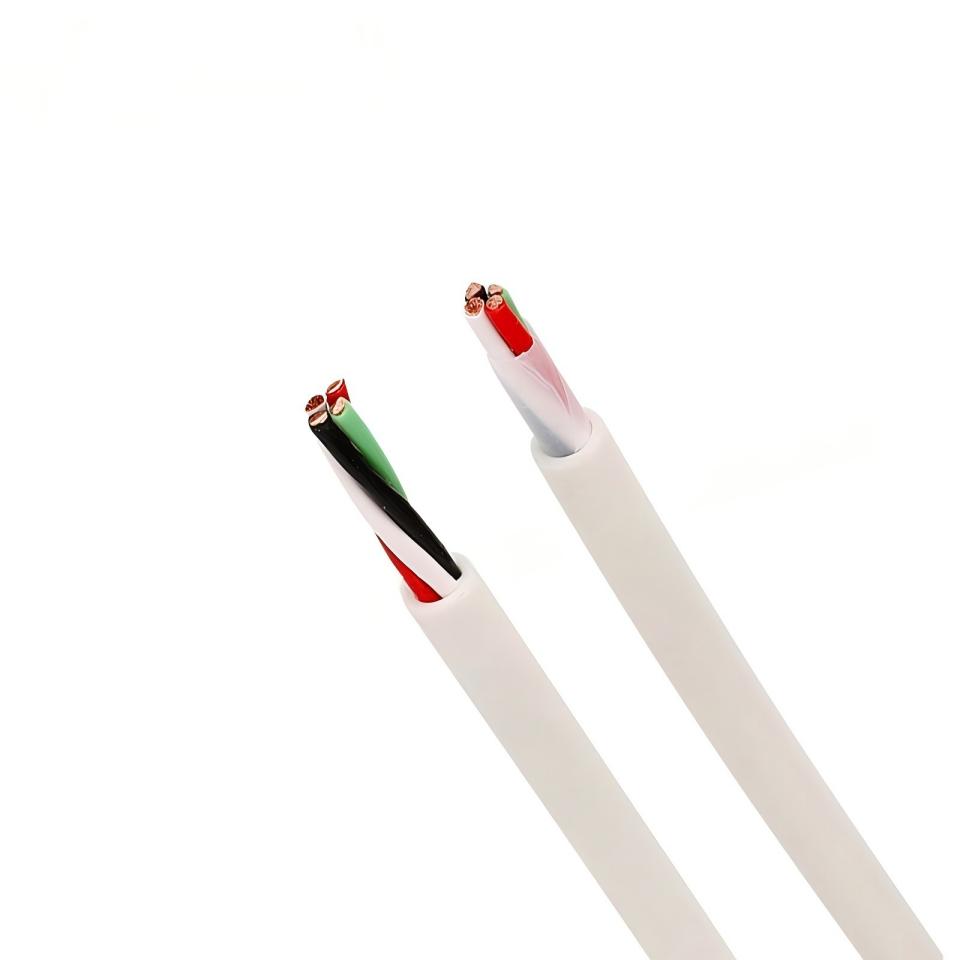
Cleanroom rated cable is a flexible multi-core cable in which every material — insulation, filler, binder tape, jacket, colour concentrate, and packaging — is selected, tested, and controlled to minimise contamination of the cleanroom environment. The cable does not shed particles that would increase the cleanroom's particulate count (ISO 14644-1). It does not outgas volatile organic compounds (VOCs) that would condense on wafer surfaces, optical components, or pharmaceutical product contact surfaces (ISO 14644-8). It contains no silicone (PDMS — polydimethylsiloxane) that would contaminate semiconductor photolithography processes. And the jacket is formulated to resist the cleaning and sterilisation chemicals used in the specific cleanroom application.
A standard industrial cable installed in a semiconductor cleanroom would fail on all counts: the PVC jacket's plasticizers migrate to the surface, trapping particles; the PVC outgasses phthalates and other VOCs; the jacket surface is microscopically rough, providing particle attachment sites; the manufacturing process uses silicone lubricants on the conductor drawing and stranding; and the wooden reel and cardboard packaging introduce fibres and particulates into the cleanroom. A cleanroom cable is designed to eliminate each of these contamination sources.
Why Silicone-Free Matters — The Semiconductor Contamination Problem
In semiconductor manufacturing, a single silicone molecule (PDMS, molecular weight 300–10 000 g/mol) landing on a wafer during photolithography creates a defect that can render the entire die non-functional. PDMS is a particularly problematic contaminant because:
- It is extremely surface-active — a monolayer of PDMS on a wafer surface changes the surface energy and prevents uniform photoresist coating
- It is volatile at the elevated temperatures of semiconductor process chambers (CVD, PVD, etch) and can migrate from a contaminated surface to a clean wafer through the gas phase
- It is difficult to remove — PDMS is not water-soluble and requires aggressive cleaning (piranha solution — H₂SO₄/H₂O₂) to remove from surfaces
- It is ubiquitous — silicone is used as a lubricant in many industrial processes, including standard cable manufacturing (silicone oil on conductor drawing dies, silicone release agents on extrusion tooling)
Why Choose Yichi Cleanroom Rated Cables
- Silicone-free verified — FTIR/XRF analysis on request: Every material in the cable is verified silicone-free by chemical analysis. The finished cable is tested to confirm that no silicone contamination has been introduced during the manufacturing process. A silicone-free certificate is provided with each cable batch
- PUR, LSZH, or FEP jacket — select for the cleanroom chemical environment: PUR for pharmaceutical, biotech, and medical device cleanrooms where the cable is exposed to hydrogen peroxide vapour and quaternary ammonium disinfectants. LSZH for cleanrooms where fire safety is the priority and chemical exposure is moderate. FEP for semiconductor cleanrooms where the highest chemical purity and lowest outgassing are required and the cost premium is justified by the cost of wafer defects caused by cable contamination
- Smooth, non-porous jacket surface — polished die extrusion: The jacket surface finish is not a cosmetic characteristic — it is a functional requirement for cleanroom cable. The glossy, non-porous surface (Ra <1.0 μm) minimises particle adhesion and allows the cable to be wiped clean with cleanroom wipers and IPA without releasing particles or leaving residue
- Cleanroom-compatible packaging — double-bagged for cleanroom introduction: The cable is wound on plastic reels, sealed in polyethylene bags, and double-bagged for cleanroom introduction. The outer bag is removed in the grey area (cleanroom anteroom/airlock), and the inner bag is removed inside the cleanroom. The cable enters the cleanroom without carrying external contamination
- ASTM E595 / SEMI E49 outgassing tested: The cable jacket and insulation materials are tested for outgassing per the semiconductor industry's standard test methods. The test report quantifies the TML (<1.0%) and CVCM (<0.1%) and demonstrates that the cable meets the outgassing limits for the customer's cleanroom ISO class and process sensitivity