Detailed Description
MV + Flat — Combining Two Specialized Technologies
Medium voltage cable requires a specific construction: triple-extruded semiconductive screens, EPR insulation, and copper tape metallic screens — all verified by 100% partial discharge testing. Round MV cable is the industry standard for underground and fixed installations.
Flat cable requires a specific geometry: conductors laid side by side in a ribbon profile, steel wire edge messengers for tensile support, and uniform jacket extrusion across the width. Flat cables are the standard for reeling and festoon where drum space is limited.
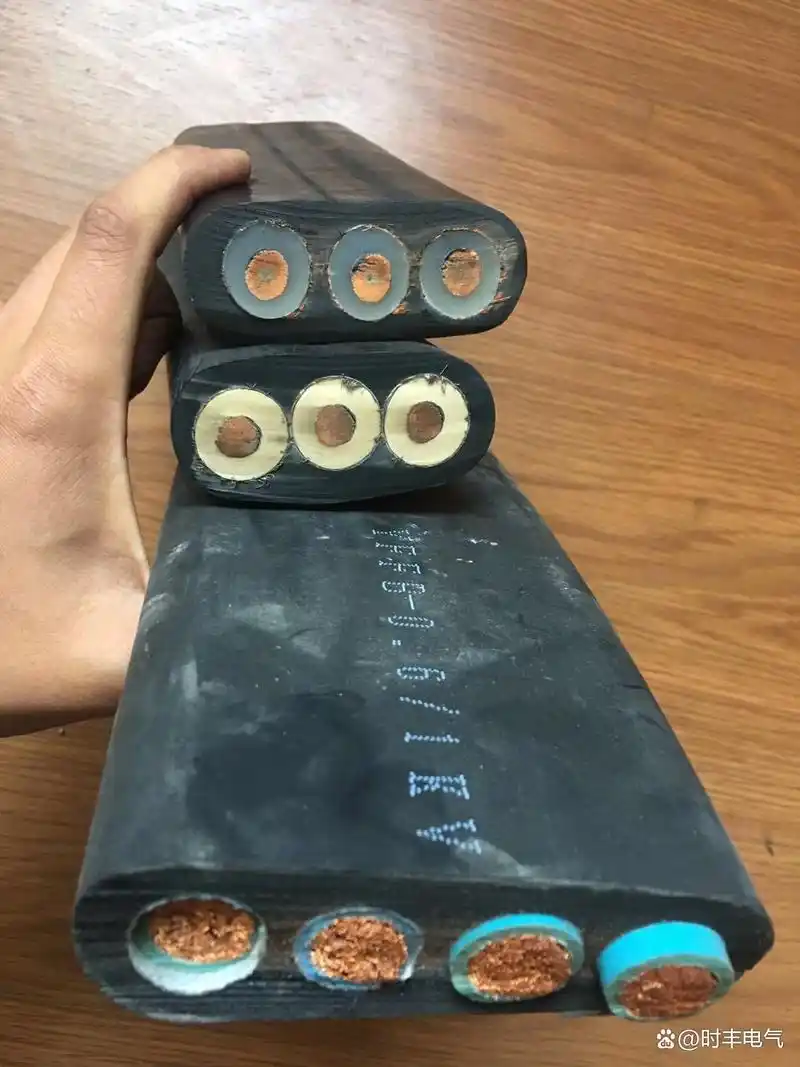
Medium voltage flat cable combines both — the MV electrical construction inside a flat geometry optimized for reeling. This is not a "modified round cable" — it is engineered from the start as a flat MV cable.The Flat Advantage for MV — Why It Matters
MV cable is thick. A 3-core 6/10 kV cable at 95 mm² has an OD of approximately 55 mm. Wound on a drum at 15:1 D/d, the minimum drum diameter is 825 mm. For a mining dragline requiring 400 m of cable, the drum would be impractically large.
A flat MV cable with the same copper cross-section is approximately 75 mm wide × 22 mm thick. The drum is sized to the thickness (22 mm × 15 = 330 mm diameter), not the width. The result: a drum diameter approximately 60% smaller for the same cable length.
This matters when:
- Retrofitting: An existing machine has a fixed drum size — round MV cable would require a new drum, flat MV cable fits the existing one
- Transport: Smaller drums fit on standard flatbed trucks without oversize permits
- Weight: Smaller drums weigh less — reduced crane capacity for installation and maintenance
MV Flat Cable — Bending in One Plane Only
Flat cable bends in the flat plane (folding over its thin dimension) — the same as stacking paper. It does NOT bend edge-wise (against the wide dimension). For MV flat cable, this is even more critical than for LV flat cable:
- MV insulation is thicker: 2.5–4.5 mm of EPR vs 0.6–1.2 mm for LV. Thicker insulation experiences higher bending strain at the inner and outer bend radii
- Triple-extruded layer bonding: The conductor screen-EPR-insulation screen interfaces must survive bending without delamination. A larger bend radius (18:1 D/d minimum) reduces shear stress at these critical interfaces
- Copper tape screen integrity: The helically applied copper tape must maintain its overlap during bending — gaps in the overlap compromise the screen's ground fault current capacity
Why Not Just Flatten a Round MV Cable?
Flattening a conventional round MV cable by running it through rollers destroys it. The triple-extruded insulation system is designed for a specific circular geometry — flattening it creates:
- Delamination between conductor screen and insulation
- Thinning of the insulation at the edges of the flattened cross-section
- Loss of copper tape screen overlap at the flattened sides
Why Choose Yichi Cable MV Flat?
- Flat MV manufacturing expertise: Our MV flat cables are designed and manufactured flat from the start — not round cables flattened as an afterthought
- 100% PD tested: Every meter of MV flat cable is partial discharge tested at 2 U₀ per IEC 60885-3 — the flat geometry does not compromise PD performance
- Tan delta verified: Dielectric loss testing confirms proper triple-extrusion bonding across the entire flat cross-section — no weak points at the edges
- Drum optimization: We calculate the precise flat cable thickness and width to maximize cable length on your existing drum — send us your drum dimensions
- Steel wire messengers engineered: Sized to your cable weight, drum depth, and winding tension — not a standard catalog size