Detailed Description
Fixed vs Traveling — Understanding the Distinction
Elevator shaft cables fall into two fundamentally different categories:
Traveling cables (elevator traveling cable, TVVBPG, YVFB, YFFB) connect the moving elevator car to the fixed building wiring. They hang vertically, flex at the shaft midpoint as the car moves, and must withstand millions of bending cycles. They incorporate steel wire suspension elements to carry their own weight. Fixed installation cables (RVV, building wire) are permanently installed in conduits, cable trays, or fixed to the shaft wall. They do not move with the elevator car and do not experience repeated flexing. They serve the shaft infrastructure — lighting, power outlets, intercom, alarm, sump pump — that operates regardless of car position.This distinction matters because specifying a traveling cable for a fixed installation wastes money (traveling cables are 2–3× more expensive than fixed installation cables of the same electrical specification). Conversely, specifying a fixed installation cable as a traveling cable will result in rapid fatigue failure — fixed cables are not designed for repeated bending.
RVV — The Standard Flexible Building Wire
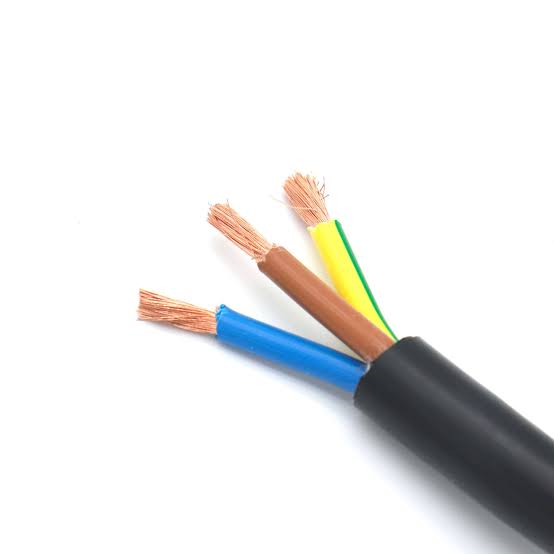
RVV is the most widely recognized flexible cable designation in Chinese and Asian building wiring standards (GB/T 5023.5, equivalent to IEC 60227-5). The designation breaks down as:
| Letter | Meaning | Significance |
|---|---|---|
| R | Flexible conductor (软) | IEC 60228 Class 5 stranded copper — not solid conductor |
| V | PVC insulation (聚氯乙烯绝缘) | Standard 70°C building wire insulation |
| V | PVC sheath (聚氯乙烯护套) | Mechanical and environmental protection |
RVV cable is the flexible equivalent of BV (solid conductor) building wire. It is specified wherever the wiring must be flexible enough for easy installation — pulling through conduits, routing through junction boxes, and terminating at equipment terminals — but does not require the extreme flexibility of a trailing or traveling cable.
Typical Elevator Shaft Fixed Wiring Circuits
A standard passenger elevator shaft requires the following fixed wiring circuits, all of which can be served by RVV cable:
| Circuit | Cores × Cross-Section | Length (Approx.) | Location |
|---|---|---|---|
| Shaft lighting | 2 × 1.5 mm² | Shaft height + 5 m | Each landing, pit, machine room |
| Maintenance power outlet | 3 × 2.5 mm² (L/N/PE) | Shaft height + 5 m | Top, midpoint, pit |
| Intercom system | 4 × 0.75 mm² | Shaft height + 20 m | Car top → machine room → security |
| Emergency alarm | 2 × 0.75 mm² | Shaft height + 20 m | Car → machine room alarm bell |
| Pit sump pump | 3 × 2.5 mm² | 10–15 m | Pit → machine room control panel |
| Machine room fan | 2 × 1.0 mm² | 5–10 m | Machine room ventilation |
| Shaft smoke detector | 2 × 0.75 mm² | Shaft height | Each landing smoke detector → fire panel |
Multiple circuits can be run in the same cable tray or conduit, but each circuit should be a separate RVV cable — mixing unrelated circuits in one cable complicates maintenance and fault-finding.
Yichi RVV Cable Quality
- Conductor stranding verified: IEC 60228 Class 5 minimum strand count per cross-section is verified on every production batch. RVV cables with fewer strands than specified are stiffer and more difficult to install
- Jacket concentricity controlled: Wall thickness measured at 4 points around circumference — minimum thickness ≥90% of nominal. Thin spots are the first point of mechanical failure when pulling through conduit
- Insulation resistance measured: ≥5 GΩ·km at 20°C for every production length. Low insulation resistance indicates moisture contamination or insulation defects
- Marking per GB/T 5023: Cable identification printed on jacket at ≤500 mm intervals — manufacturer, cable type (RVV), core count × cross-section, voltage rating, and standard reference (GB/T 5023.5)