Detailed Description
Why Shielded Control Cable in an Elevator Shaft?
A modern elevator shaft is an electrically hostile environment. In a 20-floor building, the shaft contains:
- The elevator's own VFD (variable frequency drive) — typically 7.5–30 kW — switching at 4–16 kHz carrier frequency, generating harmonics into the MHz range
- The building's main electrical riser — 400 A or more of 3-phase power running parallel to the shaft
- Multiple other elevators in the same shaft group, each with their own VFDs
- Emergency generator transfer switchgear
- Building automation system (BAS) communication wiring
- Cellular and radio signal repeaters for in-elevator coverage
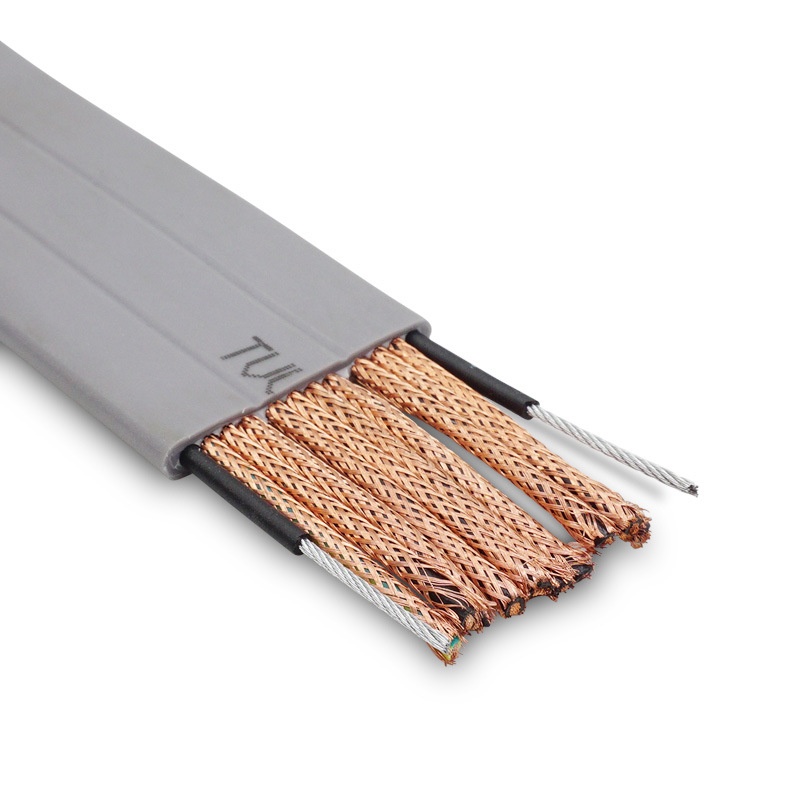
The TVVBPG cable's dual-layer shield — aluminium/polyester foil for high-frequency capacitive coupling + tinned copper braid for low-frequency inductive coupling — reduces induced noise by 40–60 dB compared to an unshielded cable. This is the difference between reliable operation and intermittent phantom calls.
TVVBPG Designation Decoded
The designation follows Chinese cable nomenclature (JB/T 8734 and related standards):
| Letter | Meaning | Significance |
|---|---|---|
| T | Copper conductor (铜) | IEC 60228 Class 5 finely stranded |
| V | PVC insulation (聚氯乙烯绝缘) | Standard elevator shaft insulation material |
| V | PVC sheath (聚氯乙烯护套) | Flame-retardant, indoor-rated jacket |
| B | Flat construction (扁形) | Parallel conductor layout for space-efficient shaft installation |
| P | Shielded (屏蔽) | Aluminium foil + tinned copper braid overall shield |
| G | Steel wire reinforced (钢丝加强) | Galvanized steel wire suspension elements for tensile support |
The "G" (steel wire) is critical — without it, the cable is simply a shielded flat cable (TVVBP). The steel wires make it suitable for vertical suspension in the elevator shaft as a traveling cable.
Shield Design — Why Two Layers?
A single shield layer (foil only or braid only) provides approximately 20–30 dB of noise reduction. The dual-layer design (foil + braid) provides 40–60 dB — a 100× improvement in noise power reduction. Each layer addresses a different noise mechanism:
| Shield Layer | Primary Function | Effective Against |
|---|---|---|
| Aluminium/polyester foil | Capacitive coupling barrier | High-frequency VFD switching noise (10 kHz–100 MHz) |
| Tinned copper braid (≥85%) | Inductive coupling low-impedance path | Low-frequency magnetic fields (50/60 Hz power, VFD fundamental) |
The foil provides 100% coverage — no gaps for capacitively coupled noise. But foil has high DC resistance and cannot carry significant induced current without heating. The braid provides a low-impedance current path (typical DC resistance 5–10 Ω/km for the overall braid) that shunts induced currents to ground. Together, they provide broadband EMI protection.
Yichi TVVBPG Cable Quality
- Braid coverage optically measured: Tinned copper braid coverage is verified on production samples using optical image analysis — ≥85% is the acceptance criterion. Visual inspection alone cannot reliably distinguish 80% from 85% coverage
- Drain wire continuity tested: The foil shield's drain wire (tinned copper, 0.22 mm²) is continuity-tested on every production length. An open drain wire renders the foil shield electrically floating — providing zero EMI protection
- Shield isolation verified: Insulation resistance between shield and each core is measured at 500 V DC — ≥5 GΩ·km minimum. A low insulation resistance indicates a pinhole in the core insulation that would allow signal-to-shield leakage
- Transfer impedance tested: Shield transfer impedance (Z_T) is measured per IEC 62153-4-3 on new cable designs — the key metric for shield performance. Lower Z_T = better shielding. Target: <100 mΩ/m at 30 MHz