Detailed Description
What the UL3321 XLPE Hookup Wire Is Built For
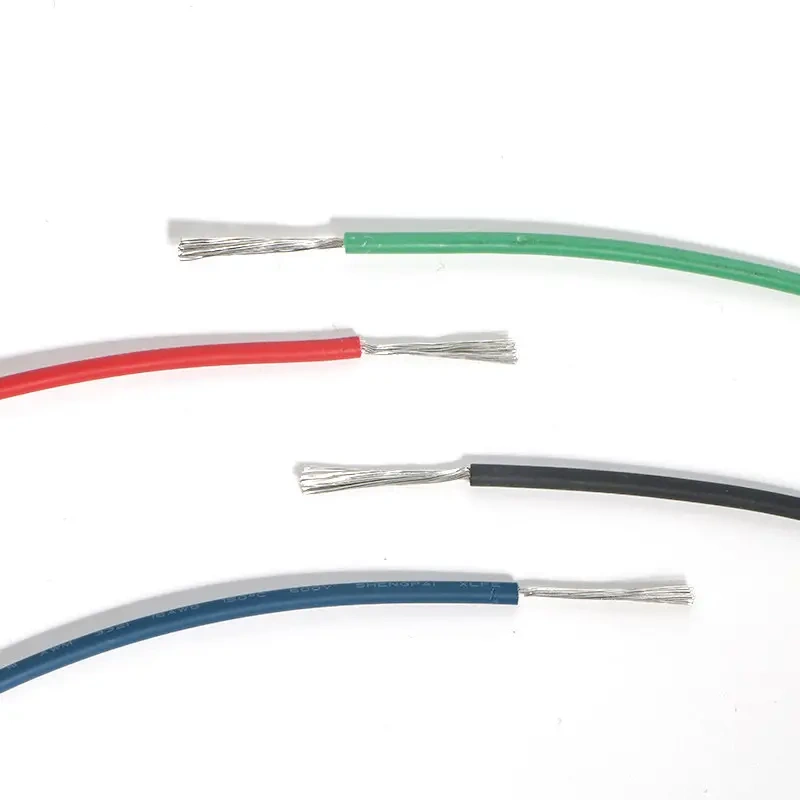
UL3321 XLPE hookup wire is a single-conductor, 600 V lead rated 150 °C and built to UL 758 under AWM style 3321. It exists for one reason: equipment interiors where a standard 105 °C PVC hookup wire runs out of thermal headroom. Around heater elements, motor windings, ballast housings and power conversion stages, a PVC lead softens, deforms against a terminal and eventually exposes conductor. The insulation on this lead is cross-linked, so the wall does not reflow when it gets hot. The 150 °C rating is printed on the jacket itself, together with the gauge, the voltage and the VW-1 flame mark.
The construction is deliberately plain: a stranded tinned copper conductor and a halogen free polyolefin insulation applied as cross-linked XLPE, with nothing else added. No braid, no shield, no outer jacket over an inner one. That keeps the overall diameter predictable for each gauge, so a harness drawing that calls out 2.73 mm for 18 AWG still fits the routing channel after the lead is cut, stripped and terminated.
Layer-by-Layer Construction, Conductor to Insulation
Conductor. Stranded tinned copper. Tinning keeps the copper from oxidising in storage and in humid cabinets, so a stripped end that sits on a bench for a week still takes solder. Stranding holds the individual wires together through automatic cutting and stripping, which means the terminal closes on the full cross-section instead of a partial one. Insulation. Cross-linked XLPE, a halogen free polyolefin compound. Cross-linking is what separates this material from ordinary thermoplastic insulation: the polymer network does not reflow when it heats up. Wall thickness follows grouped values — 0.78 mm from 30 AWG through 10 AWG including 9 AWG, 1.15 mm for 8, 6 and 4 AWG, and 1.53 mm for 2 AWG. Concentricity. The insulation is applied with low eccentricity, so the wall is even all the way around the conductor. An off-centre wall leaves a thin spot, and that thin spot becomes the dielectric weak point both under the 2500 V test and under surge conditions in service.Electrical and Environmental Ratings
| Parameter | Value |
|---|---|
| Voltage rating | 600 V |
| Test voltage | 2500 V |
| Temperature rating | 150 °C |
| Operating temperature range | -60 °C to +150 °C |
| Storage temperature | -10 °C to +40 °C |
| Conductor | Stranded tinned copper |
| Insulation | Cross-linked XLPE, halogen-free polyolefin |
| Flame rating | VW-1 |
| Overall diameter tolerance | ±0.1 mm |
| Standard | UL 758 (AWM 3321) |
The -60 °C lower limit is what makes a 150 °C hookup wire usable in cold-chain equipment, outdoor lighting enclosures and vehicle harnesses that see winter start-up. A lead rated only to -15 °C would crack in those places; the XLPE compound here is specified down to -60 °C.
Specification Table: 30 AWG to 2 AWG
| AWG | Conductor (No./mm) | Conductor dia. (mm) | Insulation (mm) | Overall dia. (mm) | Resistance (Ω/km) | Spool (m/ft) |
|---|---|---|---|---|---|---|
| 30 | 7/0.10 | 0.30 | 0.78 | 1.86 | 381 | 610/2000 |
| 28 | 7/0.127 | 0.38 | 0.78 | 1.94 | 239 | 610/2000 |
| 26 | 7/0.16 | 0.48 | 0.78 | 2.04 | 150 | 610/2000 |
| 24 | 11/0.16 | 0.60 | 0.78 | 2.16 | 94.2 | 610/2000 |
| 22 | 17/0.16 | 0.76 | 0.78 | 2.32 | 59.4 | 305/1000 |
| 20 | 21/0.18 | 0.94 | 0.78 | 2.49 | 36.7 | 305/1000 |
| 18 | 16/0.254 | 1.18 | 0.78 | 2.73 | 23.2 | 305/1000 |
| 16 | 26/0.254 | 1.50 | 0.78 | 3.06 | 14.6 | 305/1000 |
| 14 | 41/0.254 | 1.89 | 0.78 | 3.45 | 8.96 | 305/1000 |
| 12 | 65/0.254 | 2.37 | 0.78 | 3.93 | 5.64 | 305/1000 |
| 10 | 105/0.254 | 3.02 | 0.78 | 4.58 | 3.55 | 305/1000 |
| 9 | 133/0.254 | 3.36 | 0.78 | 4.92 | 2.82 | 305/1000 |
| 8 | 133/0.28 | 3.75 | 1.15 | 6.05 | 2.23 | 100/328 |
| 6 | 84/0.45 | 4.79 | 1.15 | 7.09 | 1.41 | 100/328 |
| 4 | 133/0.45 | 6.02 | 1.15 | 8.32 | 0.89 | 100/328 |
| 2 | 212/0.45 | 7.60 | 1.53 | 10.66 | 0.56 | 100/328 |
Conductor resistance is listed for every gauge so voltage drop can be calculated before the harness is built, from 381 Ω/km at 30 AWG down to 0.56 Ω/km at 2 AWG. Sizes above 2 AWG, from 1 AWG through 4/0 AWG, are available as custom constructions.
VW-1 Flame Test: What the Rating Proves
VW-1 is a vertical flame test, and the method is what gives the mark its meaning. A specimen is held vertically. A test burner with a 125 mm flame height and 500 W thermal output is applied for 15 seconds, then withdrawn for 15 seconds, and the cycle repeats five times. To pass, three conditions must all hold: afterflame must not exceed 60 seconds, no more than 25 percent of the specimen may be consumed, and the cotton placed beneath the specimen must not be ignited by anything falling from it.
For a panel builder this translates into a practical statement. A burning lead does not carry flame up the bundle, and it does not drip ignited material onto components below. Combined with the halogen free insulation, which produces low smoke and no halogen acid if it does burn, the lead is a defensible choice inside enclosures where a fault is possible and people work nearby.
Where This 150 °C Lead Goes Inside Equipment
- Appliance internal wiring — oven, dryer and heater leads running close to elements at the terminal block, where ambient exceeds what PVC tolerates.
- Motor lead wire — pump, fan, compressor and gearmotor terminations, where the joint must survive both winding heat and continuous vibration.
- Temperature sensor lead — thermocouple and RTD extensions, including in-probe runs, where a lead that changes properties with heat would corrupt the reading.
- New energy vehicle harnesses — battery pack, charger and inverter internal runs that see high ambient and wide temperature swing.
- Lighting fixture and LED driver wiring — driver output leads, where a slim overall diameter helps the lead fit a narrow extrusion.
- Robotics, drones and portable electronics — internal power runs and moving harness sections that need repeated flexing without insulation cracking.
Selection, Configurations and Ordering
Match the gauge to the current first, then check the ambient at the hottest point the lead actually touches, not the cabinet average. The 150 °C rating applies at the conductor and the insulation, so a run passing a heater can be sized on the hot spot. Leave the ±0.1 mm overall diameter tolerance in the routing calculation: a channel sized to the nominal value can pinch the lead once tolerance stacks against the terminal.
For terminating, the tinned stranded conductor is intended for standard automatic cut-and-strip equipment and for crimped or soldered joints. Because the insulation is cross-linked rather than thermoplastic, a short soldering dwell at the joint stays within the material's rating and the wall does not pull back from the conductor.
Standard colors are white, black, red, brown, yellow, blue, green and yellow-green. The jacket carries the AWM 3321 legend with the gauge, 150 °C, 600 V, VW-1 and XLPE. Spools follow the gauge: 610 m / 2000 ft for 30 AWG to 24 AWG, 305 m / 1000 ft for 22 AWG to 9 AWG, and 100 m / 328 ft for 8 AWG to 2 AWG. Custom constructions from 1 AWG to 4/0 AWG are built to order.
Why this lead fits your equipment: one AWM style covers 30 AWG to 2 AWG at 600 V and 150 °C, with a published conductor resistance for each gauge and a VW-1 flame rating, so the same print legend and the same insulation system carry across every lead in the harness instead of forcing a second approved part.Send the gauge, color, cut length and annual volume through the enquiry form on this page, and we will confirm the construction and the lead time for your order.