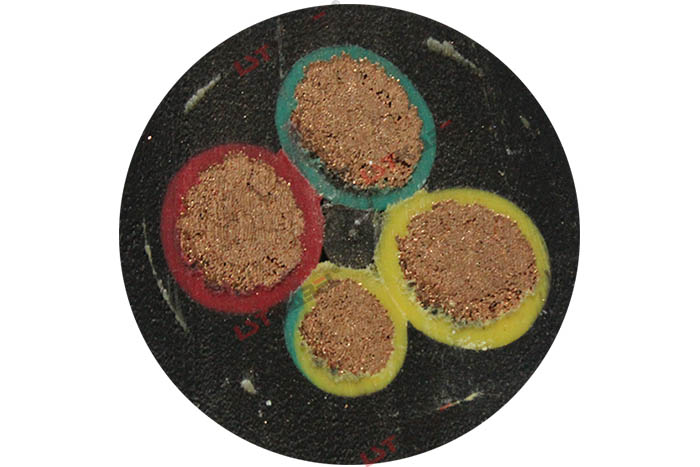
Detailed Description
The Chemistry of Waste — Why Standard Cables Fail
A waste handling facility is a chemical reactor operating at ambient temperature. The cable environment is dominated by decomposition chemistry:
Organic Acid Attack — The Primary Threat
Decomposing organic waste generates a mixture of short-chain organic acids — acetic, propionic, butyric, and valeric — at concentrations that lower the pH of liquid leachate to 3–6. These acids are:
- Water-soluble: They dissolve in the high-humidity atmosphere of a waste bunker and deposit on cable surfaces as acidic condensate
- Plasticizer-extracting: PVC jacket plasticizers are extracted by organic acids within weeks, leaving the PVC brittle and cracked
- Rubber-swelling: CR (neoprene) swells in organic acid solutions, losing up to 30 % of its mechanical tensile strength over 3–6 months of exposure
H₂S — The Copper Corrosion Accelerator
Anaerobic decomposition of sulfur-containing organic matter (proteins in food waste, gypsum in construction debris) generates hydrogen sulfide (H₂S). Concentrations of 5–50 ppm are typical in waste bunkers. H₂S reacts with bare copper:
4Cu + 2H₂S + O₂ → 2Cu₂S + 2H₂OCopper(I) sulfide (Cu₂S) is non-conductive. It forms a dark, brittle layer on the conductor surface that increases contact resistance at terminations and can flake off, creating conductive debris paths.
The solution: Every copper conductor in the cable is tinned (coated with a tin-lead or pure tin layer). Tin does not react with H₂S — the conductor remains clean and conductive throughout the cable's service life.Moisture + Heat = Hydrolysis
The combination of constant moisture (70–95% relative humidity in a waste bunker) and elevated temperature (30–50°C from biological activity) creates ideal conditions for hydrolysis — the chemical breakdown of polymer chains by water molecules.
Polyester-based PUR hydrolyzes: The ester bonds (-COO-) in polyester PUR are attacked by water, breaking the polymer backbone. The jacket loses mechanical strength, develops surface cracks, and eventually disintegrates. Typical failure in 6–18 months. Polyether-based PUR resists hydrolysis: The ether bonds (-C-O-C-) in polyether PUR are chemically stable against water. The jacket maintains its mechanical properties through years of wet-warm exposure.Material Selection — The Critical Decision
| Cable Component | Wrong Choice | Consequence | Correct Choice |
|---|---|---|---|
| Jacket | PVC | Plasticizer extraction → embrittlement in 4–8 weeks | Polyether PUR |
| Jacket | CR neoprene | Swelling in organic acids → 30 % strength loss in 3–6 months | Polyether PUR |
| Jacket | Polyester PUR | Hydrolysis → jacket disintegration in 6–18 months | Polyether PUR |
| Conductor | Bare copper | H₂S attack → Cu₂S formation → increased resistance + flaking | Tinned copper |
| Tensile core | Galvanized steel | Zinc dissolves in acidic leachate → rust → strength loss | Stainless steel |
| Tensile core | Standard steel | Rapid corrosion → structural failure within 12 months | Stainless steel |
Only one combination survives all waste environment threats simultaneously: polyether PUR jacket + tinned copper conductors + stainless steel tensile core. Every other material combination fails on at least one dimension.
Why Choose Yichi Waste Handling Crane Cable?
- Polyether PUR only: We default to polyether PUR for all waste application cables — polyester PUR fails in this environment and we will not supply it for waste handling
- Tinned copper mandatory: Every conductor is tinned — this is not an optional extra, it is the engineering minimum for H₂S resistance
- Stainless steel tensile core: Eliminates galvanic corrosion between the steel core and the acidic waste leachate environment
- ISO 846 verified: Microbe resistance tested and certified — important for organic waste facilities where bacterial and fungal growth is continuous
- Smooth, low-adhesion jacket: Our PUR formulation includes micron-scale solid lubricants that reduce waste debris sticking to the cable surface — less cleaning required, less abrasive drag during reeling
- Orange jacket option: High-visibility orange for waste facility safety — standard for European waste handling installations