คำอธิบายโดยละเอียด
What a 300 °C Rating Means in Practice
A 300 °C cable is not simply a silicone cable with a higher number on the datasheet. At that temperature, the failure modes change: the conductor oxidizes faster, the insulation softens and loses mechanical strength, and anything pressed against the cable — a tray edge, a clamp, a metal guard — will cut through a soft insulation wall.
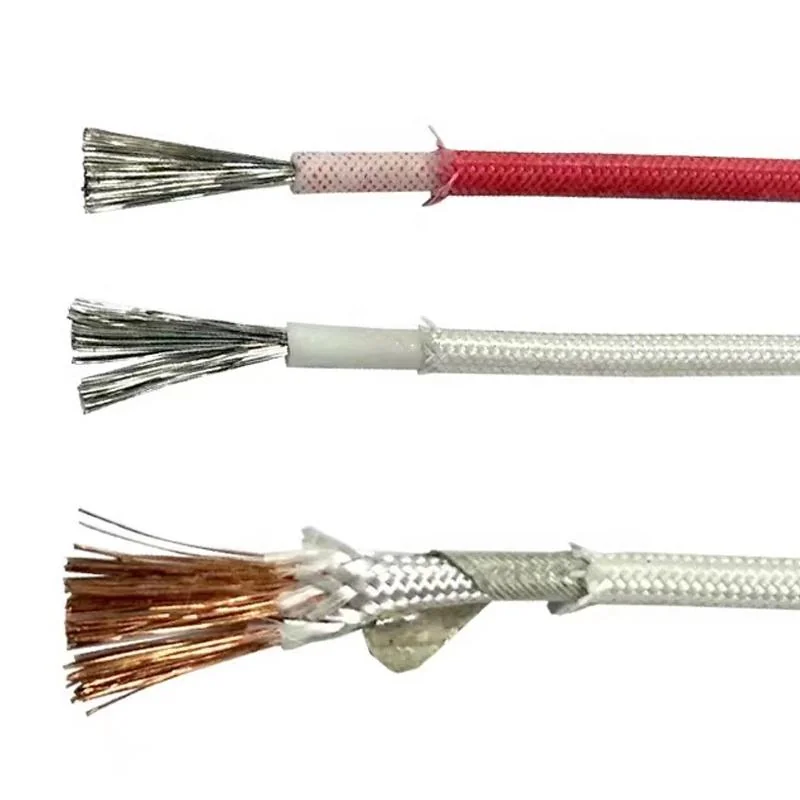
That is why the AGRP construction has two layers doing two different jobs. The silicone provides the dielectric strength and stays flexible across the range, and the fibreglass braid on the outside takes the abrasion and the radiant heat. The rating is the result of the pair, not of either layer alone.
The cable is rated 300/500 V and covers −60 °C to +300 °C, from the radiant heat beside a furnace or a ladle to the cold of an unheated outdoor route.
Construction: Tinned Copper, Silicone, and the Fibreglass Braid
The build runs from the conductor outward in three layers:
- Conductor — high-purity tinned copper, stranded. The tin coating is there for the temperature: at 300 °C, bare copper oxidizes and the oxide layer raises the resistance of the joint and of the conductor surface. Tinning holds the surface stable.
- Insulation — environmentally friendly silicone rubber, extruded at a controlled wall with low eccentricity. An even wall is what prevents the thin spot that becomes the breakdown point.
- Outer braid — high temperature fibreglass, heat treated and braided over the insulation. It is the abrasion barrier, the radiant-heat barrier, and the layer that sheds oil and water rather than absorbing them.
Electrical and Thermal Ratings
| Parameter | Value |
|---|---|
| Rated voltage | 300/500 V |
| Temperature range | −60 °C to +300 °C |
| Cross-sections | 0.5, 1, 2.5, 4, 6 mm² |
| Conductor | Tinned copper, stranded |
| Insulation | Silicone rubber |
| Outer braid | Heat-treated fibreglass |
| Flame behaviour | Self-extinguishing after flame removal |
| Flame performance | Core intact after 2 minutes of direct flame |
| Chemical resistance | Oil, water, heat, corrosion |
| Immersion test | Intact after 60 days |
| Standard length | 95 m per coil, customizable |
The flame figures deserve a note. Self-extinguishing and a two-minute intact core are useful properties for a plant cable, but they are not the same as circuit integrity under fire conditions. Where a circuit must keep working during a fire — an alarm, a pressurisation fan, an evacuation system — a fire resistant cable tested to a fire test standard is the correct product, not a high-temperature cable.
Where the Cable Is Used
The construction is specified in six settings, all of them defined by heat rather than by current:
- Metallurgy and foundry — wiring near furnaces, ladles, and heat-treatment lines, where the ambient temperature is above what PVC or a standard silicone cable can take.
- Instrumentation in hot zones — sensor and signal leads on equipment that runs hot.
- Power and lighting in high-temperature areas — fixture wiring and distribution where the route passes close to a heat source.
- Electrical and electronic equipment — internal and inter-unit wiring in appliances and equipment that generate heat.
- Telecommunications equipment — wiring in cabinets and enclosures where heat build-up is a design constraint.
- Building services — high-temperature routes where a standard cable would degrade.
Lengths, Customization, and Certification
The standard coil is 95 m, and the length can be customized for a project. For other models in the range, lengths below 100 m are supplied as measured cut lengths. State the cross-section, the circuit current, and the route length, and the coil or cut length is set from those three inputs.
Certification is market-specific and is not fixed by the construction. Tell us the destination market — China, the EU, North America, or another region — and the certificate required for that market is confirmed before the order is placed, rather than assumed from the cable type.
To specify AGRP cable, four items are enough: the cross-section, the circuit voltage, the maximum temperature at the installation point, and the route length. Send them through the enquiry form on this page and the construction and the coil length are confirmed against them.