Detailed Description
What Is Combination Coaxial Cable?
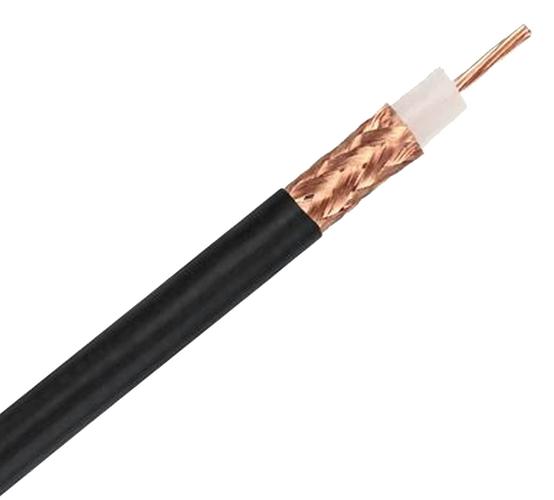
A combination coaxial cable is a composite cable that contains multiple individual coaxial elements — each a complete, impedance-matched coaxial transmission line with its own centre conductor, dielectric, and shield — bundled together with optional power conductors, control cores, twisted pairs, and fiber optic elements in a single overall jacket. It is the cable that replaces multiple separate coaxial cables with one multi-function cable assembly.
The most common application is the multi-camera CCTV or broadcast camera cable: one combination cable carries 4–12 channels of video (each on its own 75 Ω coaxial element), the camera power supply (on power conductors), the pan/tilt/zoom control signals (on shielded twisted pairs), and the intercom audio and tally signals (on additional control cores). A single cable connects the camera to the control room — one cable pull, one multi-pin connector, one cable management system. Without the combination cable, the installer pulls 4–12 individual coaxial cables plus separate power and control cables, ties them into a bundle, and terminates each one individually.
Coaxial Element Selection — RG174 to RG59 and Beyond
| Coaxial Element Type | Impedance (Ω) | Nominal OD (mm) | Attenuation at 100 MHz (dB/100 m) | Best For |
|---|---|---|---|---|
| Micro-coax (0.8–1.5 mm) | 50 or 75 | 0.8–1.5 | 50–80 | Medical ultrasound, aerospace — highest channel density |
| RG174 | 50 | 2.5 | 30 | RF instrumentation, antenna feeds — compact 50 Ω |
| RG179 | 75 | 2.5 | 28 | Compact video — equivalent OD to RG174 but 75 Ω for video |
| RG58 | 50 | 5.0 | 15 | Standard 50 Ω RF — lab instrumentation, antenna distribution |
| RG59 | 75 | 6.1 | 10 | Standard HD-SDI video — lower attenuation for longer cable runs |
| RG6 | 75 | 7.0 | 7 | Long-distance video — lowest attenuation for longest runs |
| RG11 | 75 | 10.3 | 5 | Very long-distance video — backbone distribution between buildings |
For a combination coaxial cable, the element type is selected for each channel based on the signal frequency, the channel's maximum cable length, and the space available within the overall cable OD. A 12-channel broadcast camera cable might use RG179 for the 10 lower-bandwidth channels (return video, audio, intercom) and RG59 for the 2 main program video channels that require the lowest attenuation over the 100–300 m cable run from the camera to the CCU.
Why Choose Yichi Combination Coaxial Cables
- Custom configurations — manufactured to your signal routing diagram: Every combination coaxial cable is a custom design. You specify the coaxial elements (type, impedance, count), any power conductors, control cores, twisted pairs, or fiber elements, and the overall jacket material and colour. Yichi engineers the core assembly for the optimal electrical performance, mechanical robustness, and compact OD — and delivers the cable with a full electrical test report per coaxial element
- Impedance-matched and attenuation-tested — every coaxial element verified: Each coaxial element in the cable is tested for characteristic impedance (TDR — Time Domain Reflectometry) and attenuation at the specified frequency. The test report per element is provided with the cable batch — if an element is out of specification, the cable is rejected. The electrical performance of every channel is verified before the cable leaves the factory
- Individual element shielding — >60 dB channel-to-channel isolation: Each coaxial element has its own braid shield (≥90% coverage). An optional overall foil + braid shield over the complete core assembly provides additional external EMI protection. The inter-channel crosstalk is controlled to < -60 dB at 100 MHz — ensuring that a strong signal on one video channel does not appear as ghosting or interference on an adjacent channel
- PUR jacket for broadcast and industrial field applications: The PUR jacket is the standard for cables that are handled, coiled, uncoiled, run over by camera dollies, exposed to outdoor weather, and expected to survive years of production use. PVC jackets crack from flex fatigue and degrade under UV — PUR is specified wherever the cable is a tool, not a fixed installation
- Application engineering support — select the right coaxial element for your signal type and cable length: Send us your signal requirements (frequency, cable length, connector type) for each channel, and we recommend the coaxial element type that provides the required signal quality at that cable length — balancing performance, cable OD, and cost