Security System Cable — RG59/RG6 Coaxial Video Cable, Multi-Core Combined Power + Video Siamese Cable, Cat5e/Cat6 Network Cable, and Shielded Multi-Conductor Control Cable for CCTV Surveillance, IP Camera, Access Control, Intercom, and Integrated Building Security System Installation
Industrial, Mining & Control Cables /Security System Cable

Security System Cable — RG59/RG6 Coaxial Video Cable, Multi-Core Combined Power + Video Siamese Cable, Cat5e/Cat6 Network Cable, and Shielded Multi-Conductor Control Cable for CCTV Surveillance, IP Camera, Access Control, Intercom, and Integrated Building Security System Installation

Security system cable: RG59/RG6 coax, Siamese power+video, Cat5e/Cat6 network, shielded multi-conductor control. For CCTV, IP cameras, access control, intercom. PVC or LSZH. 300/500V. Flame retardant. Pre-terminated options. CE, RoHS.

Key Features

Complete security system cable portfolio — RG59 and RG6 coaxial cable for analog HD CCTV cameras, Siamese cable (coax + 2-core power in one jacket) for single-cable camera installation, Cat5e/Cat6 network cable for IP cameras, and shielded multi-conductor control cable for access control, intercom, and system integration
RG59 coaxial cable with 95%+ copper braid coverage — 75 Ω characteristic impedance, solid copper or copper-clad steel centre conductor, foam PE dielectric; RG59 is the standard cable for analog CCTV (composite video, HD-TVI, HD-CVI, AHD) with video transmission distances up to 300–500 m depending on the camera resolution
RG6 coaxial cable for longer-distance and higher-resolution CCTV — larger centre conductor (1.02 mm vs 0.81 mm for RG59) and thicker dielectric, providing lower attenuation at high frequencies; RG6 is specified for 4K / 8MP analog HD cameras and for cable runs exceeding 200 m where RG59's attenuation would degrade the video signal
Siamese cable — RG59 or RG6 coaxial video cable + 2-core stranded copper power cable (18/2 or 16/2 AWG) in a single figure-8 or round jacket; one cable from the DVR/NVR to each camera carries both the video signal and the 12 V DC or 24 V AC camera power — one cable pull, one cable route, one termination at each end, no separate power cable
Cat5e/Cat6 UTP or SFTP network cable for IP camera systems — 100 MHz (Cat5e) or 250 MHz (Cat6) bandwidth, 1 Gbps data rate; solid copper conductor for permanent installation cable runs from the PoE (Power over Ethernet) switch to each IP camera; the same cable carries the camera's video data stream (up to 4K H.265) and PoE power (up to 30 W per IEEE 802.3at)
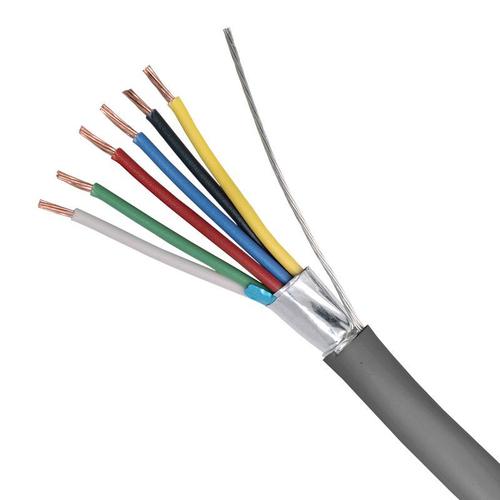
Shielded multi-conductor control cable — 2–12 cores, 0.22–1.5 mm², overall foil/braid screen; for access control system wiring (card readers, electric locks, door position sensors), intercom system wiring, and security system integration between the intrusion alarm, CCTV, and building management system
PVC, LSZH, or outdoor PE jacket options — PVC for indoor general installation; LSZH for public buildings and escape routes; outdoor PE jacket for external camera and device cabling exposed to weather and UV
Pre-terminated options available — BNC connectors on coaxial cable, RJ45 connectors on Cat5e/Cat6, and DC power connectors on Siamese and power cables; factory-terminated cables reduce on-site installation time and eliminate termination quality variability

Applications

CCTV camera installation — RG59 or RG6 coaxial cable (analog HD cameras) or Cat5e/Cat6 network cable (IP cameras) from the DVR/NVR location to each camera position around the building perimeter, car park, and internal areas; the cable is routed through ceiling voids, external conduit, and surface trunkingSiamese camera cabling — a single Siamese cable (coax + power) to each camera location; the installer pulls one cable, connects the BNC to the camera's video output and the DC connector to the camera's power input — half the cable pulls and half the termination time compared to separate coax and power cablesIP camera PoE system — Cat5e or Cat6 solid conductor network cable from the PoE switch in the equipment room to each IP camera; the switch provides both the network connection and the DC power over the same cable, eliminating the need for a separate power supply at each camera locationAccess control system — multi-conductor shielded cable from the access control panel to each controlled door, carrying the card reader data (Wiegand or OSDP protocol), the electric lock power, the door position sensor circuit, and the request-to-exit button circuitVideo intercom and door entry system — multi-core cable or Cat5e/Cat6 for video door stations, indoor monitor panels, and the central control unit; the cable carries the video signal (analog composite or IP digital), the two-way audio, and the door release controlIntegrated security management — Cat5e/Cat6 backbone cabling connecting the CCTV NVR, access control server, intrusion alarm panel, and building management system on a common security network; the network cable enables centralized monitoring, alarm correlation, and remote access

Technical Specifications

Cable Types RG59 coaxial (75 Ω); RG6 coaxial (75 Ω); Siamese (coax + 2-core power); Cat5e/Cat6 UTP or SFTP (100 Ω); shielded multi-conductor control (300/500 V); outdoor PE sheathed variants
RG59 — Centre Conductor 0.81 mm (20 AWG) solid bare copper (BC) or copper-clad steel (CCS); BC for best video signal quality (low DC resistance over long runs); CCS for shorter runs where the steel core provides additional tensile strength for pulling
RG59 — Dielectric Foam polyethylene (FPE); 3.7 mm OD; the gas-injected foam dielectric has a lower dielectric constant than solid PE, reducing attenuation per meter
RG59 — Shield Aluminum/polyester foil (100% coverage) + tinned copper braid (95% coverage); the dual-layer shield provides excellent EMI rejection for the analog video signal in the electrically noisy building environment (adjacent to mains cables, VSDs, fluorescent lighting ballasts)
RG59 — Jacket PVC (grey or black, indoor); PE (black, outdoor UV-resistant); LSZH (white, public buildings)
RG59 — Attenuation at 100 MHz (Typical) 10–12 dB/100 m; determines the maximum cable length for a given camera resolution — the DVR/NVR's video input sensitivity dictates the maximum allowable attenuation
RG59 — Maximum Recommended Length (Analog CCTV) 300 m (standard definition, 960H); 200 m (HD-TVI/CVI/AHD 1080P); 150 m (4 MP / 8 MP analog HD); the attenuation at the video signal's highest frequency component limits the maximum cable length for a given resolution
RG6 — Centre Conductor 1.02 mm (18 AWG) solid bare copper; 25% larger cross-sectional area than RG59, reducing DC resistance and high-frequency attenuation
RG6 — Attenuation at 100 MHz (Typical) 7–8 dB/100 m; approximately 30% lower attenuation than RG59, extending the maximum cable length or supporting higher camera resolutions at a given cable length
RG6 — Maximum Recommended Length (Analog CCTV) 400 m (SD/960H); 300 m (HD 1080P); 200 m (4 MP / 8 MP)
Siamese Cable — Video Element RG59 or RG6 coaxial as above
Siamese Cable — Power Element 2-core stranded bare copper, 18 AWG (0.82 mm²) or 16 AWG (1.31 mm²); red (positive) and black (negative); PVC insulation; the power cores carry the camera's 12 V DC or 24 V AC supply from the central power supply unit
Siamese Cable — Construction Figure-8 (coax and power cable moulded side-by-side in a single jacket — the two elements can be separated by tearing the web between them for termination) or round (both elements inside a single circular jacket — more compact and easier to pull through conduit)
Siamese Cable — Maximum Cable Length (Power Limitation) The voltage drop in the power conductors limits the cable length: a 12 V DC camera drawing 500 mA on an 18 AWG Siamese cable (power conductor resistance 21 Ω/km one-way) has a voltage drop of 21 Ω/km × 0.5 A × 0.2 km = 2.1 V over 200 m (one-way) = 4.2 V total; the camera's minimum input voltage is typically 10 V — the Siamese cable supports a 200 m run at 18 AWG; for longer runs, 16 AWG or a local power supply at the camera is required
Cat5e Network Cable — Construction 4 twisted pairs (4×2), 24 AWG solid bare copper, PE insulation, overall PVC or LSZH jacket; 100 MHz bandwidth; UTP (unshielded) or SFTP (foil + braid shielded)
Cat6 Network Cable — Construction 4 twisted pairs (4×2), 23 AWG solid bare copper, PE insulation, cross separator between pairs, overall PVC or LSZH jacket; 250 MHz bandwidth
Cat5e/Cat6 — PoE Capability IEEE 802.3af (PoE, 15.4 W at the switch), IEEE 802.3at (PoE+, 30 W), IEEE 802.3bt (PoE++, 60–100 W); the 24 AWG or 23 AWG solid copper conductor carries the DC power to the IP camera; the cable's DC loop resistance per pair limits the maximum PoE cable length — typically 100 m per the Ethernet standard
Cat5e/Cat6 — Maximum Length (Ethernet) 100 m (the channel length per ISO/IEC 11801, including the patch cords at both ends); the 100 m limit is set by the Ethernet signal timing, not by the cable attenuation — at 100 m at 1 Gbps, the signal propagation delay and the return loss, not the insertion loss, determine the link performance
Shielded Multi-Conductor Control Cable Per the Alarm & Security Cable specifications — the same cable construction used for access control, intercom, and system integration wiring
Maximum DC Conductor Resistance at 20°C — Coax Centre Conductor RG59 BC: 33.9 Ω/km (0.81 mm); RG59 CCS: higher resistance (the steel core has higher resistivity than copper — CCS RG59 is not recommended for long cable runs or high-resolution cameras); RG6 BC: 21.5 Ω/km (1.02 mm)
Test Voltage (AC) — Coaxial 2 000 V AC / 5 min (centre conductor to shield) for the jacket electrical integrity; the coaxial cable is not a power cable — the test voltage verifies the jacket integrity rather than a rated operating voltage
Temperature — PVC Jacket -15°C to +70°C (indoor installation); 0°C minimum during installation
Temperature — PE Jacket (Outdoor) -40°C to +80°C; UV-stabilized for permanent outdoor exposure
Temperature — LSZH Jacket -15°C to +70°C
Minimum Bend Radius — Coaxial 10× cable OD during installation; 5× cable OD fixed routing; the minimum bend radius is larger than for twisted-pair cable because bending the coaxial cable deforms the circular dielectric cross-section, changing the characteristic impedance at the bend point and creating a signal reflection
Minimum Bend Radius — Cat5e/Cat6 4× cable OD during installation (the minimum bend radius that does not kink the twisted pairs or deform the pair geometry — both of which would change the pair's characteristic impedance and create signal reflections at the bend)
Flame Retardant — PVC/LSZH IEC 60332-1-2
Certifications CE; RoHS; CPR Euroclass (EN 50575) for permanently installed building cables; ISO 9001 manufactured

Detailed Description

What Is Security System Cable?

Security system cable is the collective term for the cables that connect CCTV cameras, access control devices, intercom stations, and other building security equipment to the central recording, control, and management systems. It is not one cable type — it is a family of cables, each optimised for a specific security system function: coaxial cable for analog video, Siamese cable for combined video and power, network cable for IP-based systems, and multi-conductor cable for access control and integration.

The cable selection for a security system is determined by the camera or device technology:

Security System FunctionCable TypeTypical Cable
Analog HD CCTV (HD-TVI, HD-CVI, AHD)RG59 or RG6 coaxialRG59 for up to 200 m at 1080P; RG6 for longer runs or 4K
Analog CCTV + camera powerSiamese (coax + 2-core power)RG59 + 18/2 or 16/2 AWG power cores
IP camera (network video)Cat5e or Cat6 network cableSolid copper, UTP or SFTP, PoE capable
Access controlShielded multi-conductor control cable6–12 cores, 0.22–1.5 mm², overall foil/braid screen
Video intercomCat5e/Cat6 or multi-core + coaxDepends on the intercom system technology — IP-based uses network cable; analog uses multi-core + coax
Security network backboneCat6 or Cat6a / fiber opticGigabit Ethernet for NVR-to-switch, server-to-server

Siamese Cable — The Installer's Time-Saver

Siamese cable combines the video coaxial cable and the camera power cable in a single jacket — one cable pull from the DVR/NVR location to the camera position instead of two. The figure-8 construction allows the installer to separate the video and power elements at the termination point by simply tearing the web between them. The round construction pulls more easily through conduit and is more compact in cable tray installations.

The economic case for Siamese cable is straightforward: the cable cost is approximately 20–30% higher than separate coax and power cables, but the installation labour cost (pulling two cables vs one, terminating two cables vs one, managing two cable routes vs one) is reduced by approximately 40–50%. For a multi-camera installation, the labour saving from Siamese cable typically exceeds the material cost premium. For retrofit installations where the existing cable route is congested and pulling a second cable is difficult or impossible, Siamese cable may be the only practical solution.

Why Choose Yichi Security System Cables

  • Complete security cable portfolio — one supplier, all cable types: RG59, RG6, Siamese, Cat5e, Cat6, multi-conductor control, outdoor PE jacket variants — the complete cable specification for any CCTV, access control, or intercom installation. One supplier simplifies procurement and ensures consistent quality across all cable types on the project
  • RG59/RG6 with 95%+ copper braid coverage — verified attenuation performance: The braid coverage and the foam PE dielectric quality determine the video signal quality over the cable run. 95% braid coverage is the minimum for CCTV — lower coverage (60–80%, common in consumer-grade coaxial cable) allows EMI ingress that appears as horizontal lines, hum bars, or snow in the video image. Every production batch is tested for attenuation vs frequency — the test data confirms the cable meets the published attenuation specification
  • Solid bare copper conductor for CCTV coaxial and network cable: Bare copper (BC) for the best electrical performance. Copper-clad steel (CCS) is cheaper but has higher DC resistance (limiting the cable length before the video signal degrades) and cannot carry PoE power effectively in network cables. Yichi CCTV and network cables use bare copper conductors as standard — CCS is available only on request for cost-sensitive short-run installations
  • Siamese cable in figure-8 and round constructions: Select the construction that matches the installation method. Figure-8 for surface-mounted and accessible cable routes where the installer benefits from the ability to separate the video and power elements at the termination. Round for conduit pulling and cable tray installations where the compact circular profile is easier to handle
  • Outdoor PE jacket for external camera cabling: The PE jacket is UV-stabilized and weather-resistant for permanent outdoor exposure — the camera mounted on the external wall or lighting column, the cable run along the external wall or through external conduit. PVC jacket degrades under UV exposure and should not be used outdoors without conduit protection

Product Inquiry

Product: Security System Cable — RG59/RG6 Coaxial Video Cable, Multi-Core Combined Power + Video Siamese Cable, Cat5e/Cat6 Network Cable, and Shielded Multi-Conductor Control Cable for CCTV Surveillance, IP Camera, Access Control, Intercom, and Integrated Building Security System Installation

Add technical specifications (optional)

The more detail you provide, the faster and more accurate our quotation.

No file chosen

PDF, Office, image or CAD file — up to 5 MB

Need Help?

Certifications

ISO 9001
Quality
CE
European
RoHS
Environmental
TÜV
Certification

Need a Quote for This Product?

Send us your requirements and receive a detailed quotation within 24 hours.