Detailed Description
What Is an Industrial Ethernet Bus Cable?
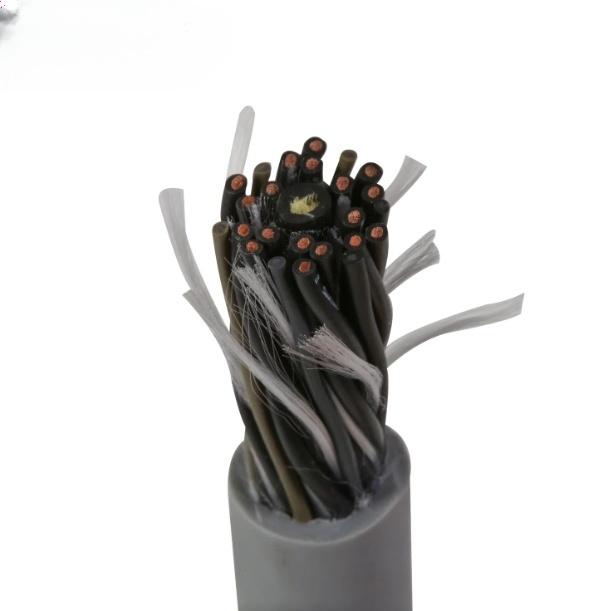
An industrial Ethernet bus cable is a 4-pair shielded twisted pair cable designed for Ethernet-based communication on the factory floor — where the physical environment (oil, coolant, vibration, flexing) and the electrical environment (VFD noise, contactor transients) are far more demanding than the air-conditioned office spaces for which CAT5e/CAT6/CAT7 standards were originally written.
The cable carries the same Ethernet protocol — TCP/IP, UDP, PROFINET, EtherNet/IP, EtherCAT, Modbus TCP — as any office network. But the construction is fundamentally different:
- Double shielding (SFTP) — foil per pair prevents crosstalk between the four pairs; overall braid suppresses external EMI from motor power cables. An office UTP (unshielded twisted pair) cable in a factory cable tray picks up enough VFD noise to cause packet loss within minutes of commissioning
- Industrial jacket — PUR (polyurethane) resists oil, coolant, and abrasion. A PVC-jacketed office cable in a cable carrier will crack within weeks from oil exposure and flex fatigue
- Flex-rated conductors — stranded AWG 26 copper survives millions of flex cycles in a drag chain. Solid-conductor office cable work-hardens and fractures after a few thousand bends
- Controlled delay skew — the difference in propagation delay between the four pairs is critical for Gigabit Ethernet and 10 Gbps, which transmit data in parallel across all four pairs. Excess skew causes bit errors and retransmission
CAT5e vs CAT6 vs CAT7 — Selecting the Right Grade
| Parameter | CAT5e | CAT6 | CAT7 |
|---|---|---|---|
| Bandwidth | 100 MHz | 250 MHz | 600 MHz |
| Max Data Rate | 1 Gbps (1000BASE-T) | 1 Gbps (1000BASE-T); 10 Gbps to 37 m | 10 Gbps (10GBASE-T) to 100 m |
| Shield Construction | FTP or SFTP | SFTP standard | SFTP with PiMF (Pairs in Metal Foil) |
| Typical Industrial Use | PROFINET, EtherNet/IP, Modbus TCP at 100 Mbps | GigE Vision cameras, backbone links between switches | High-speed backbone, 10 Gbps server connections, future-proofing |
| Cost Relative | 1.0× (baseline) | 1.2–1.5× | 1.8–2.5× |
For the vast majority of factory automation applications today, CAT5e is technically sufficient — PROFINET and EtherNet/IP operate at 100 Mbps, well within CAT5e's 1 Gbps capability. CAT6 provides additional headroom for GigE Vision cameras and backbone links. CAT7 is the choice for high-bandwidth backbones and installations where the cable infrastructure is expected to support 10 Gbps within its 10–20 year service life.
Application Analysis
- Machine-mounted Ethernet: A CAT6 cable from the machine control cabinet switch to the HMI panel, vision camera, and remote I/O block on the machine frame — the industrial jacket and double shielding protect against the coolant spray and VFD noise
- Production line backbone: CAT7 trunk cable between the central network rack and distributed switch cabinets along the line — the higher bandwidth supports aggregated traffic from dozens of machines and cameras
- GigE Vision inspection systems: CAT6 cable from the GigE camera on the inspection station to the vision processor — the cable's controlled impedance and low skew maintain image data integrity at gigabit speeds
- Warehouse and logistics Ethernet: CAT5e/CAT6 horizontal cabling for Wi-Fi access points, barcode scanners, IP cameras, and conveyor control in logistics centres
Why Choose Yichi for Industrial Ethernet Cables
- All three performance grades from one source: CAT5e for 100 Mbps machine networking, CAT6 for GigE Vision and backbone, CAT7 for 10 Gbps — standardized on PUR jacket and SFTP shielding across the range
- Double-shielded (SFTP) as standard for every grade: We do not offer UTP or single-shield FTP in industrial Ethernet cable — the factory environment demands the additional EMI protection of the overall braid
- Factory tested to TIA/EIA-568 and ISO/IEC 11801: Wiremap, length, insertion loss, NEXT, return loss, delay skew — the full set of Ethernet cable performance parameters measured on every production length
- Green jacket for PROFINET, blue for general Ethernet: The colour coding that commissioning engineers recognize — specify the jacket colour that matches your network standard
- Factory-direct for project quantities: For machine builders and system integrators wiring production lines with kilometres of Ethernet cable, Yichi provides consistent quality and competitive volume pricing