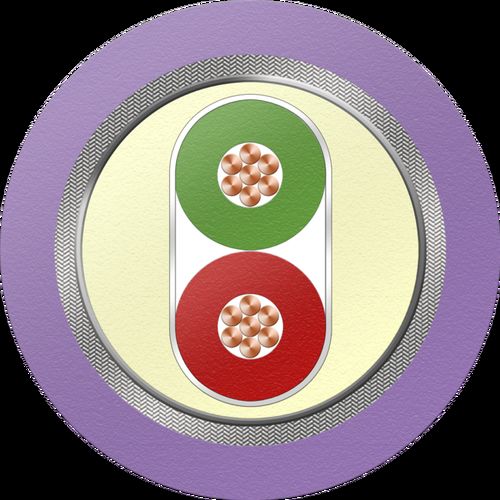
CANBUS / PROFIBUS Hybrid Cable — Combined 120 Ohm CAN Bus and 150 Ohm PROFIBUS Shielded Twisted Pairs in a Single Industrial PUR-Jacketed Hybrid Cable for Multi-Protocol Machine Networking
Data, Network & Bus Cables /Fieldbus & CAN

CANBUS / PROFIBUS Hybrid Cable — Combined 120 Ohm CAN Bus and 150 Ohm PROFIBUS Shielded Twisted Pairs in a Single Industrial PUR-Jacketed Hybrid Cable for Multi-Protocol Machine Networking

CANBUS/PROFIBUS hybrid cable: combined 120 Ohm CAN + 150 Ohm PROFIBUS pairs, individually shielded, PUR jacket, 2x2x0.22-0.34 mm2, multi-protocol. CE, RoHS.

Key Features

Two independent fieldbus pairs in one cable — one 120 Ω CAN bus pair (per ISO 11898-2) and one 150 Ω PROFIBUS pair (per EN 50170); each pair is individually foil-shielded with its own drain wire for complete electrical isolation between the two bus protocols
Individually shielded pairs for protocol isolation — the CAN pair and PROFIBUS pair carry different protocols at different impedances; the per-pair foil shield prevents crosstalk between the two buses, ensuring that PROFIBUS telegrams do not interfere with CAN bus arbitration
120 Ω ±10 Ω CAN pair and 150 Ω ±15 Ω PROFIBUS pair — each pair is impedance-matched to its respective bus standard; CAN pair: white/yellow + brown/green; PROFIBUS pair: red + green (per PROFIBUS colour convention)
Overall tinned copper braid shield (≥85%) — provides an additional EMI barrier for the complete cable assembly; essential for factory floor environments where both fieldbuses share cable tray routing with VFD motor power cables
PUR TMPU industrial jacket — oil, coolant, and abrasion resistant; –30°C cold-flex; available in purple (PROFIBUS convention) or black
Tinned copper conductors (IEC 60228 Class 5) — corrosion resistance and flexibility; 0.22–0.34 mm² per conductor for CAN pair, 0.34 mm² per conductor for PROFIBUS pair (larger for the 150 Ω impedance)
Eliminates one cable in multi-protocol machines — a single hybrid cable replaces two separate fieldbus cables in the drag chain or cable carrier, reducing weight, fill, and installed cost
CE, RoHS compliant; impedance verified by TDR on each pair of every production length

Applications

Multi-protocol machine tools — a CNC machine with CANopen servo drives (motion control) and PROFIBUS remote I/O (auxiliary functions); the hybrid cable carries both fieldbuses in one drag-chain-rated jacketManufacturing cells with mixed fieldbus equipment — an automated assembly cell with legacy PROFIBUS sensors and actuators alongside newer CANopen drives and encoders; the hybrid cable connects both to the cell controllerRetrofit and migration projects — replacing separate CAN and PROFIBUS cables with a single hybrid cable during a machine upgrade, freeing space in the cable carrier and reducing installation labourRobotic work cells — a robot controller communicating with CANopen servo axes and PROFIBUS I/O modules on the end-effector; one cable in the robot arm instead of twoConveyor and material handling systems — distributed PROFIBUS motor starters and CANopen sensor I/O blocks on the same conveyor section, cabled with a single hybrid trunkTest and measurement systems — laboratory and production test stands where both CAN bus (instrument control) and PROFIBUS (data acquisition) are required at the test specimen

Technical Specifications

Cable Type CANBUS / PROFIBUS hybrid, individually shielded pairs + overall braid
Conductor Material Tinned copper, IEC 60228 Class 5 fine stranded
CAN Pair 1 twisted pair, 0.22–0.34 mm²; 120 Ω ±10 Ω at 1 MHz; white/yellow + brown/green
PROFIBUS Pair 1 twisted pair, 0.34 mm²; 150 Ω ±15 Ω at >3 MHz (per EN 50170); red + green
Pair Insulation PE or PP; 0.2–0.4 mm wall thickness
Pair Shield Aluminium/polyester foil per pair; 100% coverage; dedicated tinned copper drain wire per pair
Pair Stranding Two individually shielded pairs cabled together with non-hygroscopic filler
Overall Shield Tinned copper braid; ≥85% coverage; braid angle 30–45°
Overall Drain Wire Tinned copper, 0.22 mm², in contact with braid
Inner Sheath PVC or TPE (optional)
Outer Jacket PUR TMPU or PVC; 1.0–1.8 mm wall; purple (standard), black
Cable OD 7.0–10.0 mm depending on conductor size
CAN Pair — Characteristic Impedance 120 Ω ±10 Ω at 1 MHz
PROFIBUS Pair — Characteristic Impedance 150 Ω ±15 Ω at >3 MHz (3–20 MHz per EN 50170)
DC Loop Resistance (CAN) ≤160 Ω/km (0.22 mm²); ≤110 Ω/km (0.34 mm²)
DC Loop Resistance (PROFIBUS) ≤110 Ω/km (0.34 mm²)
Capacitance (Pair, at 1 kHz) ≤60 pF/m (CAN); ≤30 pF/m (PROFIBUS — lower capacitance for higher data rate)
Capacitance Unbalance (Pair-to-Ground) ≤1 500 pF/km
Rated Voltage 30 V
Test Voltage (Core/Core) 700 V DC, 1 minute
CAN Max Data Rate 1 Mbps (at 40 m) per ISO 11898-2
PROFIBUS Max Data Rate 12 Mbps (at 100 m) per EN 50170
Temperature — Flexing -30°C to +80°C (PUR); -5°C to +70°C (PVC)
Temperature — Fixed -50°C to +90°C (PUR); -30°C to +80°C (PVC)
Minimum Bend Radius (Flexing) 12× cable OD
Minimum Bend Radius (Fixed) 8× cable OD
Oil / Coolant Resistance IEC 60811-404 (PUR jacket)
Flame Retardant IEC 60332-1-2
Certifications CE, RoHS; CAN and PROFIBUS cable compliance reference; impedance certified per pair

Detailed Description

What Is a CANBUS / PROFIBUS Hybrid Cable?

A CANBUS / PROFIBUS hybrid cable is a multi-protocol fieldbus cable containing two independent shielded twisted pairs — one pair for CAN bus (120 Ω) and one pair for PROFIBUS (150 Ω) — within a single overall shield and jacket. It replaces two separate fieldbus cables in applications where machinery or test equipment uses both protocols simultaneously.

CAN bus and PROFIBUS coexist on many production machines for historical and technical reasons:

  • CAN bus (and CANopen) dominates modern servo drive and motion control networking. Its multi-master arbitration, deterministic latency, and simple 2-wire physical layer make it the natural choice for real-time control of drives and I/O
  • PROFIBUS DP is the most widely installed industrial fieldbus in the world — hundreds of millions of nodes in factories, process plants, and infrastructure. Many machines have legacy PROFIBUS I/O, sensors, and actuators that continue to operate reliably and are not replaced just because CANopen is available for the new drives
The hybrid cable accommodates both on a single cable run, particularly valuable in drag chains and cable carriers where space is limited and each additional cable adds to the total weight and drag.

CAN vs PROFIBUS — Two Protocols, Two Pairs, One Cable

ParameterCAN Bus PairPROFIBUS Pair
StandardISO 11898-2EN 50170 / IEC 61158
Characteristic Impedance120 Ω ±10 Ω150 Ω ±15 Ω
Physical LayerDifferential, 2-wire (CAN_H, CAN_L)RS-485 differential, 2-wire (A, B)
Typical Data Rate125 kbps – 1 Mbps9.6 kbps – 12 Mbps
Colour Convention (Pair)White/yellow + brown/greenRed + green
Termination120 Ω at each bus endActive termination or 150 Ω resistor per segment
TopologyLinear bus with short stubsLinear bus (RS-485); up to 32 nodes per segment
Primary Use in MachinesServo drive control, I/O blocks, encoders (CANopen)Remote I/O, sensors, actuators, HMIs (PROFIBUS DP)

The two pairs are electrically independent — the CAN bus termination, biasing, and common-mode voltage have no effect on the PROFIBUS pair, and vice versa. The per-pair foil shield (100% coverage) ensures that the PROFIBUS RS-485 driver — which generates higher voltage swings and faster edge rates than CAN — does not couple noise onto the CAN pair.

Application Analysis

  • CNC machine tools: The machine controller communicates with CANopen servo drives (X, Y, Z, spindle, tool changer axes) on the CAN pair and with PROFIBUS I/O blocks (coolant pump, chip conveyor, interlocks, tool magazine sensors) on the PROFIBUS pair — one hybrid cable in the drag chain carrying both fieldbuses
  • Robot cells: A 6-axis robot uses CANopen for the servo axes (fast, deterministic motion control) and PROFIBUS for the end-effector I/O (gripper, weld controller, vision camera trigger) — the hybrid cable in the robot arm replaces two separate flex-rated fieldbus cables
  • Mixed-fieldbus machine upgrade: A legacy machine with PROFIBUS networking is being upgraded with new CANopen servo drives. Rather than running a second PROFIBUS cable alongside the new CAN cable in the existing cable carrier, a single hybrid cable replaces both — saving carrier space and installation time
  • Production line sections: A conveyor section with PROFIBUS motor starters and CANopen distributed I/O — the hybrid trunk cable runs the length of the section with drop cables at each field device

Why Choose Yichi for CANBUS / PROFIBUS Hybrid Cables

  • Two independently impedance-matched pairs — verified by TDR: The CAN pair is 120 Ω and the PROFIBUS pair is 150 Ω. Yichi measures each pair's impedance with a time-domain reflectometer on every production length — two separate impedance certificates on one cable
  • Per-pair foil shield for complete protocol isolation: The aluminium/polyester foil on each pair (100% coverage) ensures that the CAN and PROFIBUS signals do not couple to each other. The overall braid provides the external EMI barrier. This is a true individually-shielded-pair construction, not a single overall shield shared by both pairs
  • PUR jacket for drag chain and machine duty: The hybrid cable often runs in the same drag chain as the servo motor power and feedback cables. The PUR jacket provides the oil, coolant, and abrasion resistance that PVC cannot match in this environment
  • Red/green PROFIBUS pair and white/brown CAN pair — standard colour codes: Commissioning engineers can identify which pair is which at the connector without referencing the cable schedule. Standard colours reduce wiring errors
  • One cable instead of two — reduced drag chain fill and installed cost: A 4-core hybrid cable occupies approximately 60% of the space and weight of two separate 2-core fieldbus cables, reducing the total cable carrier load and simplifying installation

Product Inquiry

Product: CANBUS / PROFIBUS Hybrid Cable — Combined 120 Ohm CAN Bus and 150 Ohm PROFIBUS Shielded Twisted Pairs in a Single Industrial PUR-Jacketed Hybrid Cable for Multi-Protocol Machine Networking

Add technical specifications (optional)

The more detail you provide, the faster and more accurate our quotation.

No file chosen

PDF, Office, image or CAD file — up to 5 MB

Need Help?

Certifications

ISO 9001
Quality
CE
European
RoHS
Environmental
TÜV
Certification

Need a Quote for This Product?

Send us your requirements and receive a detailed quotation within 24 hours.