Detailed Description
What Is an Encoder Signal Cable?
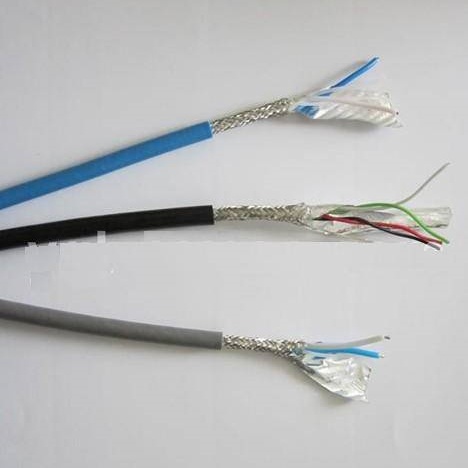
An encoder signal cable is the dedicated wiring that carries position and speed feedback from a rotary or linear encoder to the controller, PLC, or servo drive that evaluates it. Unlike general-purpose instrumentation cable, an encoder cable is engineered around the electrical characteristics of encoder interfaces:
- Incremental encoders transmit quadrature signals — typically 5 V differential RS-422 pairs (A/A-not, B/B-not, Z/Z-not). Pulse frequencies commonly range from 10 kHz to 500 kHz, and the cable must preserve sharp pulse edges over its full length
- Absolute encoders (SSI, BiSS C, EnDat, Hiperface) transmit clock and data on the same pair, with clock rates from 100 kHz up to 16 MHz. At these frequencies, cable capacitance and crosstalk directly limit usable length and data integrity
Encoder Signal Cable vs Standard Control Cable — Parameter Comparison
| Parameter | Encoder Signal Cable | Standard Control Cable (e.g. TRVV) |
|---|---|---|
| Core insulation | PE, low capacitance (≤60 pF/m) | PVC (≥150 pF/m typical) |
| Shielding | Foil (100%) + braid (≥85%) | Optional braid only, or none |
| Conductor stranding | Class 6 extra-fine (flex-rated) | Class 5 fine (light flex) |
| Typical application | Encoder/signal transmission | General control and switching |
| Max encoder cable length | 10–50 m depending on interface | Not specified for signals |
The difference matters in practice: with PVC insulation, a 100 m run of a 1 MHz SSI clock line shows visibly rounded edges and higher crosstalk, reducing noise margin at the receiver. The PE-insulated, shielded encoder cable maintains clean signal edges over the same distance.
Encoder Signal Length Limits by Interface Type
| Encoder Interface | Clock / Pulse Rate | Practical Max Cable Length | Limiting Factor |
|---|---|---|---|
| Incremental (RS-422, 5 V) | 500 kHz | 50 m | Capacitance — pulse edge rounding |
| SSI | 1 MHz | 50 m | Capacitance + crosstalk |
| BiSS C | 10 MHz | 25 m | Transmission line effects |
| EnDat 2.1 | 2 MHz | 50 m | Capacitance + timing |
| EnDat 2.2 | 16 MHz | 10 m | Signal attenuation at high frequency |
Beyond these limits, an active line driver at the encoder end or a reduced clock frequency is required. For most machine applications — 3 to 20 m cable runs — a correctly specified encoder signal cable provides full signal integrity without additional electronics.
Application Analysis: Where Encoder Signal Cables Are Used
- CNC machine tools: Spindle orientation encoders, tool magazine position encoders, and linear scale signals all rely on clean, low-capacitance signal paths. A noisy or high-capacitance cable here causes position drift and periodic alarm faults that are difficult to diagnose
- Robotics: Robot auxiliary axes and rotary indexers use encoders for repeatable positioning. The cable follows the moving axis, so flex life and shield integrity under constant motion are as important as electrical performance
- Packaging and printing: Registration and cut-length encoders run at high pulse rates on fast-moving webs. Signal loss or jitter translates directly into wasted product
- AGV and material handling: Drive-wheel and steering encoders on automated guided vehicles need cable that survives continuous flexing on the vehicle chassis and maintains signal integrity in an electrically noisy environment
Why Choose Yichi for Encoder Signal Cables
- Capacitance-tested production: Core-to-core capacitance at 800 Hz is measured on every production length — the key electrical parameter for encoder signal quality is verified, not assumed
- Shield coverage optically verified: Braid coverage ≥85% is confirmed by image analysis on production samples, with braid angle held at 30–45° for coverage-versus-flexibility balance
- Two jacket options: PUR for oil/coolant/abrasion environments and drag chain duty; PVC for cost-sensitive, fixed or light-flex installations — you specify, we manufacture
- Flexible configuration: Any core count from 2 to 20, twisted-pair or concentric construction, numbered cores, and custom color codes per your drawing or connector scheme
- Factory-direct value: Direct manufacturing without intermediary markups, with full test certificates, batch traceability, and fast lead times on standard configurations