Detailed Description
What Is a Multi-Core Shielded Cable?
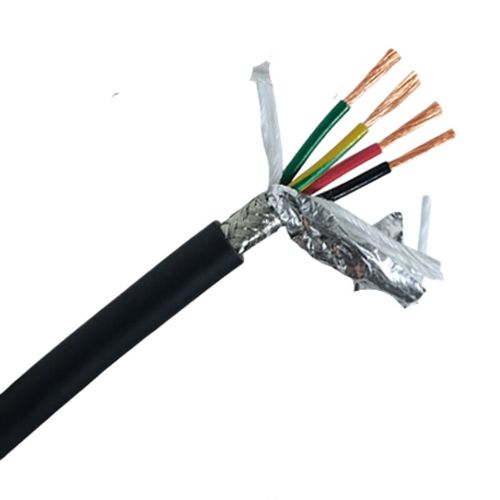
A multi-core shielded cable is a flexible control and signal cable with a large number of individually insulated conductors — up to 37 — enclosed under a single overall electromagnetic shield. It is the cable of choice when a machine or installation has many low-voltage signal circuits that all need EMI protection but do not require the per-signal isolation of individually shielded pairs.
The value proposition is cable consolidation. On a typical automated production machine, between the control cabinet and the remote I/O block on the moving section, you might have:
- 16 digital inputs (limit switches, proximity sensors, pushbuttons)
- 8 digital outputs (solenoid valves, indicator lamps, relays)
- 4 analog inputs (pressure transmitters, temperature sensors, flow meters)
- 2 serial communication pairs (RS-485 Modbus to a distributed drive)
Multi-Core Shielded Cable vs Individual Cables — Cable Count Reduction
| Wiring Approach | Cables in Drag Chain | Cable Carrier Fill | Shield Terminations | Documentation |
|---|---|---|---|---|
| Individual shielded cables (3-core) | 10 cables for 30 signals | High — individual cables pack inefficiently in round cable carrier | 10 shield terminations at each I/O block | 10 cable numbers, 10 drawings |
| Multi-core shielded cable (30-core) | 1 cable | Low — single round cable | 1 shield termination (drain wire + EMC gland) | 1 cable number, 1 core schedule |
| Saving | -9 cables | -50 to -70% fill reduction | -9 terminations → lower installed cost and fewer failure points | Simplified documentation |
The practical benefits go beyond the bill of materials: fewer cables in the drag chain means lower total weight, less friction, and longer cable carrier service life. Fewer shield terminations mean fewer points where a poor connection can create an intermittent noise problem that is difficult to diagnose.
Multi-Core Shielded Cable vs Unshielded Control Cable — Parameter Comparison
| Parameter | Multi-Core Shielded Cable | Unshielded Control Cable (e.g. TRVV) |
|---|---|---|
| EMI protection | Overall tinned copper braid, ≥85% coverage | None — signal conductors exposed to external fields |
| Shield transfer impedance | ≤250 mΩ/m at 30 MHz | Not applicable |
| Typical use | Multi-signal PLC I/O, analog sensors, RS-485, measurement circuits | Non-critical switching, relay outputs, indicator lamps |
| Noise coupling from adjacent VFD cable | Suppressed by 20–30 dB | Full coupling — signal corruption likely |
| Core insulation option | PVC for general use; PE for low-capacitance measurement | PVC only |
| Cable diameter | Slightly larger (shield thickness) | Smaller OD |
| Cost | Moderate premium for the braid shield | Lowest cost |
The cost difference is modest — the braid shield and one additional manufacturing step. Against the cost of a single machine stoppage caused by a noise-induced false sensor reading, the shielded multi-core cable is a small investment in signal reliability.
Core Count Selection — Matching the Cable to the Application
| Core Count | Typical Use | Example Machine |
|---|---|---|
| 2–5 cores | Single sensor or simple actuator loop | Proximity sensor cable, solenoid valve cable |
| 7–12 cores | Small I/O block, multi-sensor cluster | 8-input sensor distribution box on a robot gripper |
| 14–21 cores | Medium I/O consolidation | Remote I/O block on a linear transfer slide |
| 24–30 cores | Large I/O consolidation | Main I/O block on an automated assembly station |
| 36–37 cores | Maximum consolidation | Full machine I/O from control cabinet to moving section |
Yichi standard core counts follow DIN 47100 — a widely adopted industrial color-code standard that assigns unique base colors and ring markings to each core. When you specify a 25-core cable, the core identification is unambiguous: core 1 is white, core 2 is brown, core 3 is green, and so on through the full DIN 47100 table. For installations where DIN 47100 is not used, black numbered cores (white numbers printed on black insulation) are available.
PVC vs PE Insulation — Signal Integrity Trade-Off
| Property | PVC (General-Purpose) | PE (Measurement-Grade) |
|---|---|---|
| Dielectric constant | 3.5–6.0 | 2.3–2.4 |
| Capacitance (800 Hz) | ≤120 pF/m core-to-core | ≤80 pF/m core-to-core |
| Signal types supported | 24 V DC digital I/O, relay outputs, indicator lamps, simple switching | 4–20 mA analog, 0–10 V, RS-485, thermocouple extension, mV-level signals |
| Temperature (flexing) | -5°C to +70°C | -30°C to +80°C (stiffer but wider range) |
| Cost | Lower | Moderate premium |
For a cable carrying 30 digital I/O signals at 24 V DC, PVC insulation is the cost-effective choice — the signal-to-noise ratio is so high (tens of volts of signal versus millivolts of coupled noise) that the higher capacitance of PVC is irrelevant. For a mixed-signal cable where several cores carry 4–20 mA analog or RS-485 data alongside digital I/O, PE insulation or mixed insulation (PE on analog cores, PVC on digital cores) is the right specification.
Application Analysis: Where Multi-Core Shielded Cables Are Used
- Automated assembly lines: 24-core or 30-core shielded cable from the station control cabinet to the moving assembly pallet — carrying sensor inputs, actuator outputs, and safety interlock signals in a single drag-chain-rated cable
- Robot cell wiring: Multi-core cable from the robot controller to the end-of-arm tooling I/O block — gripper sensors, part-present sensors, solenoid valves, and vacuum switches on one cable that flexes with the robot wrist
- Packaging machinery: 18-core to 25-core shielded cable between the fixed cabinet and the moving forming/filling/sealing head — temperature sensors, position sensors, film registration sensors, and solenoid actuators
- CNC machine tool auxiliary wiring: Tool changer sensors, coolant pump signals, chip conveyor controls, and spindle chiller monitoring — auxiliary machine functions consolidated into one shielded multi-core
- Elevator car control: Traveling flat or round multi-core cable between the elevator car and the machine room controller — car call buttons, door sensors, position indicators, intercom, and safety chain signals
- Retrofit of ageing machinery: Replacing multiple brittle, unshielded single cables with a single flexible, shielded multi-core — improving reliability, simplifying cable management, and reducing troubleshooting time
Why Choose Yichi for Multi-Core Shielded Cables
- Full core-count range from a single manufacturer: 2 to 37 cores in standard catalog diameters — no need to source from multiple suppliers for different core counts, no minimum order quantity penalty on high-core-count cables
- Mixed cross-sections without the long lead time: Many machines need a few power/supply cores (1.0–2.5 mm²) plus many signal cores (0.22–0.50 mm²) in the same cable. Yichi manufactures these as standard configurations, not special one-offs
- Class 5 and Class 6 stranding options with honest guidance: We help you decide whether Class 5 (fine stranded, for fixed and light-flex wiring) or Class 6 (extra-fine, for drag chain) is right for your mechanical environment — and we do not charge a premium for the right technical choice
- Braid shield that does what it is supposed to: Coverage ≥85%, verified optically. Transfer impedance ≤250 mΩ/m at 30 MHz. Drain wire in continuous contact with the braid for reliable shield termination over the full cable length
- Core identification to DIN 47100 or your own scheme: Standard color code reduces installation errors and speeds up commissioning. For OEMs with their own wiring color standards, we manufacture to your documentation
- Factory-direct value with full traceability: Direct from our manufacturing line to your receiving dock — no distributor layers. Full test records (conductor resistance, insulation resistance, HV test per core) shipped with every production batch