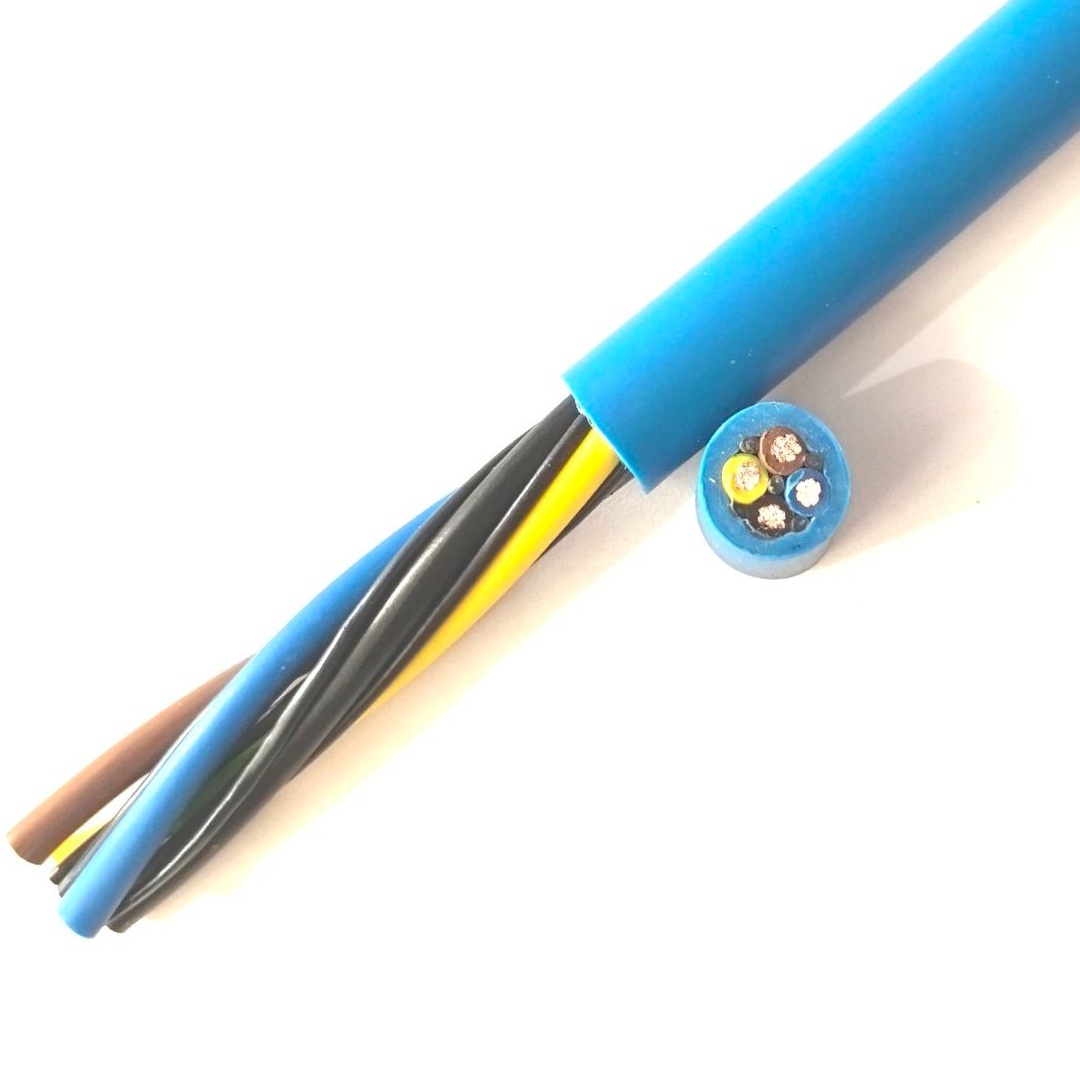
Detailed Description
The Robot Cable Design Challenge — Torsion
A 6-axis industrial robot arm subjects its internal cabling to a combination of mechanical stresses that no other cable application imposes:
- Axis 1 (base rotation): Bending as the arm rotates at the base
- Axis 2 (shoulder): Bending as the upper arm tilts forward/backward
- Axis 3 (elbow): Bending as the forearm tilts
- Axis 4 (wrist roll): Torsion (twisting) — the cable bundle rotates around its own axis as the wrist rolls
- Axis 5 (wrist pitch): Bending
- Axis 6 (wrist rotate): Torsion — further twisting at the end effector
The SZ Stranding Solution
Standard cable stranding uses a single-direction helical lay (S-lay or Z-lay) — all conductors are twisted in the same direction. When this cable is twisted, the conductors on one side tighten (lay length decreases) and on the other side loosen (lay length increases) — creating an imbalanced stress distribution.
Robot cable uses SZ stranding — alternating sections of S-lay and Z-lay, typically 0.5–1.0 meters per section. When the cable is twisted, the S sections and Z sections respond in opposite directions, canceling the net stress. The anti-torsion filler elements (typically PU rods or aramid-reinforced profiles) fill the interstices and provide elastic recovery force that returns the cable to its neutral position when the twist is released.
This is the fundamental difference between a robot cable and all other flexible cables: the stranding pattern is designed for torsional freedom, not just bending flexibility.
Cable Layout — What Goes Inside a Robot Cable?
A modern 6-axis welding robot cable assembly includes conductors for every function the robot needs — all routed through the arm in one cable:
| Function | Conductor Type | Typical Specification | Connects |
|---|---|---|---|
| Servo motor power (axes 1–6) | 4× (3P+PE) power cores, 2.5–16 mm² each | 0.6/1 kV, Class 6 copper | Robot controller → servo motors at each axis |
| Motor brake power | 2× 2-core, 0.75–1.5 mm² | 24 V DC | Controller → motor brake solenoids |
| Encoder feedback (axes 1–6) | 6× individually shielded twisted pairs | 0.22–0.34 mm², PP insulation | Controller → motor encoders |
| Tool I/O (gripper/weld gun) | 8–16 cores, 0.5–0.75 mm² | 24 V DC signals | Controller → end effector |
| EtherCAT / PROFINET bus | 1–2 shielded twisted pairs | 0.22 mm², 100 Ω impedance | Controller → robot arm distributed I/O |
| Vision system (camera) | 1× GigE (4 pairs) or USB 3.0 (shielded pairs) | CAT6a data element | Vision processor → wrist-mounted camera |
| Weld power (if required) | 1× 35–70 mm² welding power conductor | 0.6/1 kV, special insulation | Weld power source → weld gun |
| Safety circuit | 2× 2-core, 0.75 mm² | 24 V DC, dual-channel safety | Safety PLC → robot arm safety I/O |
| Pneumatic air tube (optional) | 1× 6–8 mm PU air tube | 6–8 bar compressed air | Valve manifold → gripper/weld gun |
Not every robot cable contains all of these elements — the configuration is specific to the robot model, application, and end effector. But the trend is toward more integration, not less: a single composite cable replaces 3–5 separate cables that would otherwise run through the robot arm, competing for space and creating multiple potential failure points.
PUR — The Only Jacket Choice
Industrial robot environments expose cables to aggressive chemicals:
- Arc welding: Weld spatter (molten metal droplets at >1 500°C) lands on the cable. PVC burns and melts. PUR does not sustain combustion and the spatter does not adhere — it cools and falls off
- Machining coolant: Water-based cutting fluids, synthetic coolants, and way oil. PVC absorbs some coolants and swells — jacket softening and loss of mechanical strength. PUR is resistant to the full range of metalworking fluids
- Grease and hydraulic oil: Robot joint lubrication grease and hydraulic oil from auxiliary equipment. PUR's oil resistance (IEC 60811) exceeds PVC and CR
- Solvent cleaning: Paint shop robots are cleaned with solvents between color changes. PUR resists the common paint solvents; PVC does not
Yichi Robot Cable Manufacturing
- Class 6 conductor verified: IEC 60228 Class 6 requires a higher minimum strand count per cross-section than Class 5. Strand count is verified on every production batch — the finer stranding is essential for torsion fatigue resistance
- SZ stranding lay length controlled: The alternating S/Z section length is set to 0.5–1.0 m depending on cable diameter and expected torsion angle. Lay length is verified on every production length using optical measurement
- Anti-torsion filler design: The filler elements are not generic PVC fillers — they are PU or aramid-reinforced rods with specific elastic modulus and recovery characteristics. The filler design is matched to the cable's overall diameter and expected torsion angle
- Torsion life tested: Every new cable design is tested on a torsion test machine — ±180° per meter, 10 000 000 cycles minimum. Acceptance criteria: zero conductor breaks, <10% increase in conductor resistance, no jacket cracks, no shield degradation. This is the definitive qualification test for a robot cable